

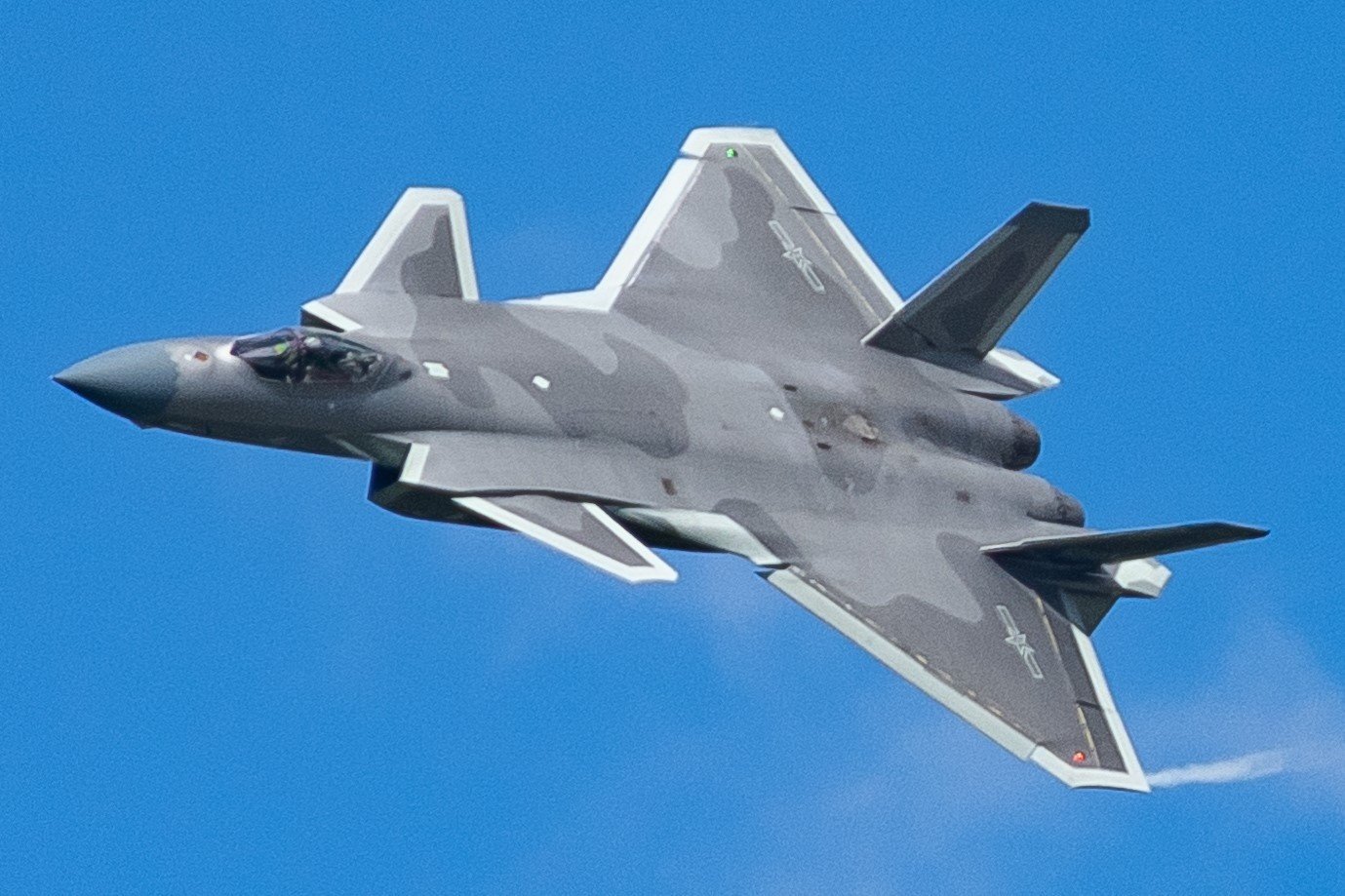
A stark new intelligence estimate has thrust India’s technological gap with China into the spotlight, revealing an asymmetric challenge that could dictate the outcome of any future conflict.
Writing in the U.S. defense journal The War Zone, veteran military analyst Andreas Rupprecht estimates that China’s People’s Liberation Army Air Force (PLAAF) may now possess around 500 operational J-20 “Mighty Dragon” stealth fighters.
This figure is more than double previous baseline estimates, suggesting that Beijing has scaled up production of its premier fifth-generation combat aircraft to a pace that may outstrip even the United States.
The Current Reality: 500 vs. 0
While China rapidly expands its stealth fleet—with J-20 units already deployed in Tibet, just 150 kilometers from the Sikkim border—India’s current inventory of operational stealth fighters stands at exactly zero.
In modern aerial warfare, stealth aircraft act as battlefield openers. They are designed to slip past radar nets, neutralize air defense systems, and eliminate high-value assets to clear the skies for non-stealth fighters.
Without an equivalent platform, the Indian Air Force (IAF) faces a massive tactical disadvantage at the onset of a potential conflict.
India’s Long-Term Solutions vs. Immediate Pressures
India’s primary response to China’s fifth-generation push relies on domestic development and long-term partnerships, but none offer an immediate fix:
-
The AMCA Project: India’s indigenous Advanced Medium Combat Aircraft (AMCA) is currently in development. However, even under highly optimistic timelines, the fifth-generation fighter is still at least a decade away from active frontline service.
-
The Russian Su-57: While the Russian-built jet represents the only theoretically available “emergency import,” defense analysts warn it lacks the true low-observable (stealth) characteristics of the J-20 or American F-35, making it a compromised stopgap.
-
European Partnerships: India has signaled interest in joining Europe’s Future Combat Air System (FCAS) sixth-generation program, but this initiative targets the late 2030s and offers no utility for a near-term crisis.
By the time India’s AMCA reaches operational readiness, projections suggest China could field up to 1,000 J-20s alongside highly advanced sixth-generation platforms already in testing.
How India is Offsetting the Deficit
To counter this numerical and technological disparity, India is not relying solely on a direct fighter-to-fighter match. New Delhi is heavily investing in asymmetric defenses:
-
Advanced Air Defenses: Deploying highly sensitive, stealth-specific radar networks and surface-to-air missile systems (such as the S-400) designed to track and target low-observable aircraft.
-
Sensor Integration: Building dense, overlapping sensor grids along the Line of Actual Control (LAC) to erode the passive advantages of Chinese stealth airframes.
An Industrial Wake-Up Call
The current crisis is not a failure of military foresight, but rather the cumulative result of decades of delayed procurement cycles, inconsistent planning, and a domestic defense-industrial complex slow to manufacture high-tech systems at scale.
With China’s J-20 production line running at full capacity, defense planners warn that bridging this gap will require immediate, out-of-the-box strategic decisions rather than relying entirely on long-term procurement schedules.
