

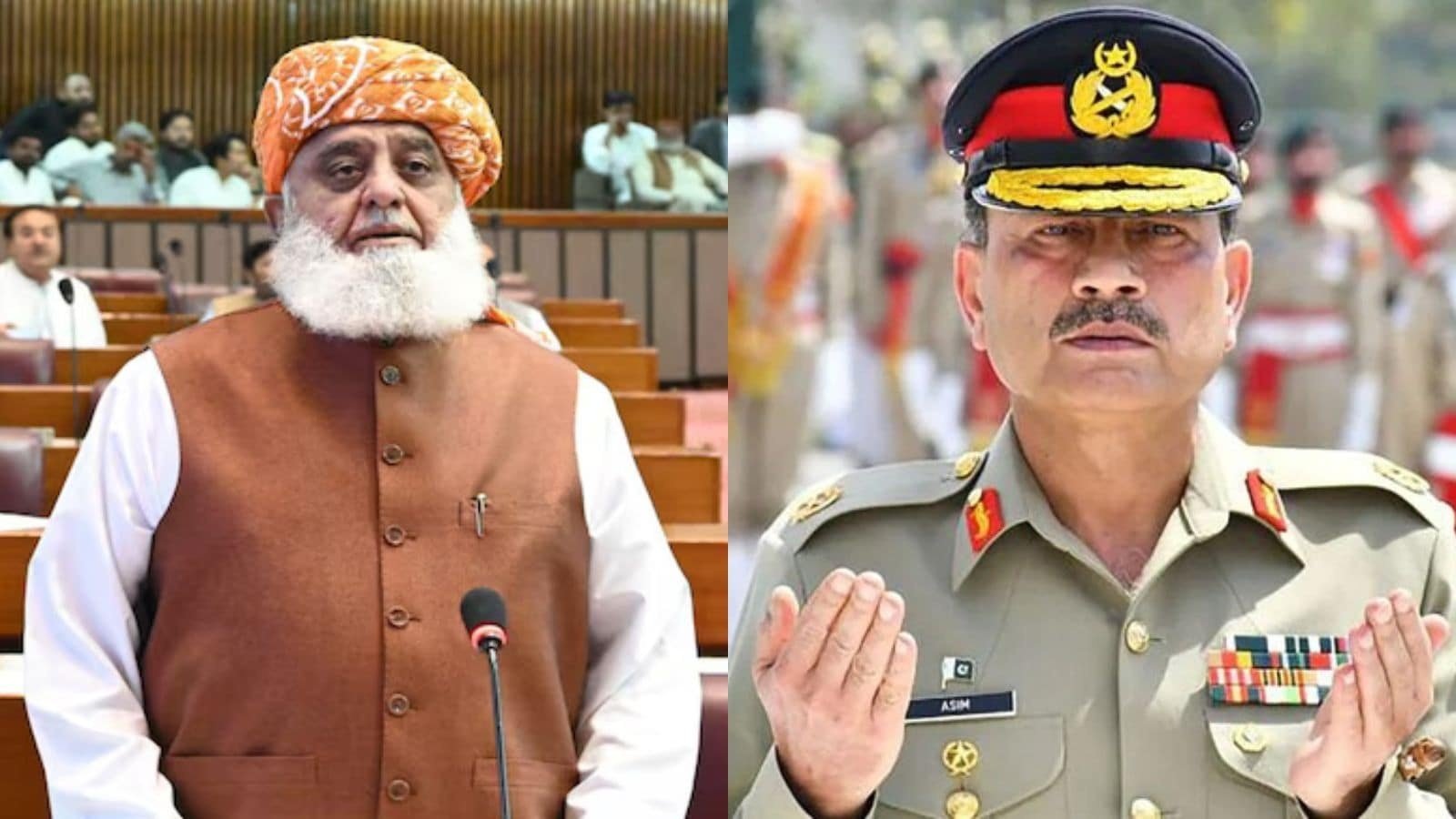
In a direct challenge to Pakistan’s military leadership, Jamiat Ulema-e-Islam-F (JUI-F) chief Maulana Fazlur Rehman has dared Army Chief Field Marshal Asim Munir to resign from his post and test his popular support through the electoral process.
Addressing a public gathering in Punjab, Rehman criticized the military’s pervasive influence over civilian governance and its history of engineering political outcomes.
Key Highlights of Rehman’s Address
1. Opposition to Political Engineering
Rehman heavily criticized the military for overstepping its constitutional boundaries, stating that making or breaking governments is fundamentally outside the army’s mandate.
“If you want to do politics, then take off your uniform and come. Take part in the election. You will get to know how many votes people in uniform receive,” Rehman said.
His remarks come amid growing public perception that Munir holds ultimate authority in the country, frequently overshadowing Prime Minister Shehbaz Sharif. The debate has been further exacerbated by the government’s recent decision to induct the Army Chief into a high-level civilian committee on population control.
2. Rejection of Civilian Militias
The veteran politician strongly opposed government suggestions that ordinary citizens should form armed militias to combat rising domestic terrorism. He emphasized that national defense is strictly the responsibility of the salaried armed forces.
-
Taxpayer Accountability: Rehman argued that soldiers are paid from public taxes to secure the country, stating, “Why do you place the burden of their blood on me?”
-
Warning of Perpetual Violence: He warned that outsourcing security to civilian militias would plunge Pakistan into generations of personal vendettas and endless internal bloodshed.
3. Deteriorating Security in Balochistan
Rehman presented a stark assessment of Pakistan’s internal security, asserting that the state has effectively lost control over large swathes of territory.
-
Loss of State Writ: He claimed that the writ of the Pakistani government no longer exists across the Baloch-majority regions of Balochistan.
-
Spreading Insurgency: He further noted that the instability and extremist violence, which were previously contained to Baloch areas, have now spilled over into neighboring Pashtun regions.
