

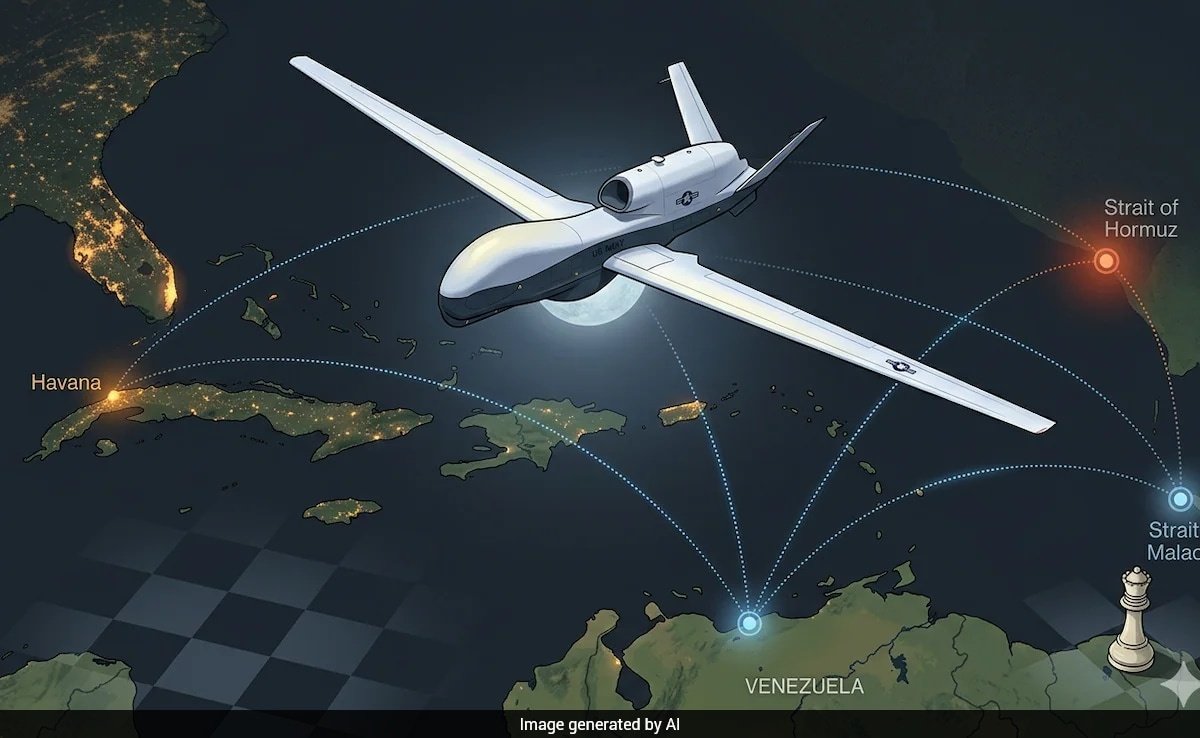
Somewhere above the Caribbean, at an altitude where the air thins and commercial jets cannot reach, a winged beast the size of a Boeing 737 carves silent circles into the night sky. This is the MQ-4C Triton, a US$240 million surveillance marvel capable of staying airborne for over 24 hours. Its mission is not kinetic, but the data it gathers is a weapon in its own right.
By loitering off the coast of Havana and monitoring the critical Jamaica Channel, the US Navy has signaled the fourth move in a grand geopolitical chess game designed to strangle China’s energy security.
The Four-Move Checkmate
The deployment of the Triton—callsign BLKCAT6—is the latest piece in a strategic “coercive architecture” the US has been building since early 2026.
| Move | Location | Strategic Impact |
| Move 1 | Venezuela | Following the January seizure of control over Venezuela’s 303+ billion barrels of reserves, the US effectively cut off China’s primary South American supply. |
| Move 2 | Strait of Hormuz | Increased pressure on Iran has throttled the 40-45% of daily crude demand China typically sources from the Middle East. |
| Move 3 | Strait of Malacca | By securing surveillance outposts in Indonesia, the US has tightened the “Malacca Dilemma,” a chokepoint for 80% of China’s seaborne oil. |
| Move 4 | Cuba/Caribbean | Monitoring the Windward Passage and Yucatan Channel to deter Chinese “shadow tankers” and eliminate local intelligence outposts. |
Why Cuba Matters Now
While the Caribbean isn’t a primary source of crude, it is a vital theater for denial of access. The US’ objective is twofold:
-
Deterrence of “Shadow Tankers”: China has attempted to keep Cuba afloat with fuel runs to counter the US energy blockade. The Triton’s orbit allows the US to track these shipments with surgical precision.
-
Electronic Warfare: The drone is likely monitoring the Chinese electronic counterintelligence post in Bejucal, 30km from Havana, neutralizing Beijing’s “eyes and ears” in the West.
The Trump Doctrine and the Final Piece
President Donald Trump’s rhetoric suggests that surveillance is merely the prelude to total control. With Cuba reeling under an energy blockade and the US Navy patrolling its waters, the island is being pushed toward a breaking point.
As Trump noted in March, “I could do anything I want with it.” By integrating Cuba into this “oil-choke” strategy, the US is not just monitoring a neighbor; it is closing the final gap in a global net designed to force Beijing to operate on American terms—or run dry.
Beijing has pivoted heavily to Russian imports (up 40.9% YoY) and overland pipelines to buy time, but on the high seas, the chessboard is almost complete.
