

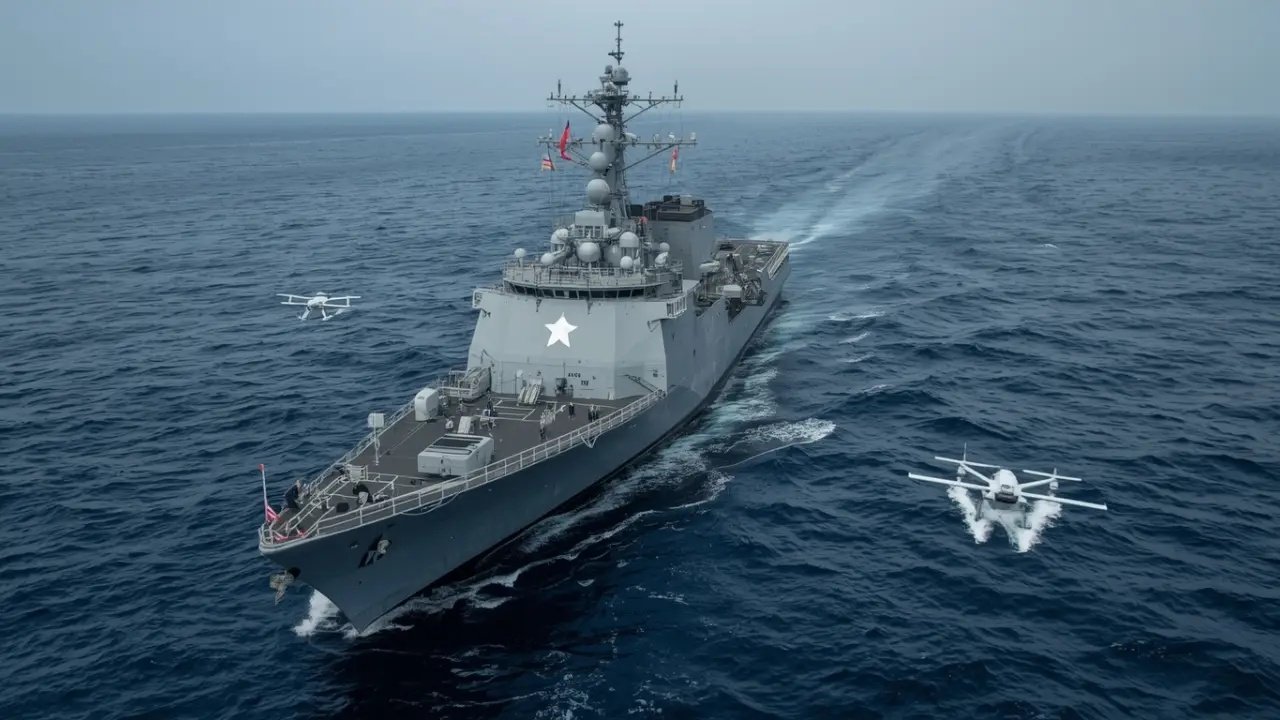
The recent dismissal of US Navy Secretary John Phelan on April 22, 2026, has thrust the Pentagon’s internal friction into the global spotlight. At the heart of the dispute is the “Trump-class” battleship, a $17-billion-per-hull gamble intended to restore American naval supremacy, which currently stands at odds with Defense Secretary Pete Hegseth’s vision of a leaner, drone-centric fleet.
The “Golden Fleet” Vision vs. Uncrewed Mass
The conflict represents a fundamental disagreement on the future of maritime warfare:
-
The Battleship Case: Outgoing Secretary Phelan championed the “Golden Fleet,” centered on massive, 35,000+ ton command hubs. These vessels are designed to be “100 times more powerful” than any predecessor, acting as floating fortresses with unmatched firepower.
-
The Drone Pivot: Defense Secretary Pete Hegseth and Deputy Stephen Feinberg reportedly favor mass-produced uncrewed surface vessels (USVs) and sea attack drones. Their logic centers on “quantity as a quality of its own”—using swarms of cheaper assets to overwhelm enemies rather than risking a single $17-billion target.
Specifications: The USS Defiant (Trump-Class)
If built, the Trump-class would be the most technologically advanced and expensive surface combatant in history.
| Feature | Specification |
| Length / Weight | 880 Feet / 35,000+ Tons |
| Cost (Lead Ship) | $17 Billion (USS Defiant) |
| Estimated Fleet Cost | $43.5 Billion for the first three hulls |
| Primary Armament | Tomahawk missiles, Hypersonic & Nuclear-capable weapons |
| Futuristic Tech | Railguns (directed-energy) & Full Electronic Warfare Suite |
| Aviation | Flight deck with an enclosed hangar (Amphibious Assault scale) |
The Numbers Game: US vs. China (April 2026)
The urgency behind this naval buildup is driven by China’s aggressive expansion. While the US maintains a technological and firepower advantage, Beijing leads significantly in “hull count.”
-
China’s Fleet: Currently estimated between 350 and 840 ships. Beijing has three active aircraft carriers with a fourth in development.
-
US Fleet: Currently stands between 290 and 465 ships.
The Trump-class was pitched as a “muscle flex” to offset China’s numerical lead by ensuring that a single US vessel could command and control an entire sector of the high seas.
Geopolitical Pressure Points
The ongoing conflict with Iran and the blockade of the Strait of Hormuz (which handles 20% of global oil) has underscored the need for a persistent naval presence at maritime chokepoints.
-
The Malacca & Caribbean Gambit: The US is moving to guarantee surveillance rights over critical passages to prevent a “chokehold” on energy supply lines.
-
The Fiscal Reality: The Navy’s $377.5 billion FY27 budget request is part of a massive $1.5 trillion Pentagon ask. With the US economy facing historic premiums on rerouted crude oil, the cost of these warships is becoming a central political flashpoint.
Pentagon in Flux
Phelan’s removal marks the fourth senior Pentagon leader sacked in April 2026 alone. This “Pentagon Purge” follows the firing of Army Chief of Staff General Randy George and others earlier this month. Critics argue that such high-level instability during active conflicts—specifically the Iran crisis—threatens troop morale and strategic continuity.
Bottom Line: While the Trump-class remains in the current budget documents, Phelan’s exit suggests a major “course correction” toward cheaper, uncrewed technology is imminent under Hegseth’s leadership.
