

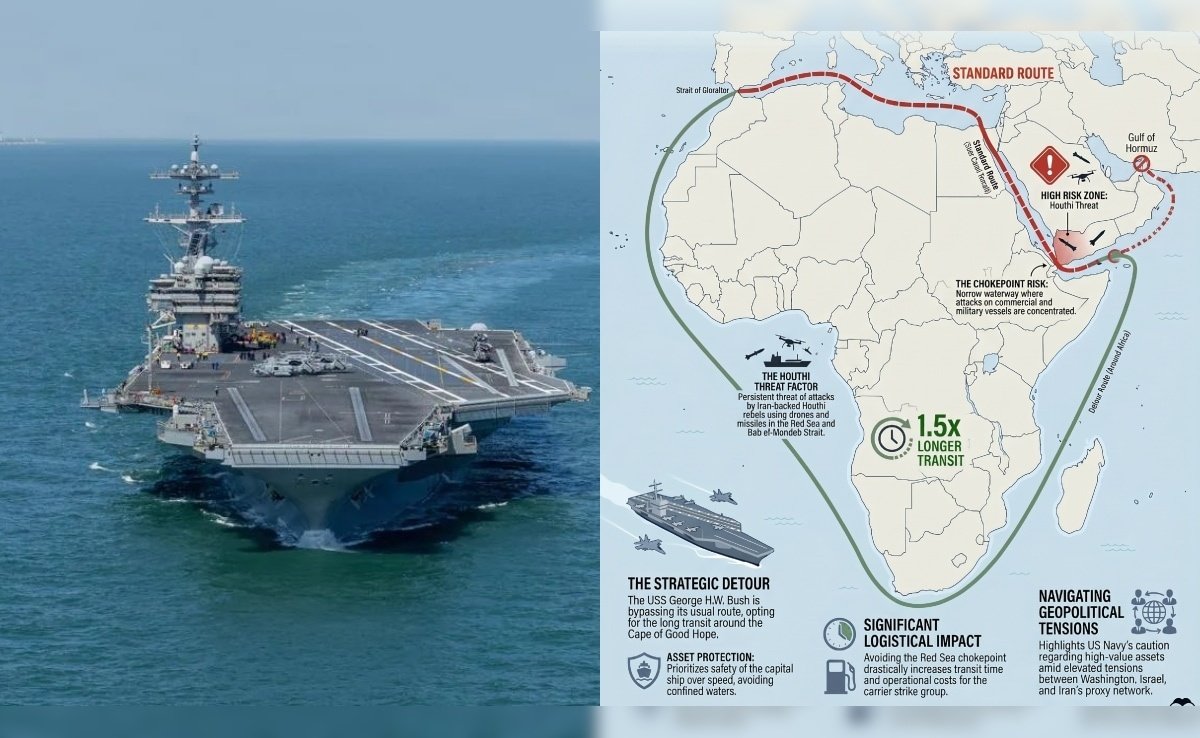
In a move that signals a tectonic shift in naval risk assessment, the USS George HW Bush—one of the world’s most formidable Nimitz-class supercarriers—is currently taking a massive detour around the African continent.
Spotted off the coast of Namibia this week, the carrier and its strike group are choosing the arduous Cape of Good Hope route rather than the traditional shortcut through the Suez Canal. This decision adds thousands of miles to its journey, a silent but deafening admission that the Red Sea has become a “no-go zone” for even the US Navy’s crown jewels.
The Cost of Caution: Route Comparison
The detour isn’t just a minor course correction; it is a fundamental logistical hurdle. By avoiding the Red Sea, the US Navy is prioritizing the safety of its 5,000 sailors and aviators over speed.
| Feature | Traditional Route (Suez/Red Sea) | Current Detour (Cape of Good Hope) |
| Total Distance | 8,000 – 9,000 nautical miles | 13,000 – 15,000 nautical miles |
| Key Chokepoint | Bab el-Mandeb (The “Gate of Tears”) | Southern Tip of Africa |
| Duration Factor | Baseline | 1.5x Longer |
| Primary Threat | Houthi Anti-Ship Missiles/Drones | None (Open Ocean) |
Why Skip the “Gate of Tears”?
The Bab el-Mandeb strait is only 32 kilometers wide at its narrowest point. For a supercarrier like the Bush, transiting this area is the tactical equivalent of driving a limousine through a narrow alleyway while people throw bricks from the rooftops.
-
Houthi Hegemony: Backed by Iran, Houthi rebels control the mountain strongholds overlooking the strait. Throughout 2024 and 2025, they have evolved from using primitive drones to sophisticated anti-ship ballistic missiles.
-
The “Silent Acknowledgement”: By opting for a route that is 50% longer, the Pentagon is effectively admitting that its current ship-defense systems cannot guarantee 100% protection against the sheer volume of “asymmetric” threats—cheap drones and fast-attack boats—in confined waters.
-
Carrier Congestion: The Bush is rushing to join the USS Abraham Lincoln in the Middle East to bolster the “oil-choke” strategy against China and pressure Iran. However, the “rush” is being tempered by the reality that losing a carrier to a Houthi missile would be a catastrophic strategic and symbolic defeat.
The Strategic “Chessboard” Context
This naval movement is part of a broader 2026 strategy to isolate regional adversaries:
“The path around Africa allows the carrier and its escorts to avoid transiting the Red Sea and the Bab el-Mandeb, which were both hubs of activity for the Houthis… in 2024 and 2025.” — USNI News
While the US tightens its grip on Cuba (Move 4), Venezuela (Move 1), and Malacca (Move 3), it is simultaneously being forced to play defense in the Red Sea. The very “coercive architecture” the US is building to strangle China’s oil supply is being challenged by local militias using low-cost weaponry to force the world’s most expensive navy into a 15,000-mile detour.
