

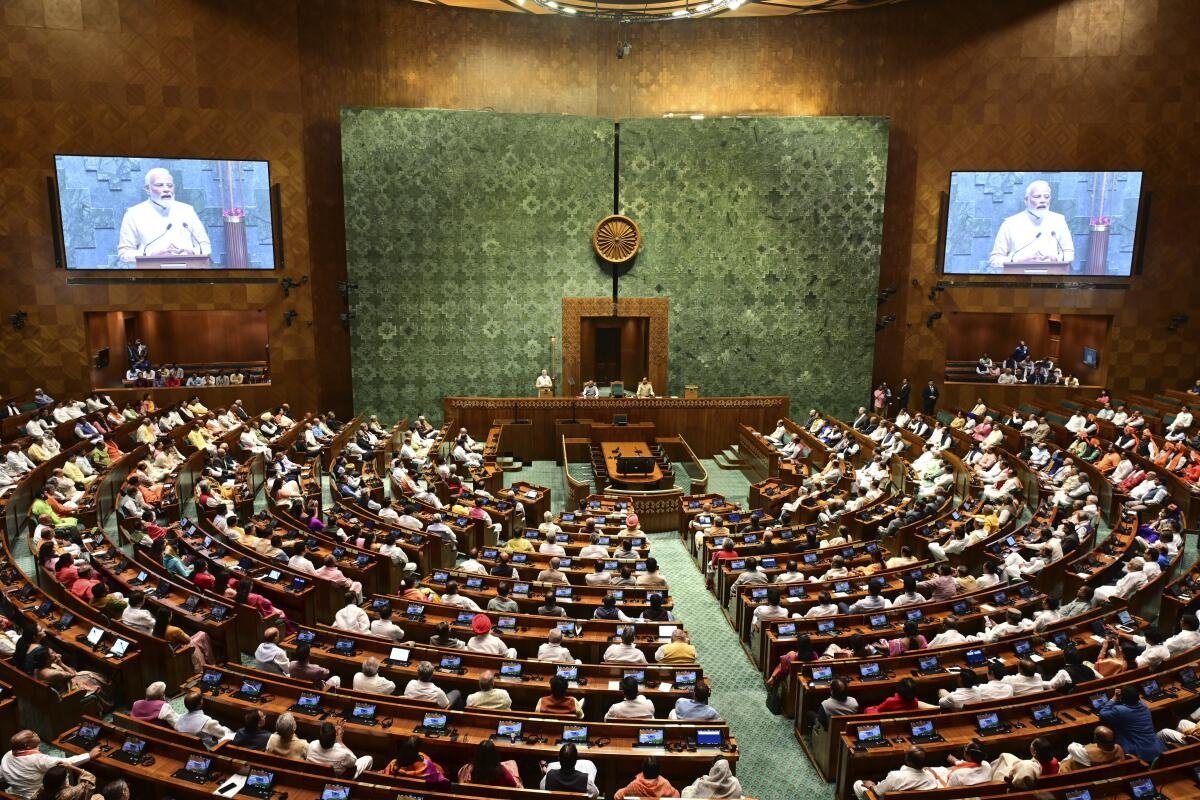
The Indian government has set the stage for a massive overhaul of its democratic architecture. By introducing the Constitution Amendment and Delimitation Bills in April 2026, the Centre aims to redrawing the nation’s electoral map—an exercise that hasn’t seen a change in seat totals for over half a century.
What is the Delimitation Exercise?
Delimitation is the process of redrawing the boundaries of Lok Sabha and State Assembly seats to reflect changes in population. The primary goal is to ensure “one vote, one value” by keeping the ratio of population to representatives roughly equal across the country.
-
The Current Proposal: The government aims to increase Lok Sabha seats from 543 to as many as 850.
-
The Catalyst: This expansion is being tied to the operationalization of the one-third women’s reservation in Parliament and the need to reflect population growth recorded in the 2011 Census.
-
Historical Context: While seat boundaries were adjusted in 2002, the actual number of seats has been frozen since 1973 (based on the 1971 Census) to avoid penalizing states that controlled their population growth.
The North-South Divide: A Growing Rift
The biggest flashpoint of this exercise is the massive disparity in projected seat gains between Northern and Southern states.
1. Population vs. Performance
Southern states argue they are being “punished” for their success. Since the 1970s, states like Tamil Nadu and Kerala have effectively implemented family planning and population control. Conversely, Northern states like Uttar Pradesh and Bihar have seen massive population surges. Using a population-only metric would significantly dilute the political voice of the South.
2. Economic Disparity
The South contributes approximately 30–31% of India’s GDP. Leaders argue that reducing their parliamentary representation while they contribute the lion’s share of national revenue is a violation of federal principles.
3. The Projected Seat Shift
| State/Region | Current Seats | Projected Seats (Approx.) |
| Uttar Pradesh | 80 | 140 |
| Bihar | 40 | 73 |
| Rajasthan | 25 | 48 |
| Tamil Nadu | 39 | 51 |
| Kerala | 20 | 23 |
Why is the Opposition Against It?
Opposition parties and Southern Chief Ministers have voiced several “existential” concerns regarding the move:
-
Political Imbalance: Critics point out that the biggest gainers (UP, Bihar, MP, Rajasthan) are traditional strongholds for the BJP-led NDA, while the “laggards” are largely governed by Opposition parties.
-
The “Mischievous” Timing: Congress and Left leaders argue that using the Women’s Reservation Bill as a “garb” to push through a flawed delimitation exercise is “devious” and “anti-federal.”
-
Threat to National Unity: Shiv Sena (UBT) and DMK leaders have warned that a lopsided political map could lead to civil unrest or “Manipur-like” situations in the South if people feel their democratic rights are being eroded.
-
Gerrymandering Suspicions: Activists like Yogendra Yadav have raised alarms over “gerrymandering”—the manipulation of electoral boundaries to favor the ruling party’s interests.
The Proposed “Hybrid Model”
To bridge the gap, leaders like Telangana CM Revanth Reddy have proposed a Hybrid Model. This would ensure that seat allocation isn’t based solely on headcounts but also rewards states for economic contribution and developmental performance.
