

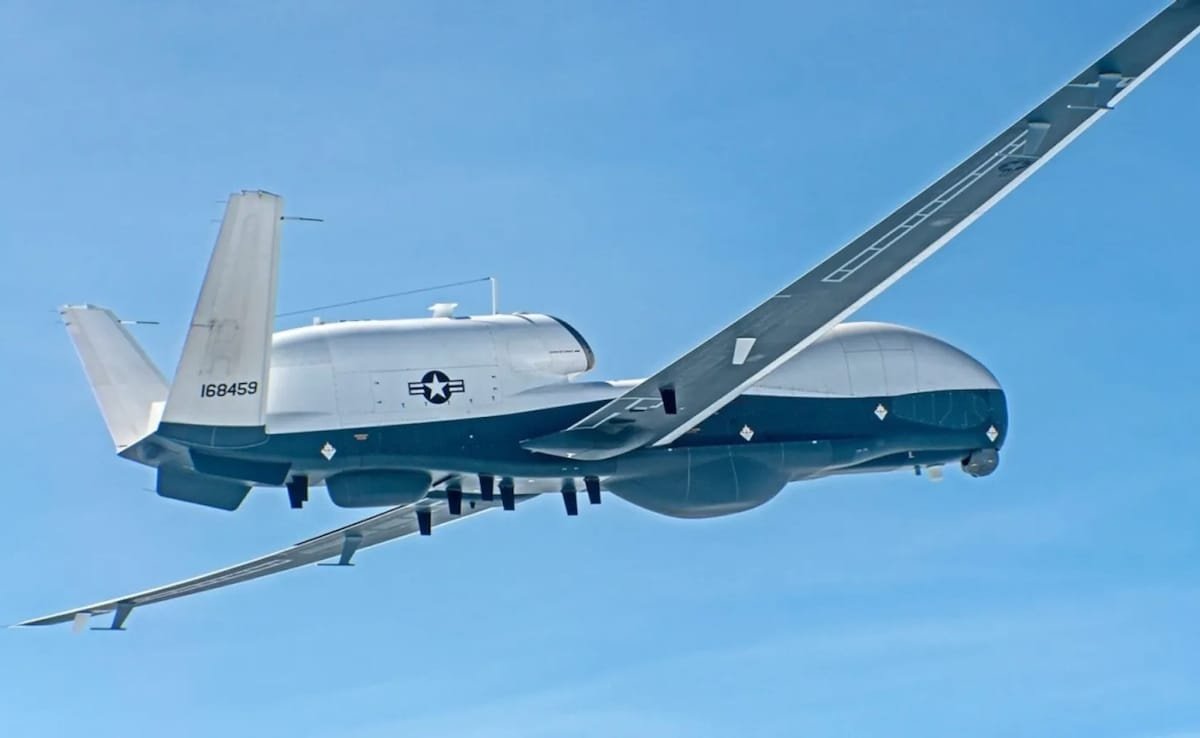
A high-stakes maritime mystery is unfolding in the Middle East as a US Navy MQ-4C Triton surveillance drone, valued at approximately $200 million, has reportedly vanished over the Strait of Hormuz. The incident, occurring on April 10, 2026, has triggered intense speculation regarding whether the aircraft suffered a technical failure or was intercepted by Iranian forces.
The Disappearance: What We Know So Far
According to open-source flight tracking data (OSINT) from platforms like Flightradar24, the drone (Serial Number 169804) was performing a surveillance mission over the Persian Gulf before things took a critical turn.
-
The Emergency Signal: The Triton began transmitting the universal “7700” squawk code, indicating a general in-flight emergency. Some reports suggest it also briefly broadcasted a 7400 code, which signifies a “lost link” between the drone and its ground controllers.
-
Rapid Descent: After the distress signal, the aircraft—which usually cruises at altitudes above 50,000 feet—was observed losing altitude rapidly, dropping below 10,000 feet in a matter of minutes.
-
The Final Turn: Before vanishing from radar, the drone reportedly made a slight turn toward Iranian airspace. It disappeared roughly 36 nautical miles southwest of Nakhiloo Island.
-
Current Status: As of now, there has been no official confirmation from the Pentagon or the US Navy regarding the drone’s fate. It remains unclear if the aircraft crashed into the sea or was brought down.
Why the Location Matters
The Strait of Hormuz is the world’s most important oil chokepoint. The disappearance is particularly sensitive due to several factors:
-
Fragile Ceasefire: The incident happened just two days after the US and Iran reportedly agreed to a ceasefire aimed at stabilizing global shipping routes.
-
Strategic Intelligence: The Triton was reportedly supporting search-and-rescue operations following the loss of a USAF F-15E Strike Eagle on April 3.
-
Regional Tensions: Iran has a history of targeting high-altitude US drones in this area, most notably the 2019 shootdown of a BAMS-D (a Triton predecessor).
Understanding the MQ-4C Triton
The Triton is not your average drone; it is a massive, high-altitude, long-endurance (HALE) platform designed to be the “eyes in the sky” for the Navy.
| Feature | Specification |
| Manufacturer | Northrop Grumman |
| Cost | ~$200 Million per unit |
| Endurance | 24+ hours of continuous flight |
| Altitude | Above 50,000 feet |
| Primary Role | Maritime Intelligence, Surveillance, and Reconnaissance (ISR) |
| Technology | Advanced AN/ZPY-3 radar and high-res infrared sensors |
Potential Explanations
Experts are currently weighing three primary scenarios:
-
Hostile Engagement: Speculation that Iranian air defenses (such as the Bavar-373 or S-300 systems) may have intercepted the drone.
-
Mechanical Failure: As a single-engine aircraft, a catastrophic engine failure or “lost link” could have forced a rapid, unrecoverable descent.
-
Electronic Warfare: The possibility of GPS jamming or “spoofing” interfering with the drone’s navigation systems.
