

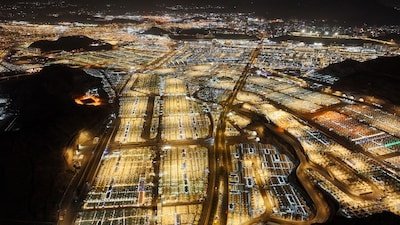
A sharp political debate has erupted following the Haj Committee’s decision to increase airfares for pilgrims by ₹10,000 (approximately $100) this year. The government cited “extraordinary circumstances” in the Middle East—specifically the geopolitical conflict involving the US, Israel, and Iran—which has significantly disrupted global crude oil supplies and driven up Aviation Turbine Fuel (ATF) prices.
The Core of the Conflict
The Haj Committee issued a circular announcing a one-time revision in airfares, requiring pilgrims to pay the additional amount by May 15, 2026.
-
Aviation Turbine Fuel (ATF) Spike: Prices for international airlines were raised by 5% today, marking the second consecutive monthly increase.
-
Negotiated Cap: Minority Affairs Minister Kiren Rijiju stated that airlines initially requested a much steeper hike of $300–$400. He argued that through intense negotiations, the government capped the increase at just $100, saving pilgrims from a more severe financial burden.
Political Reactions: “Negotiation” vs. “Exploitation”
The move has been met with fierce resistance from opposition leaders who argue the hike is a last-minute burden on middle-income families.
| Leader | Perspective |
| Kiren Rijiju (Minority Affairs Minister) | Defended the hike as a necessary evil due to global ATF surges; highlighted the $100 cap as a successful “negotiated” middle ground. |
| Asaduddin Owaisi (AIMIM Chief) | Labeled it “exploitation,” noting that most pilgrims save for years and that the committee had already collected substantial funds. |
| Imran Pratapgarhi (Congress MP) | Questioned why an increase was imposed at the last moment after fares had already been “fixed” in advance, calling it an “utter injustice.” |
Economic Context: The Global Energy Ripple
The hike is directly linked to the broader energy crisis:
-
Geopolitical Chokehold: The war in the Middle East has choked traditional oil supply routes, keeping energy prices elevated worldwide.
-
Deregulated Pricing: While ATF prices in India are aligned with international benchmarks, the current volatility has forced state-owned oil firms to revise rates more frequently.
-
Operating Costs: Fuel remains the largest expense for airlines; the government noted that carriers cannot be expected to absorb the total impact of the global surge alone.
This latest financial hurdle for pilgrims arrives just as the first batches are preparing for their journey to Mecca, turning a spiritual milestone into a point of intense economic and political friction.
