

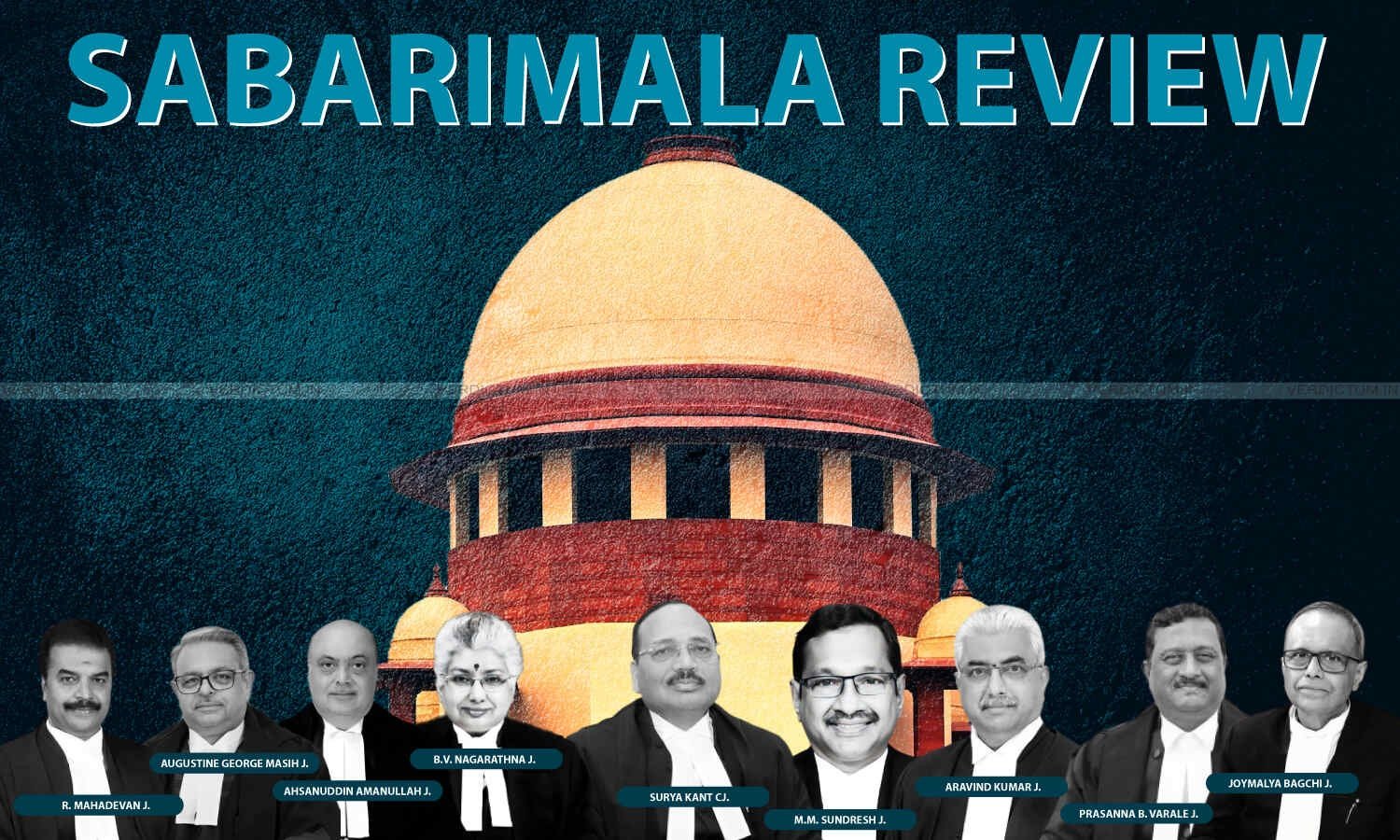
Seven years after the landmark 2018 Sabarimala verdict, a nine-judge bench of the Supreme Court is currently deliberating the broader relationship between the Indian Constitution and religious practices. At the heart of this “mini-Constitution” case is the scope of Judicial Review—the court’s power to strike down laws or traditions that violate fundamental rights.
What is Judicial Review?
Judicial review is the judiciary’s authority to ensure that all legislative and executive actions align with the Constitution. While the term is not explicitly written in the document, it is foundational to its structure:
-
Article 13: Declares any law inconsistent with fundamental rights as void.
-
Articles 32 & 226: Empowers the Supreme Court and High Courts to enforce these rights.
-
The “Basic Structure” Doctrine: Established in the 1973 Kesavananda Bharati case, this principle dictates that Parliament cannot amend the Constitution in a way that removes the power of judicial review.
The Essential Religious Practice (ERP) Test
To navigate the sensitive boundary between state intervention and religious freedom, Indian courts use the ERP Test. This doctrine originated in the 1954 Shirur Mutt case.
The Original Intent vs. The Modern Drift
| Phase | Application | Goal |
| Original (1950s) | Used to distinguish between “genuinely religious” acts and “secular” management (finances/property). | To protect state legislative reforms from being blocked by religious institutions. |
| Modern Drift | Used as a threshold to judge if a practice (like female entry or triple talaq) is “essential” to the faith. | Often used as a defense against reform, arguing that “essential” practices are immune to scrutiny. |
The Sabarimala Conflict
The 2018 Sabarimala case highlighted a critical “drift” in how the ERP test is applied. Unlike early cases where the State passed a law that a Temple challenged, Sabarimala involved individual devotees challenging a centuries-old custom in the absence of a specific new law.
The current nine-judge bench is now addressing whether:
-
Public Interest Litigation (PIL) should be allowed to challenge religious practices by individuals who may not be part of that faith.
-
Article 25 (Freedom of Religion) is subordinate to other fundamental rights, such as equality (Article 14) and dignity (Article 21).
Conclusion: Reform vs. Immunity
The Article argues that the ERP doctrine was never intended to grant “general immunity” to religion. Because Article 25 explicitly states that religious freedom is subject to “public order, morality, and health,” the courts maintain a constitutional obligation to intervene when a practice—no matter how traditional—clashes with the fundamental rights of individuals.
