

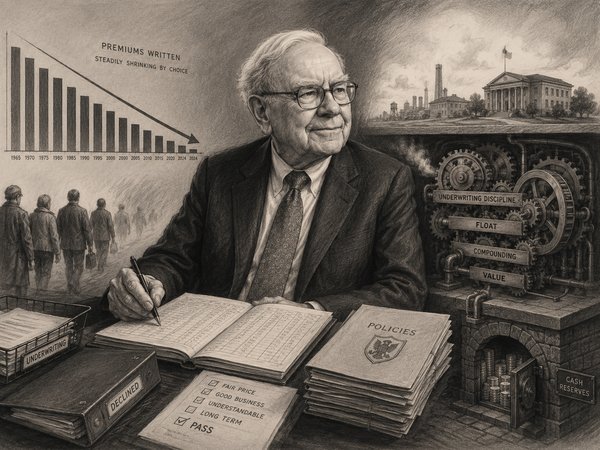
For most retail investors, the emotional reflex is hardwired: a rising stock price brings validation, while a falling ticker triggers panic. Yet, some of the most profound lessons in long-term investing turn conventional wisdom on its head. When Warren Buffett took a massive stake in IBM, he stunned Wall Street by stating something counterintuitive: he hoped the stock price would go nowhere for the next five years.
Far from a casual slip of the tongue or a paradoxical joke, Buffett laid out the exact arithmetic to prove why a stagnant or falling share price can be a long-term investor’s best friend.
The Psychology vs. The Arithmetic
Most market participants judge success purely by mark-to-market price appreciation. If the stock goes up, wealth appears to increase; if it drops, paper losses sting. Buffett, however, thinks like an owner of a business rather than a renter of stock certificates.
When a company is generating robust free cash flow and actively repurchasing its own shares, a lower stock price radically changes the economics of those buybacks.
How Buyback Math Works
To understand Buffett’s logic, imagine a cash-generative enterprise that sets aside a fixed pool of capital—say, $50 billion—to buy back its own shares over a multi-year period.
-
The High-Price Trap: If market sentiment pushes the stock valuation sky-high, that $50 billion buys back a relatively small number of shares. The total share count shrinks only marginally, meaning your proportional ownership of the underlying business barely buds.
-
The Low-Price Opportunity: If the stock price languishes, trades sideways, or drops, that exact same $50 billion buys vastly more shares. The company retires a massive chunk of its outstanding stock.
Because Berkshire Hathaway held a permanent stake in IBM, a depressed share price meant the corporate engine was quietly buying up larger slices of the underlying business on Buffett’s behalf, at a massive discount.
The Power of Compounding Ownership
When a cash-rich company repurchases shares at depressed valuations, two compounding forces are unleashed:
-
Explosive EPS Growth: Future net income is divided among a significantly smaller pool of remaining shares. Even if the company’s absolute earnings flatline, earnings per share (EPS) skyrocket faster.
-
Passive Ownership Expansion: Your proportionate share of the total enterprise grows automatically, without you spending an extra dime of your own capital.
Over a five-to-ten-year horizon, owning a rapidly expanding slice of a cash-generative business matters infinitely more than avoiding temporary price drawdowns.
The Ultimate Takeaway
Warren Buffett’s stance on IBM serves as a masterclass in separating price from value. While crowds panic over stagnant tickers, a disciplined investor recognizes that lower prices act as an accelerant for share repurchases. When the underlying business is sound, a disappointing stock price is not a crisis—it is an invitation to buy more of the pie for less.
