

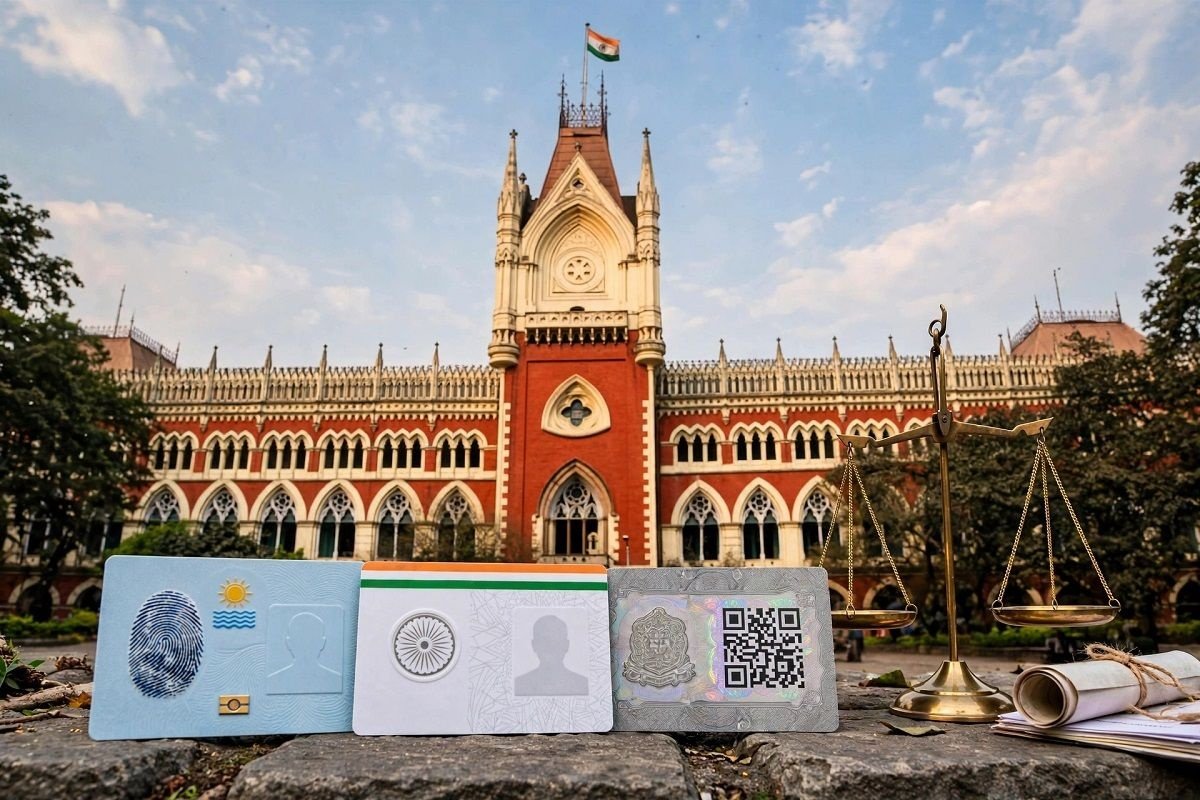
The Calcutta High Court has ruled that standard identification documents—including voter ID, Aadhaar, and PAN cards—do not serve as conclusive proof of Indian citizenship.
A division bench comprising Justice Debangsu Basak and Justice Ajay Kumar Gupta delivered the ruling while dismissing a habeas corpus petition filed by Suman Molla on behalf of his nephew, Nasir. Nasir had been placed in a detention center as a suspected foreign national after his name was removed from the electoral rolls during the Special Intensive Revision (SIR) exercise in West Bengal.
Legal Background and Court Findings
To establish Nasir’s status as an Indian citizen, the petitioner presented a voter identity card, an Aadhaar card, a PAN card issued by the Income Tax Department, and a bank passbook.
The court rejected these arguments, clarifying that:
-
Voter IDs merely show that a person was previously listed on an electoral roll, from which Nasir’s name had already been removed during the 2026 SIR process.
-
Aadhaar, PAN cards, and Bank Accounts do not constitute legal proof of Indian citizenship.
-
The detainee and petitioner failed to meet the statutory burden of proof required under the Immigration and Foreigners Act, 2025.
Nasir was detained on June 18, 2026, pursuant to a Ministry of Home Affairs circular issued on May 2, 2025. Under the guidelines, detainees are given a 60-day window to prove their Indian citizenship. The court noted that by the time of the judgment on July 20, no valid documentation proving citizenship had been produced.
Inconsistencies and Adverse Inference
During proceedings, the court permitted a phone call between Nasir and his legal counsel. When Nasir claimed his parents had passed away in India, the bench inquired about their burial locations to explore the possibility of DNA testing to verify parental links. However, both Nasir and the petitioner refused to disclose where the parents were buried, leading the court to draw an adverse inference regarding the claim that his parents were Indian citizens.
The bench also noted significant contradictions in the petitioner’s statements:
-
In a police complaint, Molla identified himself as Nasir’s cousin, but referred to himself as Nasir’s uncle in the writ petition.
-
Molla claimed to have raised Nasir following the death of Nasir’s father in 1980. However, court records showed Molla is 38 years old while Nasir is 46 years old, rendering the claim factually impossible.
Concluding that the petitioner had not approached the bench with clean hands, and referencing central government submissions that an investigation had identified Nasir as a Bangladeshi national, the High Court declined to intervene and dismissed the petition.
