

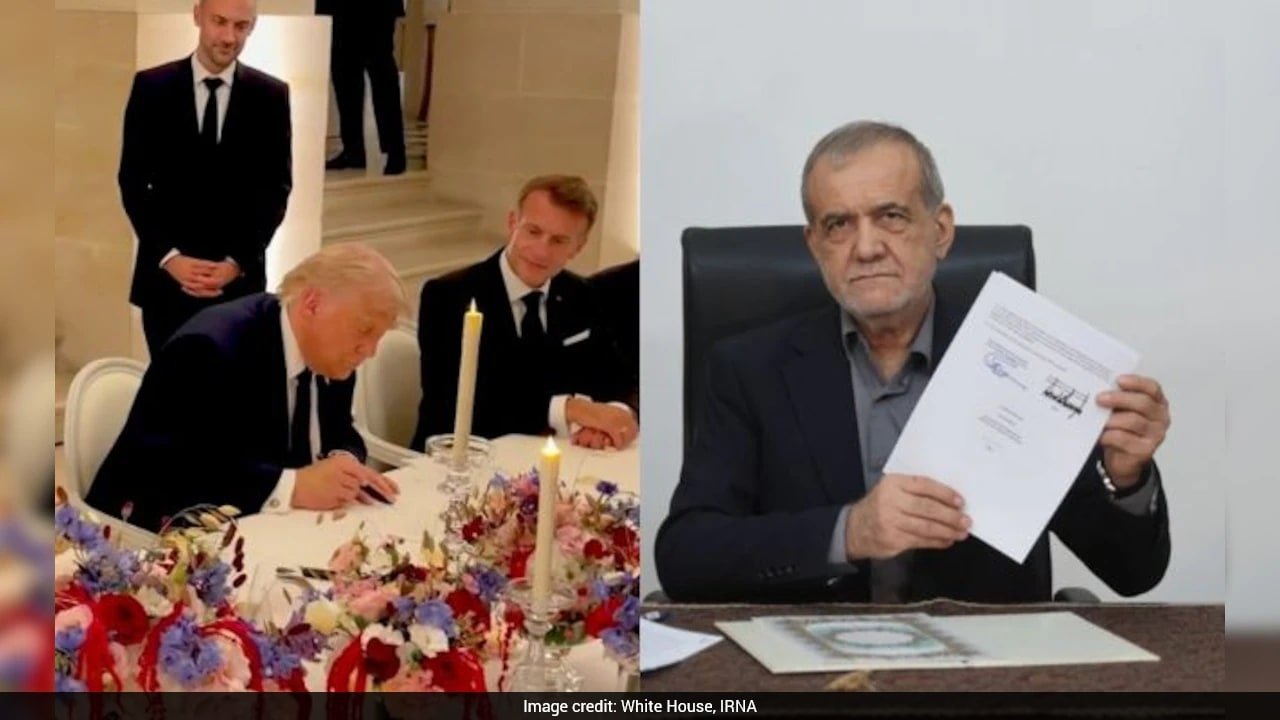
In a momentous diplomatic turnaround, US President Donald Trump and Iranian President Masoud Pezeshkian have signed a comprehensive peace agreement aimed at ending the high-stakes, months-long military conflict in the Middle East.
The breakthrough moment occurred during a high-profile dinner hosted by French President Emmanuel Macron at the Palace of Versailles following the G7 summit. Holding a pen just before putting ink to paper, Trump turned to the assembled world leaders and noted, “This was not easy—that I can tell you.” After signing, Trump held the document up to a room of applauding guests, including President Macron and US Secretary of State Marco Rubio.
Emerging from the palace, Trump simply told reporters: “Just signed it.” Simultaneously, the Iranian Embassy in India released images of President Pezeshkian holding his signed copy of the historic treaty.
Inside the 14-Point Islamabad MoU
The signed document—formally known as the Islamabad Memorandum of Understanding—outlines a swift de-escalation process alongside massive financial and atomic structural changes.
| Category | Key Provision |
| Military De-escalation | Immediate cessation of all military operations on all fronts, explicitly including Lebanon. |
| Maritime Access | Immediate lifting of the US naval blockade; Iran will instantly reopen the Strait of Hormuz to guarantee safe, free commercial passage. |
| Financial Rebuilding | Phased relief from crippling economic sanctions, the release of frozen Iranian assets, and a US-backed economic development program for Iran worth at least $300 billion. |
| Nuclear Assurances | Iran explicitly reaffirms it will not develop or acquire nuclear weapons, placing future discussions regarding enriched uranium stockpiles under strict International Atomic Energy Agency (IAEA) supervision. |
The agreement binds both Washington and Tehran to negotiate and finalize the technical, long-term terms of a permanent treaty within a strict 60-day window.
Strategic Triumphs and Blunt Warnings
Despite the optimism in the air, the rhetoric coming from both leadership camps reveals the immense friction behind the scenes. Trump praised the Iranian people as “smart” and focused on how the deal would stabilize global energy markets and lower oil prices. However, during a subsequent press conference, he issued a characteristically blunt warning:
“I want them to honor the agreement… [but] I will bomb the hell out of them if they violate it.”
— US President Donald Trump
On the other side, Tehran made it clear they are not walking into this agreement submissively. Iran’s chief negotiator, Mohammad Bagher Ghalibaf, told state-run Press TV that Iran is engaging with the US from a “position of strength.” He emphasized that their battlefield resilience provided the necessary leverage, stating, “Every war that ends in victory, if it does not ultimately lead to a legal and political document… will bring no benefit.”
Iranian Foreign Ministry spokesperson Esmaeil Baqaei echoed the sentiment, noting that with the text finalized, it is now “time to test the implementation of the agreement.”
Global Leaders React
The international community has widely celebrated the sudden breakthrough, particularly the nations that helped broker or directly felt the economic tremors of the conflict.
-
France: Host President Emmanuel Macron took to X to call the treaty an invaluable step forward that opens a definitive path toward lasting peace.
-
Pakistan: Acting as a key regional mediator during the conflict, Pakistan warmly welcomed the development. Pakistani Prime Minister Shehbaz Sharif congratulated both sides on choosing diplomacy over devastating regional escalation, confirming that the Islamabad MoU enters into force with immediate effect.
