

Every digital prompt, AI-generated image, or large language model query carries a steep, invisible environmental price tag. As artificial intelligence models scale exponentially, the infrastructure supporting them is facing a severe resource bottleneck.
According to a stark warning from the United Nations, if the current trajectory continues, AI data centers could consume as much water as 1.3 billion people by the end of this decade.
In response to this looming crisis, Nvidia—the hardware heavyweight at the center of the AI gold rush—has unveiled specialized server infrastructure designed to shift data centers away from traditional water-evaporative cooling.
The Massive Footprint of Standard Cooling
Advanced AI chips generate extreme heat under heavy computational loads. To prevent hardware failure, traditional data centers rely on massive cooling towers that continuously evaporate water to regulate temperatures.
This model has triggered intense friction in local communities worldwide, straining regional water grids, spiking electricity demand, and threatening municipal utility costs.
How Nvidia’s Technology Works
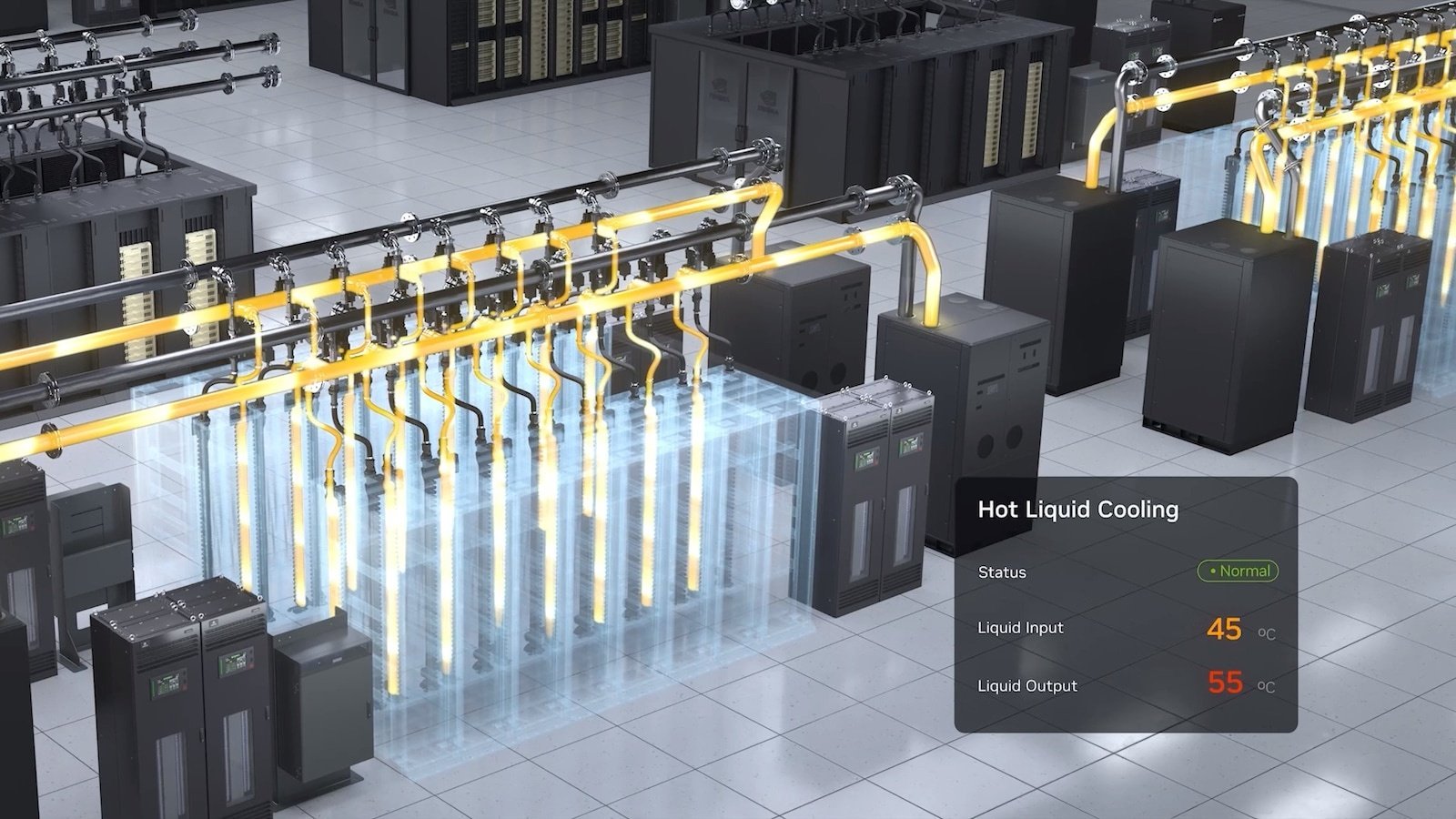
Nvidia’s new architecture utilizes a closed-loop liquid cooling system that operates similarly to a vehicle’s radiator.
-
Closed-Loop Circulation: Instead of constantly drawing in and evaporating fresh water, a specialized chemical liquid coolant continuously circulates through the system, absorbing heat directly from the chips and carrying it away to be cooled and reused.
-
High-Temperature Tolerance: The system is engineered to function reliably at temperatures as high as 45°C (113°F).
-
Eliminating the Chillers: Because the coolant can operate safely at higher ambient temperatures, data centers can eliminate or severely scale back the massive, energy-devouring chillers and industrial air conditioning units typically required.
Economic Incentive: Nvidia estimates that retrofitting or building large-scale AI facilities with this closed-loop technology could save operators millions of dollars annually in combined water and energy expenditures.
The Catch: Efficiency vs. Expansion
While a closed-loop system mitigates direct water consumption, environmental experts note that it does not entirely solve AI’s ecological footprint due to three lingering challenges:
-
The Energy Multiplier: Even if direct water usage for cooling drops to near zero, these facilities still demand enormous amounts of electricity. If that power is sourced from traditional thermoelectric or nuclear plants, massive amounts of water are still consumed indirectly at the power generation stage.
-
High Capital Expenditure: Replacing legacy infrastructure across global data networks with advanced liquid-cooling hardware is incredibly expensive and will take years to implement at scale.
-
Jevons’ Paradox: Historical tech trends show that when a resource becomes cheaper and more efficient to process, industries rarely scale back. Instead, they usually build more. Increased cooling efficiency may simply trigger an even larger explosion of data center construction.
Nvidia’s architectural shift proves that high-performance AI doesn’t inherently require draining local water tables just to keep the silicon from melting. However, whether this innovation creates a genuinely greener tech ecosystem or merely fuels an unchecked expansion of data infrastructure remains to be seen.
