

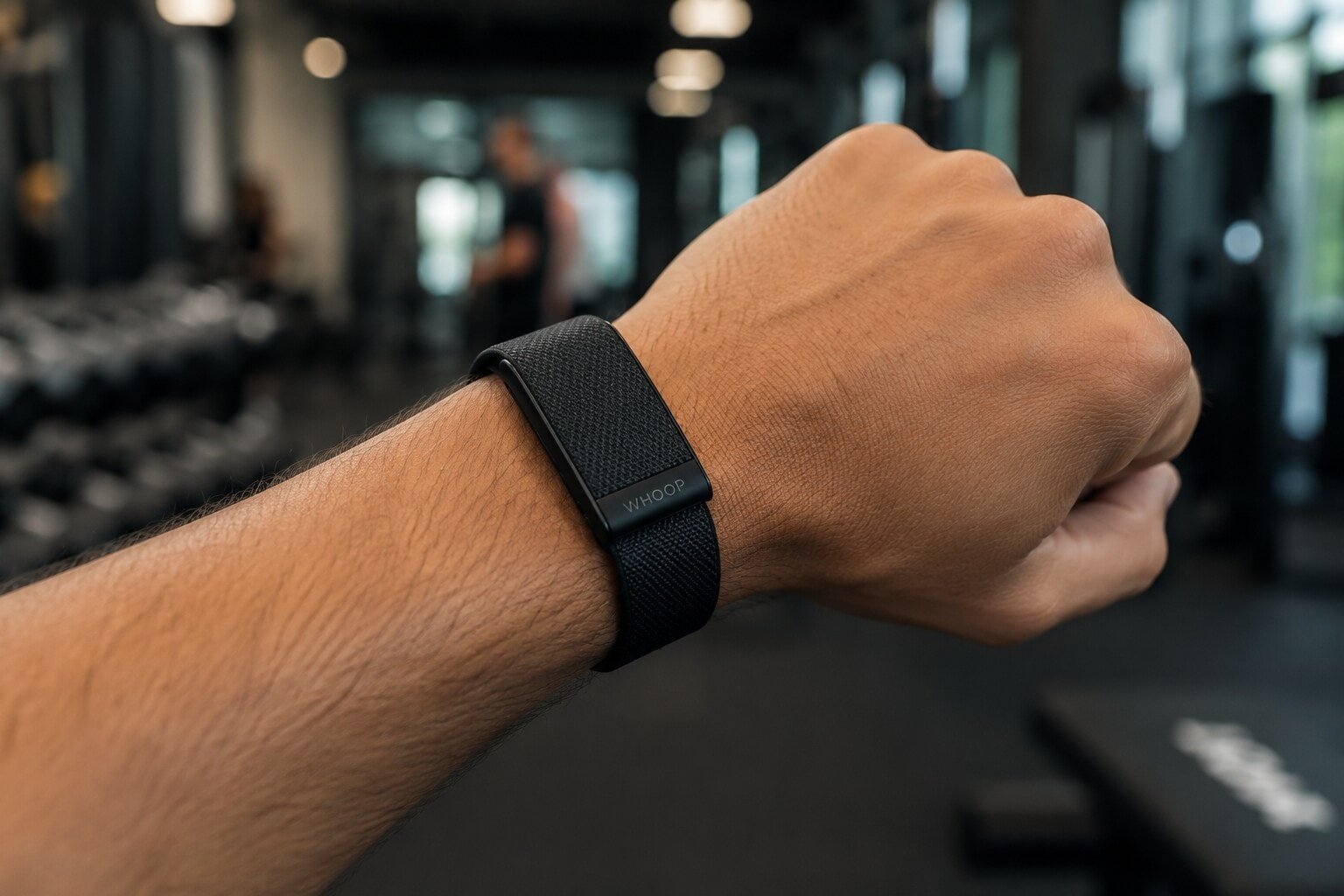
Both smartwatches and screenless wristbands monitor health, track workouts, and analyze sleep patterns, but they target fundamentally different lifestyle needs. One acts as an interactive smartphone extension on your wrist, while the other serves as a silent health collector working entirely in the background.
Understanding how their philosophies, tracking capabilities, and daily usability differ can help you determine which wearable best matches your daily routine.
Screenless Wristbands: Distraction-Free Recovery & Health Tracking
Screenless fitness bands skip displays, notifications, and interactive apps entirely. Instead of demanding your attention, they quietly collect physiological data 24/7 and deliver detailed analytics through a companion mobile app.
Key Strengths & Advantages:
-
Focus on Strain, Sleep, and Recovery: Popularized by bands like WHOOP, these wearables prioritize metrics like Heart Rate Variability (HRV), respiratory rate, skin temperature, and sleep staging to measure daily recovery and strain.
-
Distraction-Free Experience: Without an interactive screen or constant buzzes from incoming notifications, screenless bands keep you focused on your surroundings.
-
Versatile Wearing Options: Lacking a display allows for non-wrist wearing options. Devices can often be worn on the bicep or integrated into compatible athletic wear.
-
Longer Battery Life: Eliminating high-brightness color screens allows these trackers to last significantly longer on a charge—ranging from a full week to up to 45 days depending on the brand and model.
-
Discreet Styling: They leave your primary wrist free if you prefer wearing a classic analog timepiece.
Featured Screenless & Long-Battery Fitness Trackers:
-
Pebble Qore Fitness Band: Focuses on ultra-long battery life (up to 45 days), 100+ sports modes, and one-key health measurements (₹2,799).
-
pTron Reflect ACE: Lightweight design with nylon/silicon strap options, HRV tracking, and extended battery performance (₹2,499).
-
QORFIT Pulse Smart Band: IP68 waterproof tracker offering 24/7 continuous health tracking including HRV, BP estimation, and sleep insights without subscription fees (₹4,444).
-
WHOOP 5.0 (with 12-Month Membership): Premium recovery-focused wearable featuring personalized coaching, VO2 Max estimation, and continuous strain/sleep tracking (₹21,990).
Smartwatches: Real-Time Data & Seamless Smartphone Connectivity
Smartwatches are built for immediate feedback and daily convenience. By combining rich displays with advanced sensor arrays, they serve as both on-the-go health monitors and productivity tools that reduce how often you pick up your phone.
Key Strengths & Advantages:
-
Real-Time Workout Feedback: Active displays let you view live pace, heart rate zones, GPS maps, and split times during workouts without checking your phone.
-
Advanced Medical & Safety Features: High-end models often include ECG monitoring, Irregular Heart Rhythm Notifications (IHRN), blood oxygen tracking, fall detection, and emergency SOS tools.
-
Standalone Navigation & Outdoors: Built-in multi-band GPS, offline topo maps, and compass tools make smartwatches dependable companions for hiking, trail running, or marine navigation.
-
Everyday Convenience: Handle calls, reply to quick messages, check weather updates, and make contactless payments directly from your wrist.
Featured Smartwatches:
-
Garmin Instinct 2 Solar: Rugged, solar-charging GPS smartwatch with extreme battery longevity, built-in sports apps, and tough outdoor construction (₹31,990).
-
Amazfit Active 3 Premium: Features a crisp AMOLED display, offline mapping support, 12-day battery life, and over 170 workout modes (₹15,999).
-
Samsung Galaxy Watch8 (40mm): Advanced health tracking powerhouse equipped with ECG, blood pressure monitoring, vascular load insights, and dual-frequency GPS (₹27,000).
-
Apple Watch Series 11 (46mm): Comprehensive smart ecosystem integration, expansive display, advanced health sensors, and deep fitness tracking (₹44,999).
Head-to-Head Comparison
| Feature / Category | Screenless Wristbands | Smartwatches |
| Primary Focus | Background health tracking, sleep, and recovery | Real-time tracking, smart alerts, and productivity |
| User Interaction | Low / App-based only | High / Touchscreen & buttons |
| Battery Life | Several days to weeks | Typically 1 to 12 days (model dependent) |
| Notifications & Calling | None | Full support (Calls, Texts, App Alerts) |
| Form Factor | Minimalist, lightweight, highly discreet | Watch-style with varying screen sizes |
| Best For | Minimalists, traditional watch wearers, recovery tracking | Multi-sport athletes, commuters, tech enthusiasts |
Which One Should You Wear Every Day?
-
Choose a Screenless Wristband if: You want continuous health, sleep, and strain insights without adding another screen to your life. They are ideal if you prefer wearing a traditional analog watch, want a lightweight tracker for sleep, or prefer long battery life over wrist notifications.
-
Choose a Smartwatch if: You want real-time metrics during workouts, on-wrist GPS navigation, and smartphone conveniences like reading notifications or taking calls. They are best suited for those who want a single, feature-rich device to manage both daily productivity and fitness goals.
