

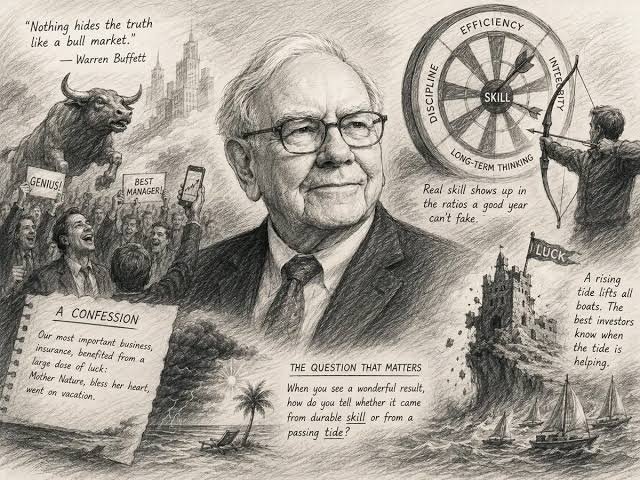
The Mirage of the Bull Market
everyone attributes their success to intellect, skill, and strategic foresight. In reality, a rising market is a tide that lifts all boats—including the ones with holes in their hulls.
As Warren Buffett famously noted, “Only when the tide goes out do you discover who’s been swimming naked.”
In prolonged bull markets, weak business models, excessive leverage, and speculative strategies often go unpunished. Returns mask flaws, making it nearly impossible for the average investor to distinguish between genuine investment acumen and plain good fortune.
Buffett’s Metric: Evaluating Relative Performance
To separate skill from luck, Buffett introduced a straightforward principle: An investor’s skill can only be measured by how they perform relative to the benchmark across a full market cycle—both the highs and the lows.
-
The Bull Market Trap: Outperforming a index during a raging bull run by taking on disproportionate risk is not proof of genius. If the market is up 20% and a high-beta portfolio rises 35%, that gain is often driven by excess risk rather than superior stock selection.
-
The Bear Market Test: True skill reveals itself when the market turns down or stagnates. A great investor preserves capital when the tide recedes, outperforming the benchmark on the downside and allowing compound interest to work its long-term magic.
Which One Are You?
Ask yourself these core questions to evaluate your own portfolio and strategy:
-
Was your performance luck-driven? Did your gains come from speculative bets, momentum chasing, or simply holding volatile assets during a market-wide rally?
-
Is your strategy repeatable? Can your investment thesis withstand rising interest rates, margin compression, or a multi-year range-bound market?
-
Do you have downside protection? Are you holding high-quality businesses with durable competitive moats, strong balance sheets, and pricing power that can weather economic downturns?
Key Takeaway
Surviving bear markets and sideways phases requires moving away from short-term momentum and anchoring your strategy in underlying business fundamentals. Great investors focus on margin of safety, risk management, and fundamental evaluation—ensuring that when the bull market returns, their gains are built on solid ground rather than temporary luck.
