

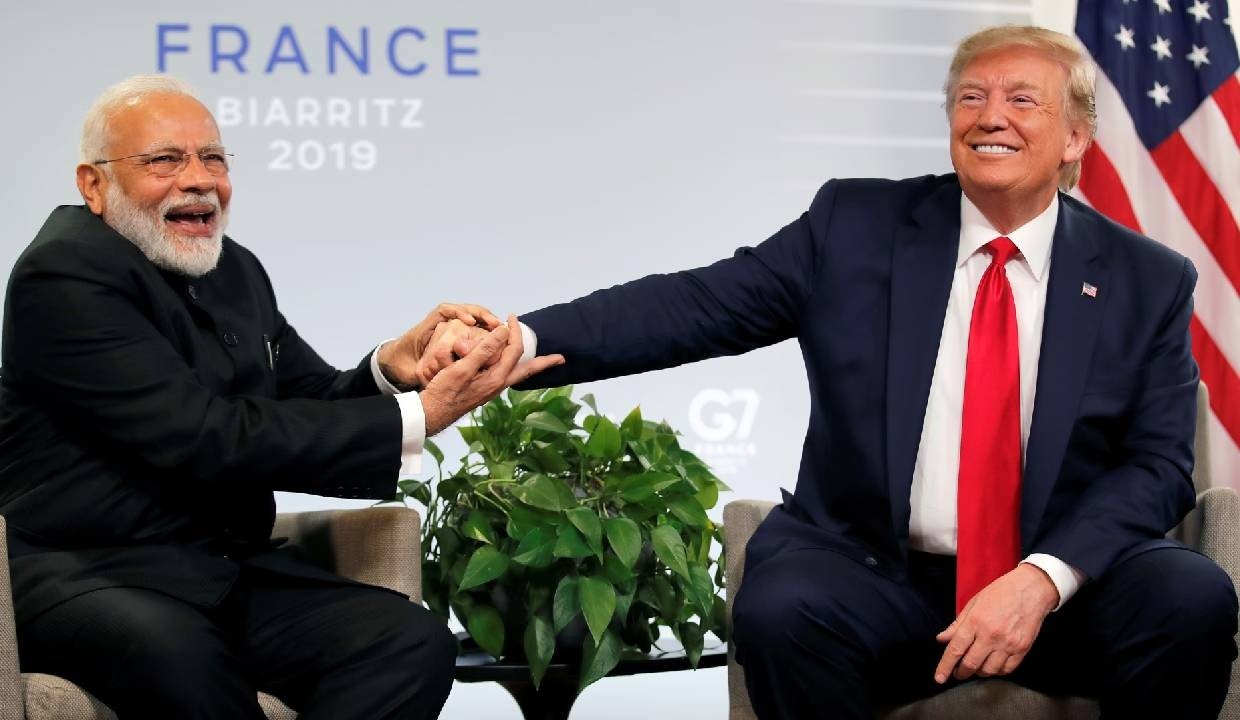
At a White House briefing, US President Donald Trump voiced strong optimism that Washington and New Delhi will successfully ink a bilateral trade deal. Even while maintaining tough economic rhetoric on historical trade imbalances, Trump heavily emphasized his personal rapport with Prime Minister Narendra Modi.
“We will get to a deal because I like your prime minister a lot. He is a good friend of mine, and we get along well. We have a good relationship.”
— US President Donald Trump
The Tariff Tensions: India “Took Advantage”
While projecting an impending breakthrough, Trump did not hold back on past trade friction. He alleged that for decades, India’s high import tariffs unfairly penalized American commerce while Indian exports entered the US practically duty-free.
-
The Harley-Davidson Example: Trump pointedly recalled the iconic American motorcycle brand, noting that India historically slammed a 200 per cent tariff on the bikes. This ultimately forced Harley-Davidson to build manufacturing plants directly in India to bypass the tax wall.
-
The Shift in Dynamic: Trump argued that his administration’s active trade strategies have completely reversed this status quo, claiming that the US is now “making a lot of money with India”.
Understanding the Backstory: The Trade Deal Tug-of-War
The economic negotiations between the two nations have seen an intense series of judicial and policy shifts:
| Timeline Component | Milestone Event & Legal Background |
| Feb 7, 2026 | BTA Framework Finalized: Following a call between Trump and Modi, both nations map out Phase 1 of a Bilateral Trade Agreement (BTA). The US agrees to slash tariffs on Indian goods down to 18% (from 50%), effectively rolling back penalties linked to India purchasing Russian oil. |
| Feb 20, 2026 | US Supreme Court Intervention: In a major check on executive policy, the US Supreme Court rules against Trump’s aggressive, blanket reciprocal tariffs enacted under the International Emergency Economic Powers Act (IEEPA) of 1977. |
| Feb 24, 2026 | The 150-Day Baseline Tariff: Pivoting from the judicial block, Trump implements a blanket 10% tariff on all global imports for 150 days, triggering the current urgent phase of bilateral renegotiations. |
| June 3, 2026 | The Section 301 Forced Labour Penalty: The U.S. Trade Representative (USTR) announces a sweeping proposal to add a 12.5 per cent tariff on India and 53 other nations. The penalty stems from a Section 301 investigation alleging a failure to curb imports of goods produced with forced labour. |
What’s Next?
Despite the newly threatened Section 301 tariffs—which experts view as a calculated US pressure tactic—official dialogue remains active. A senior US delegation wrapped up intense four-day negotiations in India. India’s Ministry of Commerce described the meetings as highly cooperative and pragmatic, with both democratic allies working fast to formalize an interim pact that secures mutual market access without completely stalling global trade.
