

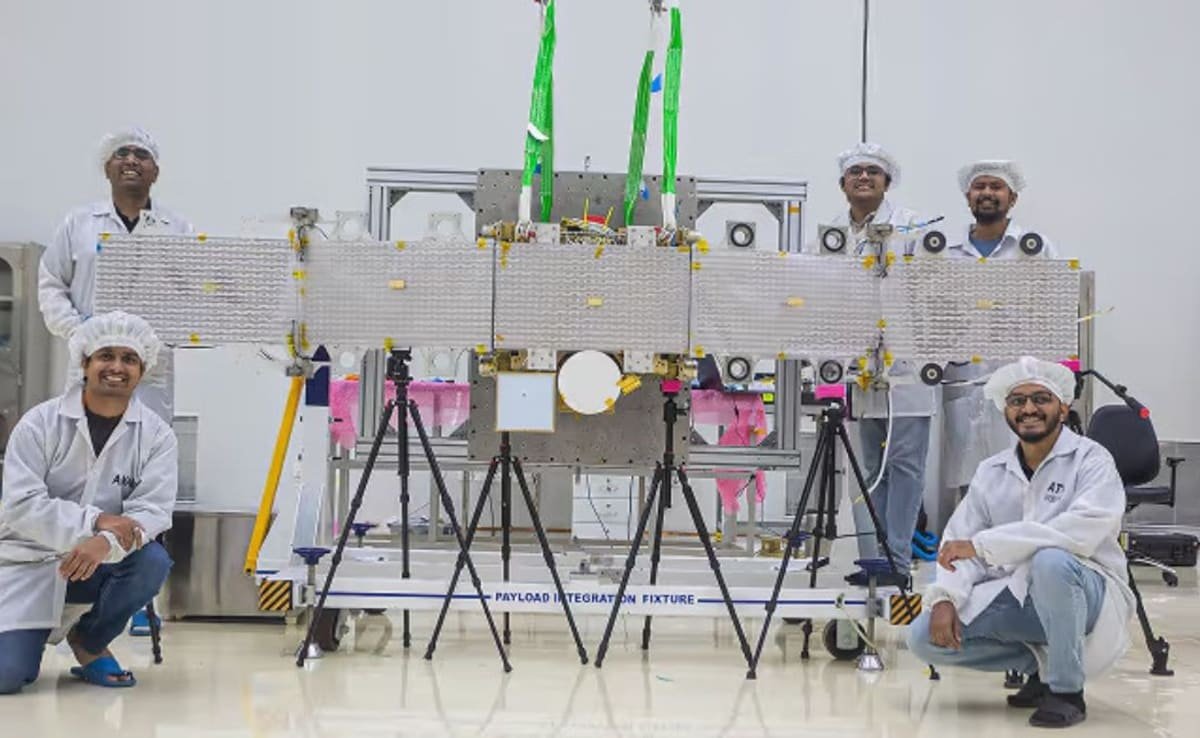
The successful launch of Drishti, a groundbreaking Earth observation satellite developed by Bengaluru-based startup GalaxEye, marks a massive shift in India’s space capabilities. Launched via a SpaceX Falcon 9 rocket on May 3, 2026, this 190-kg satellite is not just a commercial milestone—it is a strategic asset that could significantly alter the intelligence landscape regarding neighbors like Pakistan and China.
A Technological “First” for Global Intelligence
What makes Drishti a “headache” for adversaries is its unique hybrid design. Traditionally, satellites use either optical cameras (which provide clear, color images but are blinded by clouds/night) or Synthetic Aperture Radar (SAR) (which sees through darkness and clouds but produces harder-to-interpret data).
Drishti is the first in the world to combine both on a single platform.
-
Uninterrupted Surveillance: Because India is a tropical country, cloud cover often hides ground activity from conventional satellites. Drishti bypasses this “blindfold.”
-
Identical Resolution: Both the optical and SAR sensors operate at a high 1.5-meter resolution, allowing for perfectly overlaid data that provides a level of detail previously unavailable to private or even most government entities in the region.
Strategic Sovereignty: Lessons from Operation Sindoor
The mission highlights India’s push for technological sovereignty. Historically, India has often relied on American commercial giants (like Vantor, formerly Maxar) for high-resolution “Bomb Damage Assessments” during conflicts.
Recent global tensions, such as the Israel-Iran conflict, have shown that the U.S. can—and does—restrict access to satellite imagery during sensitive times. With Drishti, India gains “sovereign eyes” that cannot be turned off by foreign powers, ensuring continuous monitoring of border movements and strategic installations in any weather, day or night.
From IIT Madras to Global Gold Standard
GalaxEye, an incubator success story from IIT Madras, has patented this hybrid technology globally. CEO Suyash Singh noted that while Western nations didn’t prioritize “all-weather” sensors because they lack persistent tropical cloud cover, India’s specific climate forced a design evolution that could now become the “global gold standard.”
Key Future Targets:
-
Constellation Expansion: Drishti is the first of a planned 10-satellite constellation.
-
Sharper Vision: Future versions aim to reach a resolution of 0.3 to 0.5 meters, putting them on par with the world’s most advanced military-grade surveillance.
The Verdict: A New Era of Maturity
The launch has been hailed by former ISRO Chairman Dr. S. Somanath as a sign that India’s space ecosystem is maturing. By moving away from small experimental “nanosats” to heavy, sophisticated imaging platforms, Indian startups are no longer just participating in the space race—they are leading it with original, patented technology that provides an undeniable edge in regional security.
