

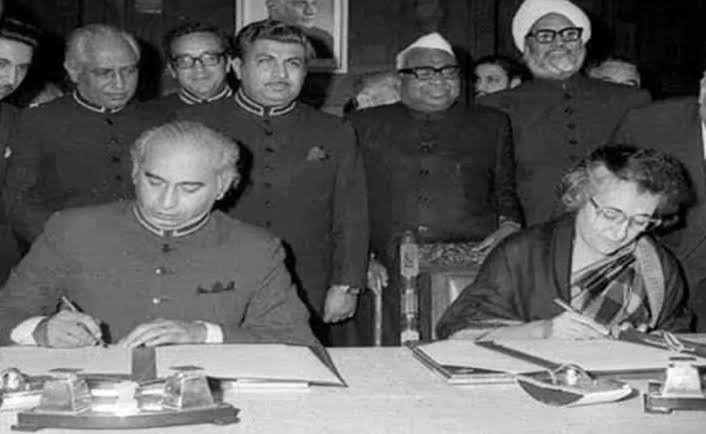
Signed on July 2, 1972, by Indian Prime Minister Indira Gandhi and Pakistani President Zulfikar Ali Bhutto, the Simla Agreement was conceived as a comprehensive blueprint for durable peace in the subcontinent. Intended to reverse the systemic hostilities of the 1971 war, the accord established the Line of Control (LoC) and mandated a strict code of mutual respect, non-interference, and peaceful coexistence.
More than five decades later, the diplomatic discourse has shifted entirely. The core issue is no longer a matter of competing legal interpretations of the text, but a fundamental divergence in state conduct. Pakistan’s reliance on cross-border terrorism, institutionalized internationalization of bilateral issues, and digital information warfare have progressively dismantled the agreement’s foundational pillars.
Structural Breaches: Treaty Provisions vs. State Practice
The Simla Agreement was built on explicit commitments to build confidence and prevent the recurrence of conflict. The table below illustrates how state-enforced actions have hollowed out these core commitments:
| Simla Agreement Framework | Documented State Practice | Strategic Consequences |
|
Strict Bilateralism Commitment to settle all mutual differences exclusively through direct, bilateral negotiations. |
Systemic Internationalization Constant diplomatic appeals to external bodies, including organizing a UN Security Council Arria-formula meeting. |
Direct violation of the bilateral exclusivity clause, attempting to force third-party mediation onto regional issues. |
|
Pledge Against Hostile Propaganda Obligation to prevent misinformation and foster information exchange that promotes friendly relations. |
State-Aligned Disinformation Deploying asymmetric information warfare campaigns to manipulate regional stability narratives. |
Over 1,400 hostile, state-linked URLs traced directly back to across the border during military standoffs. |
|
Territorial Integrity & Security Commitment to prevent the organization, assistance, or encouragement of any acts detrimental to peace. |
Sponsorship of Non-State Proxies Providing safe haven and funding to UN-listed terror networks like Lashkar-e-Taiba (LeT) and Jaish-e-Mohammed (JeM). |
Sustained border volatility; led to a four-year listing on the Financial Action Task Force (FATF) monitoring grid. |
The 2025 Escalation: The Security-Cooperation Realignment
The systemic breakdown of the treaty’s security baseline culminated in a sharp military and diplomatic realignment in early 2025, solidifying India’s position that regional cooperation cannot be decoupled from cross-border security.
-
The Pahalgam Provocation (April 22, 2025): Terrorists belonging to The Resistance Front (TRF)—a known proxy of the UN-sanctioned Lashkar-e-Taiba—opened fire on civilians in Pahalgam, Jammu and Kashmir, resulting in 26 civilian casualties. National Investigation Agency (NIA) findings traced the operational conspiracy directly across the border.
-
Operation Sindoor (May 2025): In a decisive shift in its defensive doctrine, India launched Operation Sindoor, executing precision punitive airstrikes against nine active terror infrastructure camps located across the border.
-
The Propaganda Surge: Following the military strikes, asymmetric information cells flooded digital platforms with fabricated claims regarding cyberattacks on India’s power grids and the downing of Indian fighter jets, directly breaching the anti-propaganda mandate of the 1972 accord.
-
The Indus Waters Consequence: In response to the persistent threat of cross-border terror infrastructure, India suspended the operational mechanisms of the Indus Waters Treaty (IWT). The move established a clear diplomatic precedent: a state cannot expect to reap the structural benefits of bilateral water-sharing and economic cooperation while actively violating the security foundations required to sustain those agreements.
The Geopolitical Reality: The Simla Agreement has not been rendered ineffective by legal loopholes, but by a consistent failure of compliance. Peaceful neighborly relations cannot survive in an environment where state-sponsored proxy violence and digital destabilization are leveraged as instruments of foreign policy.
