

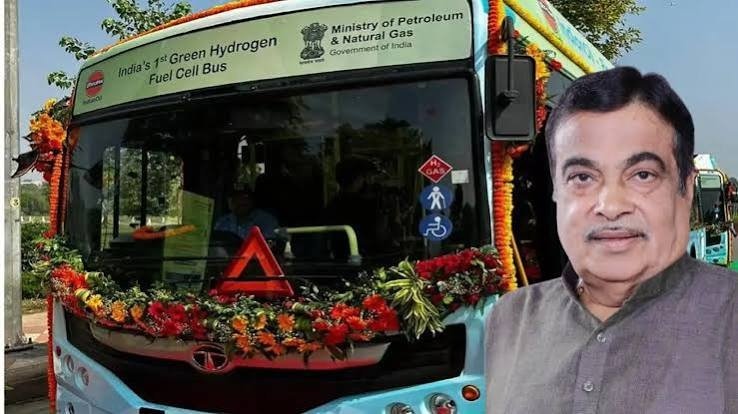
In a major push toward green mobility and waste management, Union Minister of Road Transport and Highways Nitin Gadkari announced that Delhi’s public transit buses could eventually run on hydrogen generated entirely from segregated municipal waste.
Speaking at a Delhi BJP youth conclave, the minister detailed a circular economy model where the capital’s staggering garbage burden is repurposed into clean energy. “This garbage will be segregated and used to produce hydrogen through biodigesters. The buses in Delhi will run on it. All of this is possible,” Gadkari stated. Addressing skepticism regarding the ambitious timeline, the minister remarked, “People have asked how this will happen. Has there ever been a time in the last 50 years when something I predicted did not come to pass?”
Resolving the Hydrogen Supply Bottleneck
The national capital already operates a pilot hydrogen-powered fuel cell bus in the Central Vista area, covering a 180-kilometer daily route using fuel supplied by Indian Oil Corporation Limited’s (IOCL) hydrogen station in Faridabad. However, scaling the fleet significantly has faced a critical bottleneck: a reliable, localized, and cost-effective green hydrogen supply chain.
By pivoting to a waste-to-hydrogen model utilizing local biodigesters, the government aims to solve two structural urban crises at once—fueling public transport while systematically dismantling Delhi’s notorious landfill mountains. Gadkari highlighted that the ministry has already cleared five regional pilot projects across ten nationwide transit routes to test localized hydrogen production and distribution ecosystems, backed by a ₹208 crore allocation involving major manufacturers like Tata Motors and Ashok Leyland.
Weaponizing Waste into Infrastructure
The minister framed the initiative as part of a wider legislative and logistical war on urban waste, reiterating the central government’s goal to eliminate legacy landfill waste across India by 2027.
The strategy is already underway in heavy infrastructure projects. Approximately eight million tons of excavated landfill waste from Delhi have already been integrated into the sub-base construction of regional expressways.
Gadkari further emphasized that modern waste processing is no longer a financial drain but a lucrative revenue model for local administrative bodies. He cited his own parliamentary constituency of Nagpur, where the local municipal corporation converts crisis into capital, earning approximately ₹325 crore annually simply by treating and selling recycled wastewater to industrial buyers.
