

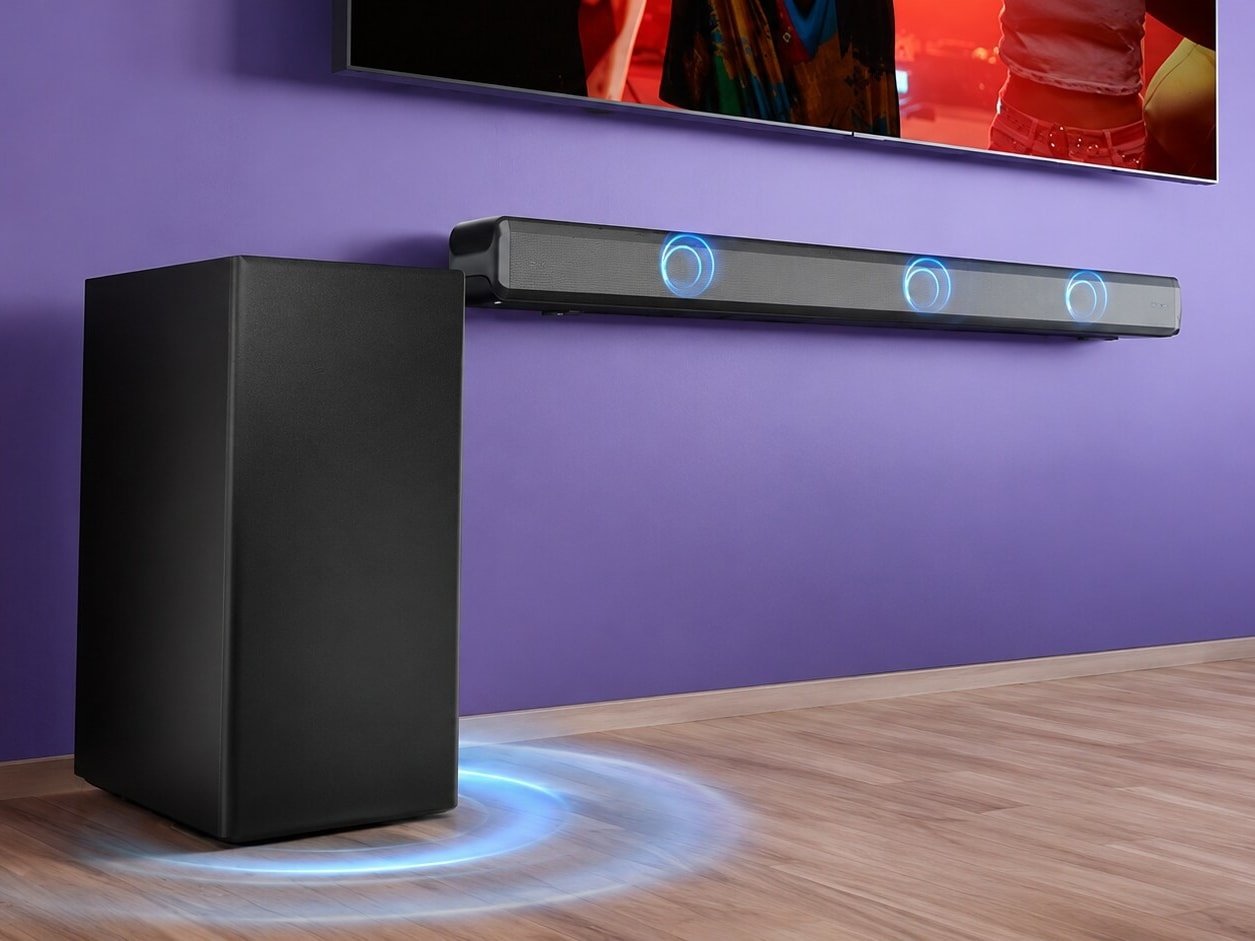
When upgrading your home entertainment system with a soundbar, focusing strictly on wattage, brand, or speaker count isn’t enough. Modern audio technologies have introduced sophisticated 3D spatial soundstages that completely transform how you experience movies, games, and music at home.
The two heavyweights in this space are Dolby Atmos and DTS:X. While both aim to deliver a cinematic, three-dimensional audio setup, they operate differently and suit distinct viewing habits.
What Is Dolby Atmos?
Dolby Atmos is an object-based audio format that creates a 3D soundstage by adding a height dimension to traditional surround sound layouts. Rather than assigning audio to static channels (like 5.1 or 7.1), sound engineers treat individual sounds—such as rainfall, a passing helicopter, or footsteps—as independent “objects” that move precisely around and above you.
Key Advantages
-
Immersive 3D Soundstage: Height channels (either upward-firing or ceiling-mounted) make height-based audio effects feel genuinely vertical.
-
Exceptional Dialogue Clarity: Object tracking enables central audio channels to render clear, distinct dialogue even during heavy action sequences.
-
Flexible Configurations: Adapts seamlessly across various physical speaker layouts ($5.1.2$, $7.1.4$, etc.).
-
Widespread OTT Support: The native format for virtually all major streaming platforms, including Netflix, Disney+, Prime Video, and Apple TV+.
What Is DTS:X?
DTS:X is also an object-based 3D audio format designed to position individual audio elements within a three-dimensional space. However, DTS:X stands out for its adaptability; it does not require a rigid speaker layout or dedicated height channels to create an immersive audio field, making it highly versatile for custom home theater environments.
Key Advantages
-
Flexible Speaker Placement: Optimizes sound based on your existing room layout without requiring precise overhead speaker positioning.
-
Dynamic Range & Bitrate: Frequently delivers higher bitrates on physical media for rich, detailed audio fidelity.
-
DTS Dialogue Control: Allows users to adjust vocal sound levels independently, improving clarity without raising overall volume.
-
Ideal for Physical Media: The preferred format for purists with extensive Blu-ray and 4K UHD disc collections.
Dolby Atmos vs DTS:X: Side-by-Side Comparison
| Key Feature | Dolby Atmos | DTS:X |
| Audio Approach | Object-based audio with dedicated height tracking | Object-based audio with flexible spatial mapping |
| Height Channels | Prefers upward-firing or ceiling speakers ($5.1.2$, $7.1.4$) | Height-capable, but easily adapts to flat layouts |
| Streaming Support | Dominates major OTT platforms (Netflix, Disney+, Prime) | Limited streaming availability; stronger on physical media |
| Physical Media | Widely used on 4K / HD Blu-ray discs | Excellent presence across 4K / HD Blu-ray titles |
| Setup Flexibility | Requires specific placement for peak efficiency | Highly adaptive to custom or irregular speaker setups |
| Ideal User Profile | Streaming enthusiasts, gamers, and plug-and-play buyers | Home theater enthusiasts and physical media collectors |
Top Dolby Atmos and DTS:X Soundbars to Consider
1. Samsung 300W 2.1ch Soundbar (HW-B45EF/XL)
-
Audio Tech: Dolby Audio, DTS Virtual:X
-
Power Output: 300W | Channels: 2.1
-
Connectivity: HDMI ARC, Optical, Bluetooth, USB
-
Best For: Entry-level room upgrades seeking solid bass and wide virtual surround without taking up much space.
2. JBL Cinema SB590 Soundbar
-
Audio Tech: Virtual Dolby Atmos
-
Power Output: 440W | Channels: 3.1
-
Connectivity: HDMI eARC, HDMI Input, Optical, Bluetooth 5.3
-
Best For: Users looking for deep bass and a dedicated center channel for crisp dialogue delivery in medium to large rooms.
3. Zebronics Juke Bar 9710C
-
Audio Tech: Dolby Atmos, DTS:X
-
Power Output: 550W RMS | Channels: 5.1
-
Connectivity: HDMI eARC, Bluetooth 5.3, AUX, Optical, USB
-
Best For: Budget-conscious buyers who want full $5.1$ surround coverage complete with wireless rear satellite speakers.
4. Zebronics Juke Bar 9890
-
Audio Tech: Dolby Atmos, DTS:X
-
Power Output: 1030W RMS | Channels: 5.1.2
-
Connectivity: HDMI eARC, Bluetooth 5.3, Optical, AUX, USB
-
Best For: Power-hungry setups that need room-shaking output combined with true overhead height channels ($5.1.2$).
5. Sony BRAVIA Theatre System 6 (HT-S60)
-
Audio Tech: Dolby Atmos, DTS:X
-
Power Output: 1000W RMS | Channels: 5.1
-
Connectivity: HDMI eARC/ARC, Optical, Bluetooth 5.3, Analogue
-
Best For: Home theater purists wanting premium build quality, advanced spatial processing (Vertical Surround Engine), and smart app control.
Summary Verdict
-
Choose Dolby Atmos if your primary source of entertainment is streaming services like Netflix, Prime Video, or Apple TV+, or if you plan to plug and play with modern consoles and smart TVs.
-
Choose DTS:X if you prioritize physical media like 4K Blu-rays or want maximum flexibility when positioning speakers in an irregular room setup.
For the most future-proof setup, look for mid-to-high-tier soundbars that support both Dolby Atmos and DTS:X decoding over HDMI eARC.
