

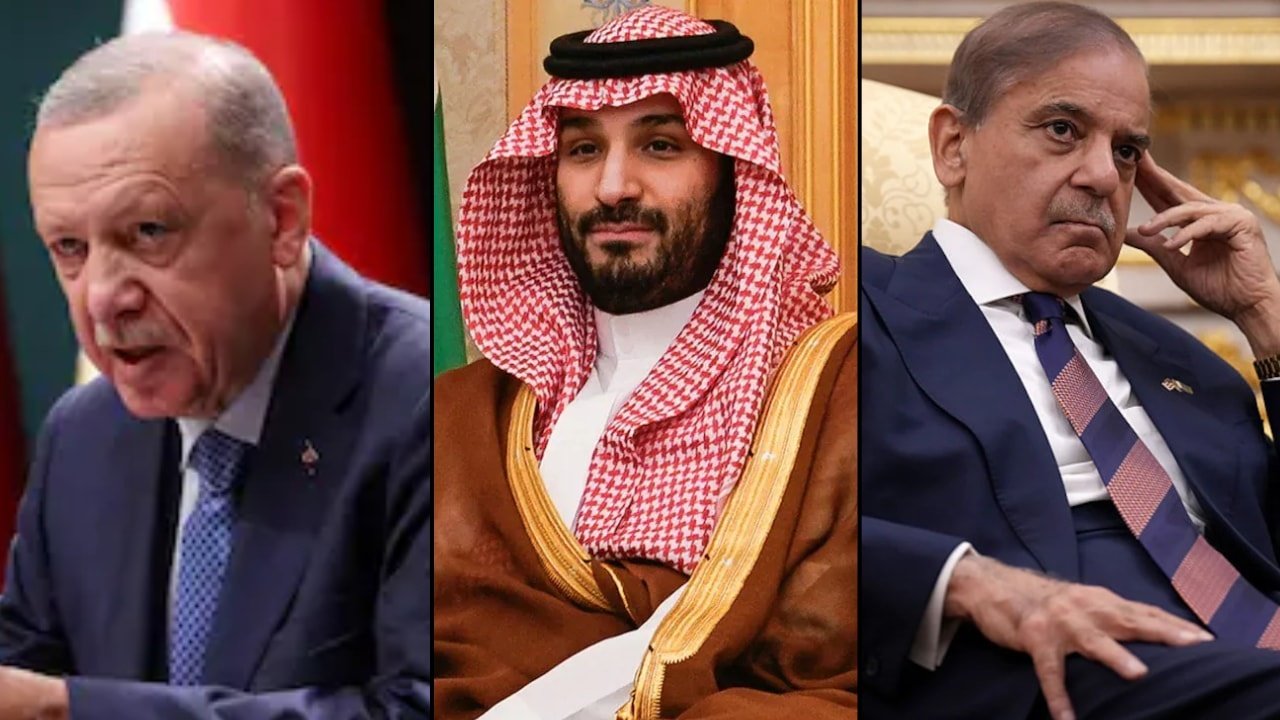
In a major realignment of regional security dynamics, Pakistan, Saudi Arabia, and Turkey formally signed a collective mutual defense pact—titled the Makkah Joint Defence Agreement—establishing a trilateral security framework across the Middle East and South Asia.
Signed at the Al-Safa Palace in Mecca following a trilateral summit, the historic accord commits all three signatory nations to treat an armed attack on any single member state as an attack against them all.
High-Level Leadership Summit
The treaty was formally executed during a summit convened by key regional leaders:
-
Saudi Arabia: Crown Prince Mohammed bin Salman
-
Turkey: President Recep Tayyip Erdoğan
-
Pakistan: Prime Minister Shehbaz Sharif (accompanied by Army Chief Field Marshal Asim Munir)
“The Agreement is intended to strengthen collective deterrence against any act of aggression, and stipulates that any armed attack against any one of the three States shall be regarded as an attack against them all.”
— Joint Statement, Ministry of Foreign Affairs
Convergence of Distinct Strategic Capabilities
The landmark pact unites three major regional powers, combining distinct economic, strategic, and defense capabilities:
-
Saudi Arabia: Represents immense economic weight, strategic oil reserves, and crucial maritime infrastructure along key trade corridors.
-
Turkey: Brings NATO’s second-largest standing army, advanced defense-industrial manufacturing, and sophisticated aerospace capabilities.
-
Pakistan: Contributes a formidable, battle-tested military force and remains the sole nuclear-armed state among Muslim-majority nations.
Strategic Drivers & Regional Context
The trilateral defense pact emerges against a backdrop of heightened regional volatility and shifting diplomatic alignments across the Middle East and Gulf regions:
-
Diversification of Security Partners: Facing recurrent drone and missile threats targeting energy and transport infrastructure, Riyadh has increasingly sought to broaden its security guarantees beyond traditional Western alliances.
-
Defense-Industrial Collaboration: The agreement builds upon prior bilateral deals—such as drone procurement and technology transfers between Ankara and Riyadh, alongside long-standing troop deployments and training partnerships between Islamabad and Saudi Arabia.
-
Scope of Cooperation: Beyond mutual military commitments, the treaty mandates expanded joint military exercises, defense technology sharing, strategic intelligence exchange, and coordinated maritime security protocols.
