

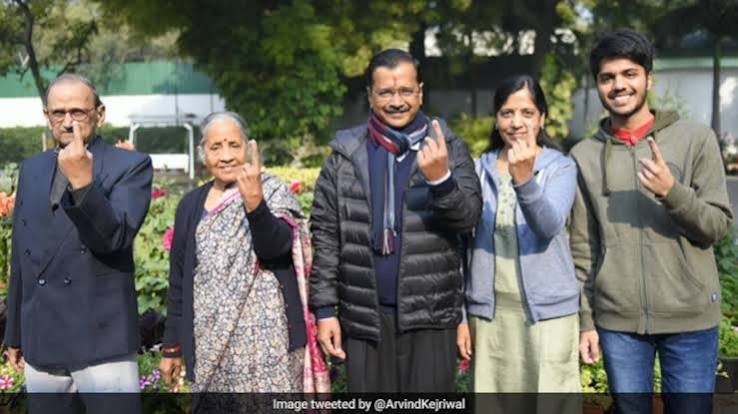
The Aam Aadmi Party (AAP) has triggered a political row by claiming that former Delhi Chief Minister Arvind Kejriwal and his family members have gone missing from the city’s electoral rolls. The dispute centers around notices issued as part of the Election Commission’s (EC) ongoing Special Intensive Revision (SIR), prompting a prompt technical clarification from poll authorities.
The Controversy and AAP’s Objections
The controversy erupted after checks on the Delhi election department portal revealed that notices under the SIR framework had been issued to the Kejriwal household in the New Delhi constituency. Alongside Arvind Kejriwal, the notices cover his wife Sunita Kejriwal, his parents Gobind Ram Kejriwal and Gita Devi, and his son Pulkit—all of whom cast their votes in previous Delhi elections.
Taking to social media, the party’s official handle expressed outrage: “How is it possible that the names of three-time Delhi Chief Minister Arvind Kejriwal Ji and his family members are missing from the Delhi voter list?”
Poll Body Responds: Mapping and Discrepancies
Addressing the claims, Election Commission officials clarified that the names have not been deleted, but rather flagged because they failed to map themselves accurately to the previous SIR database.
Delhi Chief Electoral Officer (CEO) Ashok Kumar explained that over 31.6 million notices have been generated across Delhi for two distinct categories of voters:
-
Unmapped Voters: Individuals who could not be directly linked with the electoral roll of the last revision.
-
Mapped Voters with Discrepancies: Individuals whose entries match, but contain minor logical inconsistencies, such as name spellings, date-of-birth gaps, or parent-age anomalies.
Current Delhi Chief Minister Rekha Gupta was similarly flagged under the Shalimar Bagh constituency due to a logical discrepancy—specifically, a parent-age difference of less than 15 years. However, local Electoral Registration Officers confirmed that her details have since been verified and cleared for the final electoral list.
Broader Context and Next Steps
The ongoing revision cycle has seen intense scrutiny following the publication of a draft voter list containing 9.75 million names, which followed the removal of roughly 4.7 million entries deemed absent, shifted, deceased, or duplicate.
The EC has emphasized that receiving a notice does not mean permanent disenfranchisement. Citizens whose entries are flagged can file claims and submit supporting documents via Form 6 during the active window running through September 30. Field teams and special camps are conducting hearings, with the final disposal of all notices slated for October 10 ahead of the final roll publication.
