

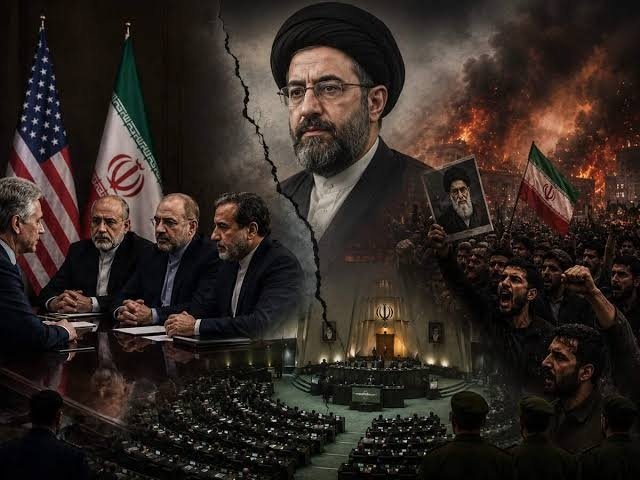
The death of Supreme Leader Ali Khamenei has plunged Iran into an intense internal power struggle, shattering the illusion of unity during his funeral and exposing deep fractures within the country’s ruling elite. Far from a solemn farewell, the transition period has sparked public outrage, with hardline factions turning aggressively against President Masoud Pezeshkian and senior officials over their diplomatic engagements with the United States.
Funeral Transformed Into Protest The depth of the divide became clear during Khamenei’s funeral procession in Tehran. Mourners targeted President Pezeshkian with chants of “death to the compromiser.” Foreign Minister Abbas Araghchi, a key figure in negotiating a recent, now-unravelling ceasefire and limited sanctions relief with the Trump administration, was forced to leave the event after being pelted with rocks by crowds labeling him a “traitorous sellout.” Hardline factions are furious that the current leadership chose diplomacy with Washington over direct military retaliation for Khamenei’s death.
A Missing Successor and Accusations of a Coup Exacerbating the political chaos is the conspicuous public absence of the new Supreme Leader, Mojtaba Khamenei, who succeeded his father. This silence has fueled speculation among radicals that senior officials are deliberately sidelining him. Analysts note that his absence has allowed Parliament Speaker Mohammad Bagher Ghalibaf and President Pezeshkian to effectively run the state, prompting ultra-hardliners to accuse them of orchestrating a domestic coup.
Hardline lawmakers have taken their grievances public. Mahmoud Nabavian questioned on social media whether a coup was underway, later pledging to “stand firm against the coup” while demanding vengeance. Another hardline parliamentarian, Kamran Ghazanfari, claimed leaders are systematically eroding the authority of the parliament and the supreme leader by shifting governing power to the Supreme Council for National Security.
Escalating Rhetoric and Direct Threats The political infighting has escalated into overt physical threats. During a public ceremony, security-linked religious singer Mohammad Ali Bakhshi issued a stark warning to the president, stating, “Mr. President, if the leader’s conditions are not fulfilled, then it will be us, the blade and your throat.” Despite widespread condemnation, no legal action has been taken against Bakhshi.
Collapsing Ceasefire and Systematic Purges The domestic rift has widened as the ceasefire with the United States disintegrates. The truce fractured following attacks on shipping lanes in the Strait of Hormuz by Iran’s Revolutionary Guards, drawing U.S. military retaliation. Hardliners are using the escalation to push for total abandonment of the diplomatic track, with some former officials even suggesting the abduction of American soldiers from regional bases.
In response, Iran’s current leadership has begun systematically stripping radicals of their political influence. Nabavian and other staunch opponents of the U.S. agreement were recently purged from the parliament’s National Security Commission. Experts view this as a deliberate effort by Ghalibaf and Pezeshkian to marginalize volatile elements that pose too high a political cost during an already unstable transition.
While Iran’s core leadership remains focused on managing the conflict, securing sanctions relief, and maintaining control over vital shipping corridors, the persistent silence of Mojtaba Khamenei and the ideological fervor of the Revolutionary Guards continue to embolden a hardline camp eager for protracted confrontation with the West.
