

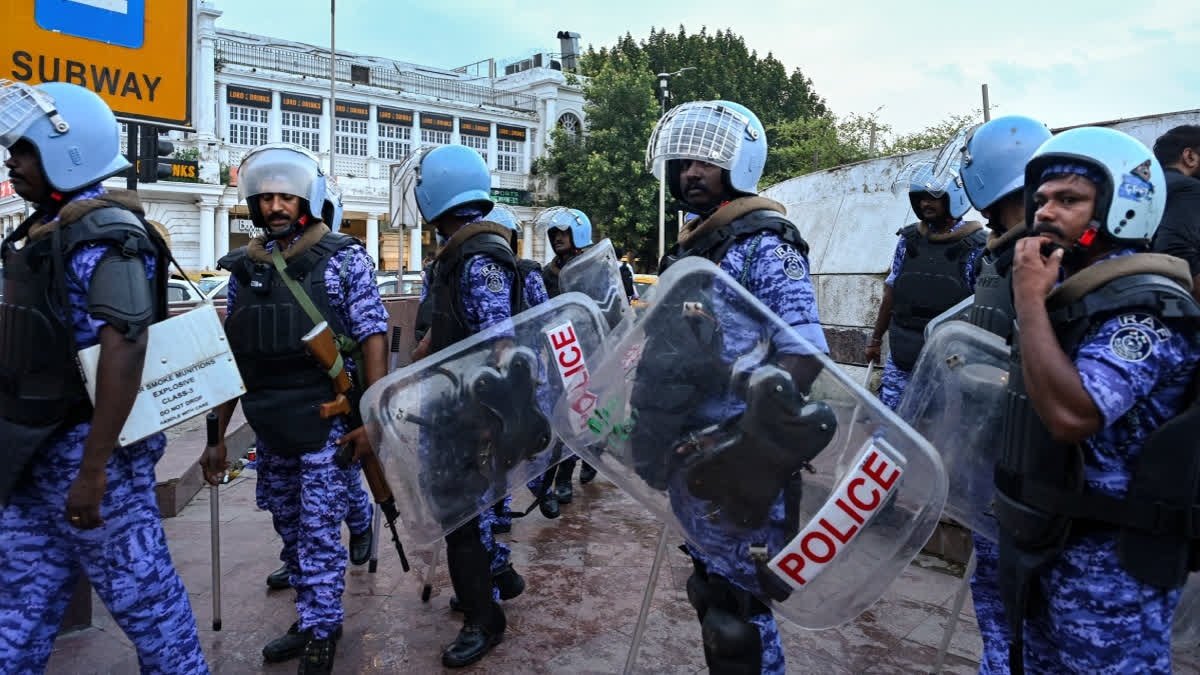
Following widespread public backlash over the deployment of non-lethal pellet guns during anti-paper leak demonstrations in the capital, CRPF Director General Gyanendra Pratap Singh delivers a decisive operational message to his force.
In the wake of intense political friction and public scrutiny over riot-control tactics in New Delhi, Central Reserve Police Force (CRPF) Director General Gyanendra Pratap Singh sent a clear signal down the chain of command: the leadership stands behind its officers.
Speaking at the CRPF’s investiture ceremony, Singh addressed personnel from both operational battalions and specialized riot-control units, assuring them that actions taken in good faith during law-and-order duties will be backed unconditionally at the highest administrative level.
“As the Director General of the CRPF, I want to assure each one of you that whether it is an operational battalion or a law-and-order unit, whatever decisions you take and whatever actions you carry out in the bonafide discharge of your duties, I take responsibility for all those decisions and actions… Continue to perform your duties fearlessly.”
— Gyanendra Pratap Singh, Director General, CRPF
Anatomy of the Contretemps
The controversy stems from the July 20 “Sansad Chalo” march organized in New Delhi over national exam paper leaks. As demonstrators marched toward Parliament near Jantar Mantar and Connaught Place, clashes broke out between protesters and security teams.
To disperse the crowd, the Rapid Action Force (RAF)—the specialized anti-riot wing operating under the CRPF—deployed tear smoke, water cannons, and Pump Action Guns (PAGs) firing non-lethal plastic pellets.
The use of pellet-firing anti-riot guns drew immediate heat from civil rights advocates, student groups, and opposition leaders after reports surfaced that multiple civilians had sustained injuries, with at least one protester facing severe eye trauma.
Concurrently, official records showed that the violence was far from one-sided: 47 RAF personnel were injured during the clashes, with several officers sustaining head injuries and fractures from iron rods and stones hurled from the crowd.
The Post-Event Assessment: SOP in Motion
While extending absolute backing to field officers, Singh confirmed that a “professional post-event assessment” is underway to audit the operation. Standard Operating Procedure (SOP) within the CRPF mandates an internal review after high-intensity operations to ensure tactical discipline.
What the Internal Review Is Examining:
-
Authorization & Mandate: Evaluating official police station General Diary entries to confirm whether pellet deployment was ordered by local command authorities.
-
Proportionality & Force Gradient: Determining if the team strictly adhered to the escalation ladder before resorting to Pump Action Guns.
-
Infiltration & External Provocation: Assessing intelligence reports regarding whether violent elements infiltrated the peaceful student demonstration, forcing field commanders to act under duress.
Operational Reality: The Fine Line in Modern Policing
The CRPF’s vast mandate spans anti-Maoist jungle warfare via its elite CoBRA unit, counter-insurgency in volatile zones, and urban crowd control through the RAF. Modern urban policing, however, presents a unique challenge: decisions must be made in fractions of a second under extreme physical provocation, often under the glare of mobile cameras and public scrutiny.
By asserting full personal accountability, the CRPF top command aims to prevent operational paralysis among ground personnel, ensuring field commanders retain the confidence to act decisively while internal review mechanisms verify that established protocols are maintained.
