

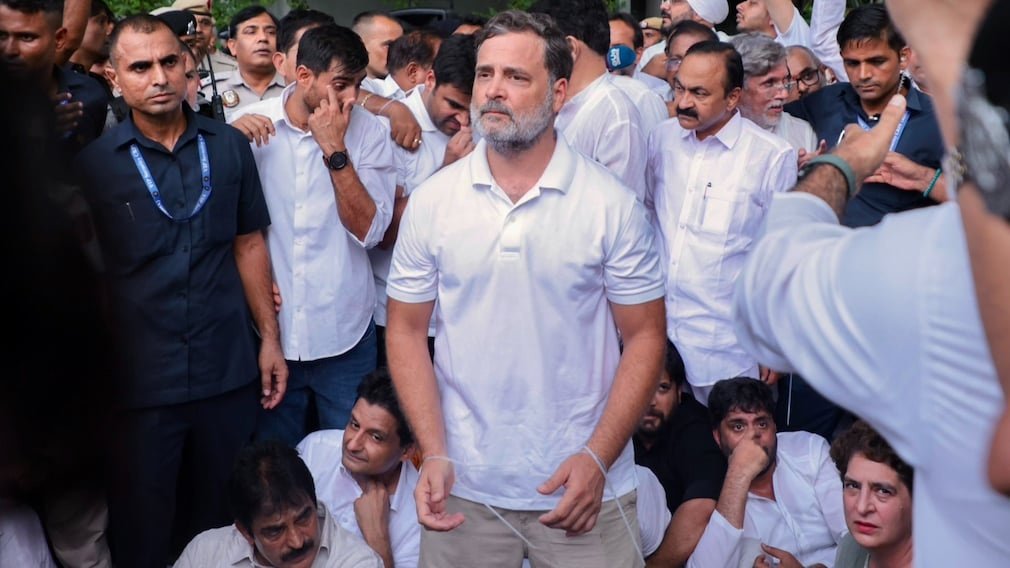
There is a long-standing habit in Indian Opposition politics: mistaking proximity to public anger for ownership of it. Whenever a protest gathers critical mass, political leaders arrive with predictable urgency. They sit on the dharna carpet, condemn the government, visit the injured, offer legal aid, and ensure the cameras capture their solidarity. None of this is inherently illegitimate—standing with citizens confronting state power is a fundamental role of an opposition.
However, the rapid rise of the Cockroach Janta Party (CJP) student agitation has raised a far more uncomfortable question: Why did tens of thousands of young Indians feel compelled to invent a new political language before the Opposition began listening?
A Protest Born in a Political Vacuum
The CJP did not emerge from a traditional party cadre or youth wing like the NSUI, Yuvajan Sabha, or CYSS. It grew as an irreverent, digitally native expression of youth frustration that attached itself to core structural issues: examination paper leaks, systemic unemployment, corruption, and the erosion of merit.
When students took to Delhi’s streets—facing batons, tear gas, and joining hands with moral figures like Sonam Wangchuk—they forced the political apparatus to take notice. By July 22, Prime Minister Narendra Modi publicly promised strict action against exam malpractice, while Education Minister Dharmendra Pradhan signaled comprehensive structural reforms.
The Structural Reality:
The fact that an organic movement created entirely outside conventional political structures forced the government’s hand should alarm the Opposition more than it comforts them.
The Ambiguity Problem & Alliance Friction
The current unrest exposes deep contradictions within the INDIA bloc, where individual party strategies often undermine collective political credibility.
1. The Pawar Paradox: Mixed Signals
In modern, highly polarized politics, voters demand clarity. When leaders like Sharad Pawar and Supriya Sule join protests at Jantar Mantar one day, and meet PM Modi the next while family members sit on opposing political sides, it sends mixed messages. Strategic ambiguity—once hailed as tactical brilliance—can easily look like political uncertainty to voters seeking an unambiguous alternative to the ruling party.
2. AAP vs. Congress: Tactical Infighting
Instead of presenting a unified front, Opposition parties frequently compete to control the narrative. Following Rahul Gandhi and Priyanka Gandhi’s participation in protests over police action against students, leaders from the Aam Aadmi Party (AAP) accused the Congress of “sabotaging” the movement. This led to the absurd spectacle of one opposition party criticizing another for protesting against the government.
The Path Forward: Trust Over Appropriation
For Rahul Gandhi and the Congress, physical presence and willingness to face detention offer temporary visibility on emotive issues. However, the true test of long-term Opposition viability lies in building durable regional partnerships—most notably with Akhilesh Yadav’s Samajwadi Party (SP) ahead of crucial state elections like Uttar Pradesh in 2027.
Leadership within a coalition requires balancing national ambitions with regional humility. Congress must learn to think large nationally while accommodating regional strengths.
The Bottom Line
Public anger is not a transferable fixed deposit; an Indian citizen dissatisfied with the ruling government does not automatically become an opposition voter by default.
While the ruling party faces clear public discontent over governance issues like paper leaks and jobs, the Opposition faces a credibility deficit. Until Opposition leaders demonstrate consistent coordination, mutual trust, and genuine alignment with grassroots movements, they will remain observers rather than beneficiaries of public outrage.
