

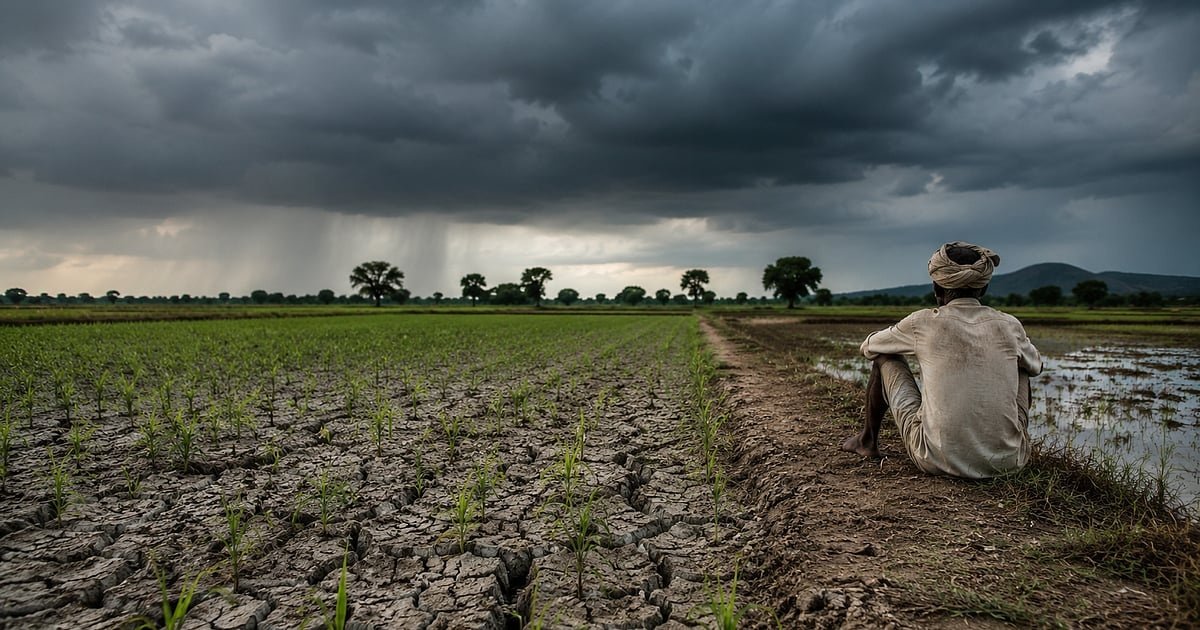
The arrival of the Southwest Monsoon across the entirety of India on July 9—just one day behind its structural timeline—marks a significant turning point for the agricultural calendar. By expanding across the north Arabian Sea, Rajasthan, Haryana, and Punjab, the active spell has rapidly repaired June’s severe 33% rainfall deficit, compressing it down to 17% by July 7.
Consequently, the tally of rain-deficient districts has dropped sharply from 262 to 178. Yet, beneath the headlines of rain-soaked metros lies a stark structural friction: Kharif crop sowing is lagging behind last year’s metrics by a massive 91.95 lakh hectares, constrained by poor reservoir storage levels and the looming atmospheric shadow of a persistent El Niño cycle.
The Agricultural Sowing Deficit at a Glance
The spatial and temporal distribution of rainfall in June directly dictates early-stage agricultural patterns. Because early moisture was sparse, total initial sowing stood at 350.85 lakh hectares, forcing a major drag on the rural economy.
-
Cash Crop Impact: The initial delay has disproportionately impacted long-duration, moisture-sensitive cash crops like soybean and cotton. Farmers in primary belts are hitting a tight biological window to plant these varieties without risking late-stage yield degradation.
-
The Input Reservoir Crutch: Even as rain intensity escalates, the water storage across 166 major national reservoirs is significantly lower than last year’s baseline. This limits the buffer capacity of canal-irrigated agricultural zones if the monsoon experiences another localized break later in July.
State-Level Interventions and Vulnerability Mapping
Union Agriculture Minister Shivraj Singh Chouhan has initiated continuous monitoring across 13 core agrarian states: Maharashtra, Madhya Pradesh, Gujarat, Uttar Pradesh, Rajasthan, Karnataka, Bihar, Jharkhand, Telangana, Andhra Pradesh, Punjab, West Bengal, and Odisha.
The strategy focuses on 262 vulnerable districts alongside 15 acute high-deficiency zones to deploy localized mitigation tactics:
1. The Seed Reserve & Crop Switching Strategy
To actively combat the brief sowing window, the Indian Council of Agricultural Research (ICAR) has put contingency models into effect. Farmers are being legally and operationally advised to shift away from traditional long-duration seeds toward short-duration, less water-intensive alternatives like maize, bajra, and moong. To back this up, a national seed reserve of 1.75 lakh quintals of climate-resilient seeds has been unlocked for swift distribution.
2. Credit Injection and Risk Insulation
Recognizing that dry spells trap smallholders in credit squeezes, the Ministry of Agriculture has accelerated its Kisan Credit Card (KCC) approval framework, clearing over 94,000 out of 1.14 lakh financial applications. Concurrently, the operational reach of the Pradhan Mantri Fasal Bima Yojana (PMFBY) is being systematically scaled up across the 13 monitored states to establish an immediate safety net against direct crop failure.
3. The El Niño Monitoring Infrastructure
Because current climate models indicate that lingering El Niño anomalies continue to disturb atmospheric circulation, the government has institutionalized a multi-tiered defense system. The El Niño Monitoring Cell and the Crop Weather Watch Group are working alongside state-level control rooms to track market pricing, soil moisture indices, and localized rainfall patterns on a daily basis.
The Macro Outlook: While the drop in the absolute rain deficit provides major relief, the next 15 days are critical. If the monsoon picks up speed through mid-July as forecasted by the IMD, the gap in Kharif sowing could shrink rapidly. However, if structural distribution remains uneven, the shift toward lower-yielding alternative crops will likely alter rural income dynamics and food inflation trajectories heading into the second half of the fiscal year.
