

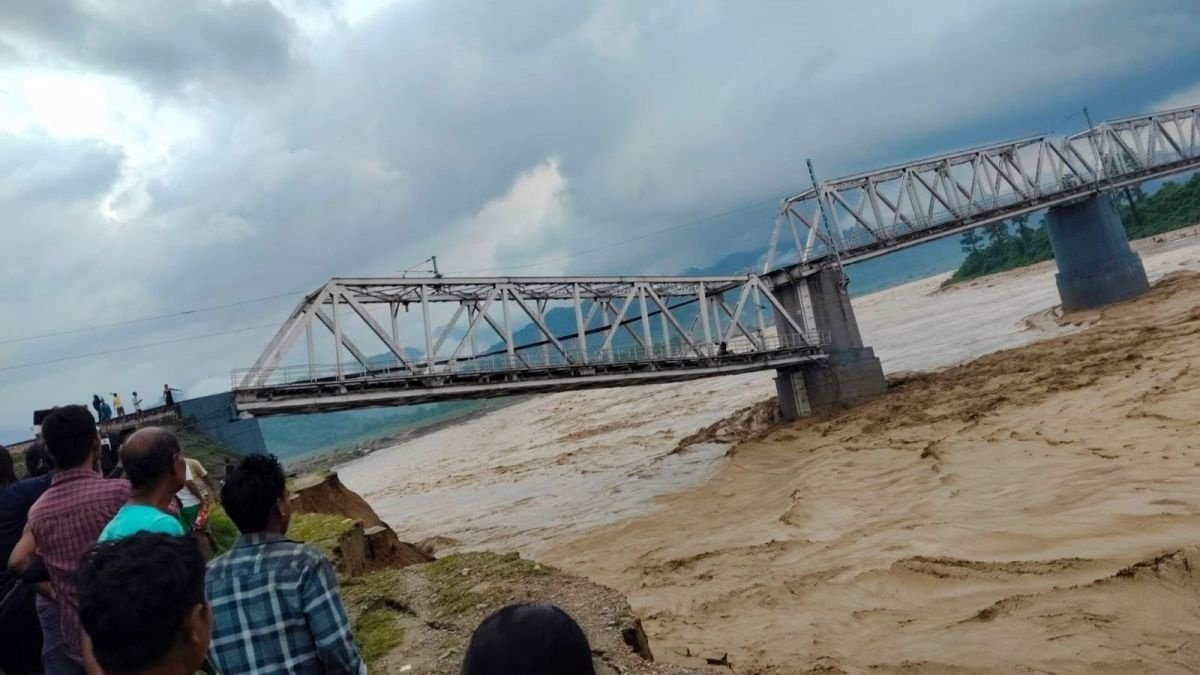
The torrential downpours on June 27–28 completely overwhelmed local river systems, causing critical structural failures at two separate transit points in Jonai and Dhemaji.
1. The Simen River Railway Bridge (Partial Collapse)
-
The Structure: Originally built in 1965 and later upgraded to support broad gauge operations, this bridge under the Tinsukia division of Northeast Frontier Railway (NFR) was structurally sound before the deluge.
-
The Failure Mechanism: The collapse wasn’t a failure of the bridge’s framework itself, but rather a catastrophic failure of the surrounding geology. Incessant rains caused massive riverbank erosion. With a large chunk of the riverbank washed away by raging currents, one of the main foundation piers became destabilized and tilted, rendering the tracks completely unsafe.
-
Casualties: Fortunately, because the NFR had already halted traffic on this low-frequency branch line due to rising water levels, no train was on the bridge, and zero injuries were reported.
2. The Chille/Kemi River Iron Road Bridge (Washed Away)
-
The Structure: A 300-metre-long iron bridge constructed just over a year ago by the local administration to provide crucial rural road connectivity between Kemi, Oyan, and Purana Jelem villages.
-
The Failure Mechanism: Around 11:00 AM on Sunday, water levels rose exponentially within a 30-minute window due to sudden flash flood runoffs from Arunachal Pradesh. By 11:30 AM, the overflowing current physically ripped the structure from its anchors and washed it downstream.
-
Local Grievance: Local residents have expressed immense frustration, pointing out that during its construction, they explicitly warned authorities against using a light iron assembly. Given the historically high velocity of the Kemi River during peak monsoons, the community had aggressively campaigned for a permanent, reinforced concrete bridge.
Immediate Logistical Impact & Emergency Response
The double bridge failure has completely severed Jonai Sadar from surrounding rural pockets and suspended the primary rail link to the far-eastern corner of Assam.
[Silapathar Station] <=== Active Rail Zone ===> [Archipathar Station] <=== SUSPENDED RAIL (Simen Bridge) ===> [Simen Chapari Station] ---> [Murkongselek Terminal]
Emergency Rail Re-routing
To manage the gridlock, the Northeast Frontier Railway has activated the following emergency protocol:
-
Suspension Zone: All train operations between Archipathar and Simen Chapari stations are suspended until further notice.
-
Short-Termination: Trains tracking along the Murkongselek–Silapathar route will now short-terminate and short-originate exclusively out of Silapathar station.
-
Alternative Inter-Modal Transit: For stranded passengers who still need to travel the remaining distance toward Murkongselek, the railway authorities have deployed a fleet of dedicated emergency operational buses.
-
Passenger Support: Active physical helpdesks have been established at Dhemaji, Silapathar, and Murkongselek stations to coordinate ticketing refunds, route assistance, and food/water distribution.
Socio-Economic Consequences for the Region
While the state government—led by Chief Minister Himanta Biswa Sarma—has deployed a “whole-of-government” approach with Ministers camping on-site to monitor the damage, the regional impact remains severe:
-
Educational Disruption: The washed-out iron bridge has cut off the only school in the area for students from Kemi village. With critical school examinations scheduled to commence shortly, students face a dangerous commute across high-velocity floodwaters.
-
Agricultural Paralysis: We are currently in the peak monsoon sowing season. Farmers whose agricultural fields sit on the opposite bank of the river are completely cut off from their livelihoods until temporary footbridges or ferry services can be arranged.
-
Broader Flood Crisis: Dhemaji is historically one of Assam’s most flood-vulnerable zones. This early wave has already impacted over 20,000 people across Upper Assam, with low-lying areas in Lakhimpur, Biswanath, and Dibrugarh also bracing for downstream overflow.
