

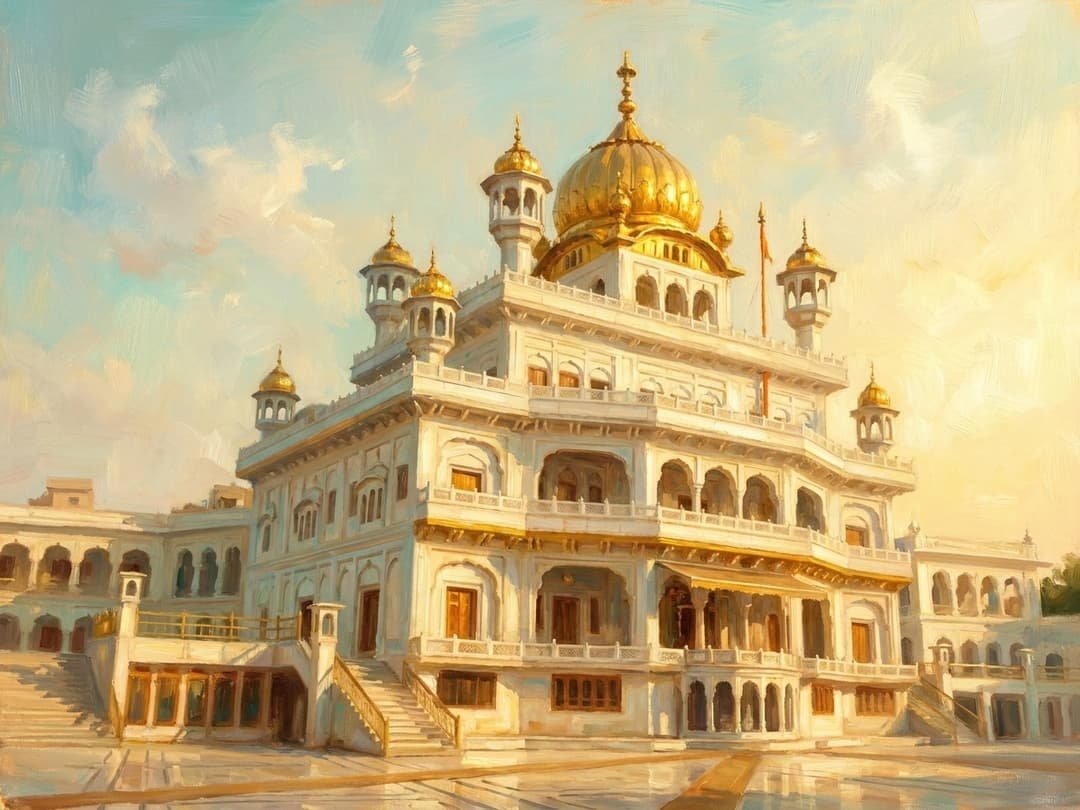
The high-stakes proceedings at the Akal Takht in Amritsar highlight a profound, centuries-old aspect of Sikh governance.
With Punjab’s Sikh MLAs and Cabinet ministers appearing in person at the Secretariat—and non-Sikh legislators submitting written clarifications—the immediate focus centers on the contentious Jaagat Jot Sri Guru Granth Sahib Satkar (Amendment) Act, 2026. However, understanding why the supreme temporal seat of Sikhism wields the power to call elected rulers to account requires looking past the immediate political friction.
1. The Foundation: The Principle of Miri-Piri
Established in 1609 by the sixth Sikh Guru, Guru Hargobind Sahib, the Akal Takht (“Throne of the Timeless One”) sits directly facing the Harmandir Sahib (Golden Temple). Its positioning and creation formalised the foundational Sikh concept of Miri-Piri, represented by the two swords Guru Hargobind wore:
-
Piri (Spiritual Authority): Embodied by the Harmandir Sahib, representing devotion, humility, inner peace, and spiritual reflection.
-
Miri (Temporal Responsibility): Embodied by the Akal Takht, representing justice, societal governance, courage, and the defense of collective dignity.
Under this doctrine, faith and politics are not entirely segregated. Instead, spiritual values are meant to actively guide worldly actions to combat injustice and oppression.
2. The Nature of an Akal Takht Summons
A summons from the Akal Takht is fundamentally different from an order issued by a constitutional court. It is an exercise of moral and religious accountability, not legal coercion:
-
Not an Automatic Verdict: A summons is not a declaration of guilt. Rather, it is an institutional forum allowing an individual to explain their conduct or legislative actions before the Panth (the collective Sikh community).
-
Universal Accountability: Because spiritual law supersedes worldly rank, no individual—whether an ordinary devotee, a billionaire, or a sitting Chief Minister—is exempt from the uniform code of conduct (Sikh Rehat Maryada).
3. Decisions and Atonement: Tankhaiya and Tankhah
When a violation of religious discipline is identified, the decision is collectively reached by the Five Singh Sahibans (the senior religious functionaries heading the five major Takhts).
The current tension involving the Aam Aadmi Party (AAP) government is part of a long historical continuum. Throughout the centuries, immense political power has never granted immunity from religious oversight:
-
Maharaja Ranjit Singh (Early 19th Century): The sovereign emperor of the vast Sikh Empire submissively presented himself before Jathedar Akali Phula Singh to accept religious discipline over a personal conduct lapse, demonstrating that the crown bowed to the Takht.
-
President Giani Zail Singh (1984): The sitting President of India submitted formal clarifications to the Akal Takht to explain his position and actions during the turbulent events of Operation Blue Star.
-
Chief Minister Surjit Singh Barnala (1988): Following a controversial police entry into the Golden Temple complex, the Punjab Chief Minister was declared a tankhaiya and spent days publicly dusting the shoes of ordinary pilgrims as penance.
-
Sukhbir Singh Badal (2024): The former Deputy Chief Minister was declared a tankhaiya for political actions taken during the SAD-BJP regime, undergoing rigorous community service at the Golden Temple.
The 2026 Constitutional Intersection
The friction surrounding the Satkar Act, 2026 stems from a delicate boundary issue. The Punjab Assembly possesses the legal, constitutional mandate to pass anti-sacrilege laws prescribing harsh penalties like life imprisonment.
However, the Akal Takht and the SGPC argue that because the law directly dictates how the Saroops (physical forms) of the Guru Granth Sahib are managed and registered, the legislature should have formally consulted the community’s primary custodian institutions beforehand. The current proceedings are an institutional effort to balance sovereign legislative independence with traditional religious autonomy.
