

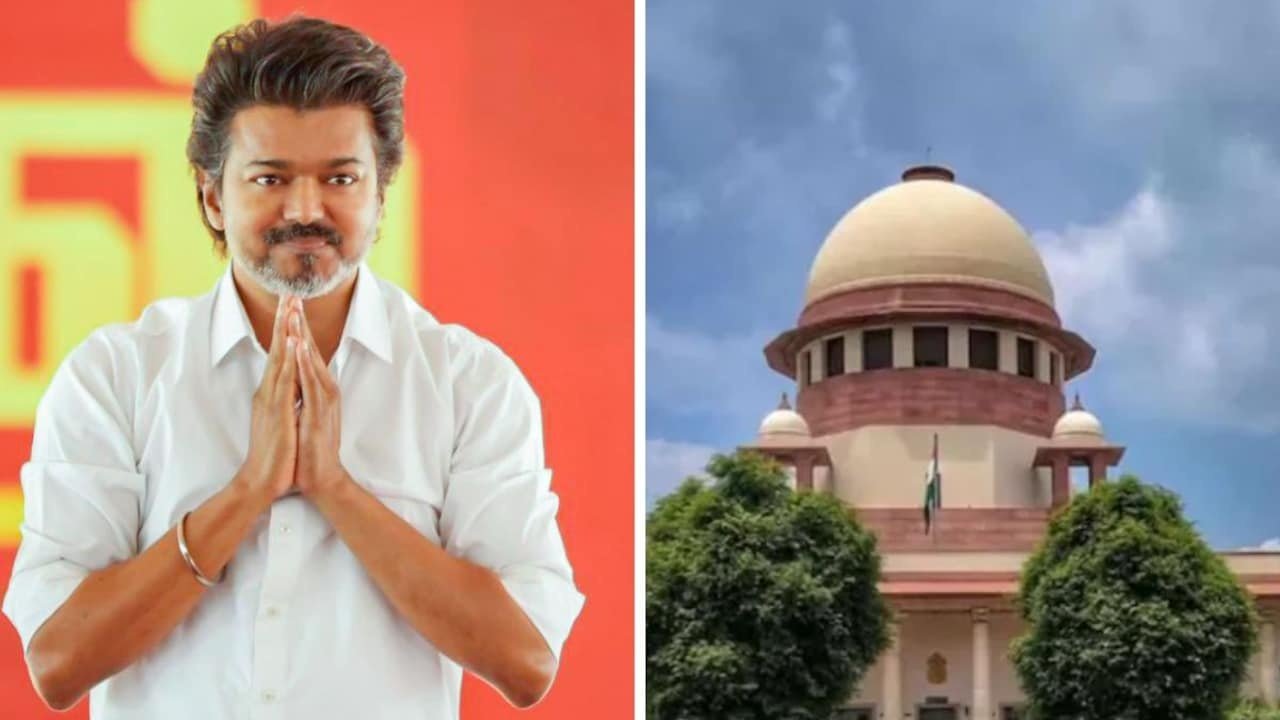
The Supreme Court of India sharply criticized the Dravida Munnetra Kazhagam (DMK) on Tuesday, dismissing its petition to restrict the public speeches and official visits of Tamil Nadu Chief Minister Joseph Vijay.
A bench comprising Justice KV Viswanathan and Justice Alok Aradhe expressed strong displeasure over the application, rebuking the opposition party for attempting to use the top court as a battleground to settle political scores. Following the court’s stern observations, the DMK withdrew its plea.
The Court’s Sharp Observations
The apex court heavily questioned the DMK’s legal logic regarding an injunction on free speech, noting that Chief Minister Vijay is not an accused in the matter.
“What exactly are you trying to say? You want the Supreme Court to dictate what a chief minister should do? How does the Supreme Court, in a matter where the CBI has been appointed to investigate, give orders against a political rival’s statement?” the bench asked DMK General Secretary RS Bharathi.
Context of the Dispute: The Karur Stampede Case
The legal friction stems from an ongoing investigation into the tragic September 2025 Karur stampede, which resulted in 41 deaths after a massive crowd gathered for Vijay’s political campaign speech.
-
The DMK’s Stance: The DMK, which held power at the time of the tragedy, alleged that the stampede resulted from “reckless and uncoordinated actions” and a “deliberate display of political power” by organizers from Vijay’s party, the Tamila Vettri Kazhagam (TVK).
-
The TVK’s Defense: Chief Minister Vijay and the TVK have consistently called the allegations a political conspiracy orchestrated by the DMK. The Central Bureau of Investigation (CBI) took over the probe following a Supreme Court directive, and Vijay has co-operated with multiple rounds of federal questioning.
Trigger for the Urgent Plea
The DMK moved the top court on an urgent basis ahead of Chief Minister Vijay’s scheduled July 10 visit to Karur, where he is slated to distribute employment letters and financial compensation to the victims’ families.
The opposition argued that the high-profile visit, alongside recent combative remarks by TVK leader Aadhav Arjuna accusing the DMK of police brutality during the incident, could be construed as an attempt to influence witnesses involved in the active CBI investigation. The Supreme Court decisively rejected this intervention, maintaining that political rhetoric cannot be regulated by judicial decree during an active federal inquiry.
