

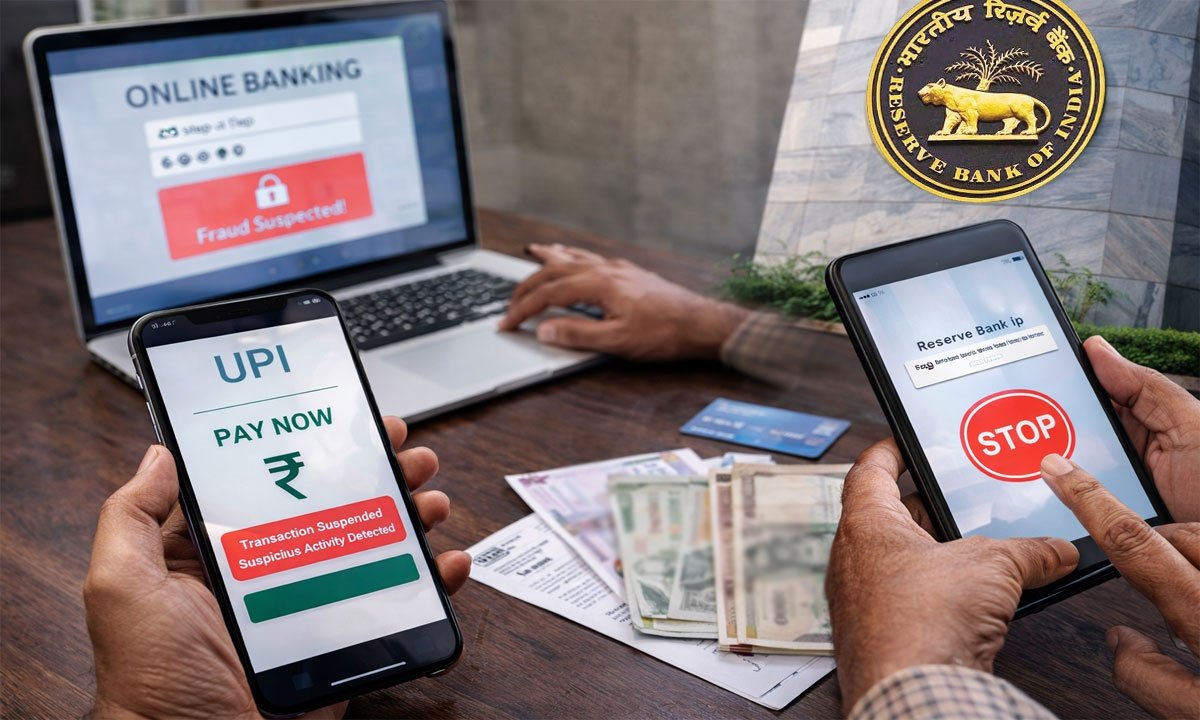
As India’s digital payment volume skyrockets, the Reserve Bank of India (RBI) is prioritizing security over speed for high-value transactions. A new discussion paper, ‘Exploring safeguards in digital payments to curb frauds’, outlines significant changes aimed at stopping “Authorised Push Payment” (APP) scams, where users are tricked into voluntarily sending money to fraudsters.
1. The One-Hour “Cooling Off” Window
To prevent instantaneous financial loss, the RBI proposes a mandatory one-hour delay for peer-to-peer (P2P) transfers exceeding ₹10,000.
-
Scope: Applies to UPI, IMPS, NEFT, RTGS, mobile wallets, and net banking.
-
How it works: Your bank debits the amount immediately, but the funds aren’t released to the recipient for 60 minutes.
-
The “Undo” Button: During this hour, you retain the right to cancel the transaction if you realize you’ve been scammed.
-
Whitelisting: To ensure convenience for regular payments, users can “whitelist” trusted contacts to bypass this delay.
2. Enhanced Protection for Senior Citizens
Recognizing that senior citizens and differently-abled individuals are often primary targets for digital theft, the RBI is proposing a “Trusted Person” protocol for transactions over ₹50,000.
-
Dual Authentication: A secondary layer of approval from a designated “trusted person” will be required to finalize large transfers.
-
Security Period: Any change to the appointed trusted person will trigger a 24-hour cooling period to prevent scammers from quickly swapping themselves into the role.
3. The “Kill Switch” & Granular Controls
The RBI wants to give customers total sovereignty over their bank accounts through a one-stroke kill switch.
-
Emergency Lockdown: If you suspect your account is compromised, the kill switch will instantly disable all digital payment channels.
-
Reactivation: To turn digital payments back on, users would likely need to undergo rigorous authentication or visit a bank branch in person.
-
On/Off Controls: New account-level settings will allow users to toggle specific transaction types (like international or high-value transfers) on or off, similar to current credit card controls.
4. What Remains Unchanged?
To avoid disrupting the economy and daily life, the RBI has exempted several transaction types from these new delays:
-
Merchant Payments: Buying groceries or shopping online via UPI or cards.
-
Recurring Payments: Automated bill payments and subscriptions.
-
Cheque-based Transactions: Traditional physical banking.
Why the Shift?
With digital payments increasing 38-fold in the last decade, the speed of UPI has become its greatest vulnerability. Scammers often disappear with funds before a victim even realizes they’ve been duped. By introducing “friction” for large, non-routine payments, the RBI is attempting to strike a balance between a digital-first economy and a secure one.
