

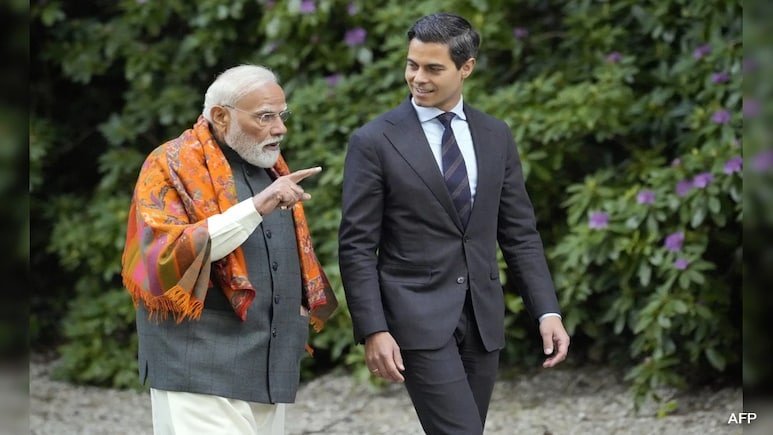
New Delhi has firmly rejected reported remarks by Dutch Prime Minister Rob Jetten regarding a decline in India’s media freedom and the erosion of minority and religious rights. Responding to the criticisms during Prime Minister Narendra Modi’s official two-day visit to the Netherlands, India’s Ministry of External Affairs (MEA) asserted that the nation remains a “vibrant democracy” and attributed the Western critique to a fundamental “lack of understanding” of India’s civilizational depth.
The diplomatic pushback occurred at a press briefing in The Hague when a Dutch journalist questioned why there was no joint press interaction scheduled between the two heads of state, while simultaneously bringing up domestic reports concerning the safety of Muslim and smaller minority communities in India.
“Learn More About India”: MEA Secretary Sibi George’s Rebuttal
Sibi George, Secretary (West) in the Ministry of External Affairs, led the response, emphasizing that India’s vast plurality is deeply rooted in five millennia of history rather than modern political mandates.
“We face these kinds of questions basically because of the lack of understanding of the person who asks the question,” George stated, urging international observers to study the country’s demographic and cultural evolution before passing judgment.
The Diplomat’s Historical Evidence for Pluralism:
-
Birthplace of Global Faiths: George highlighted that India is the unique cradle of four of the world’s major religions—Hinduism, Buddhism, Jainism, and Sikhism—all of which continue to actively flourish.
-
A Sanctuary from Persecution: He noted that the Jewish faith has coexisted peacefully in India for over 2,500 years without ever facing systemic persecution. He added that Christianity arrived immediately after the resurrection of Jesus Christ, and Islam took root during the lifetime of the Prophet Muhammad himself.
-
Demographic Growth: Addressing the core accusation of minority suppression, George pointed to statistical growth: “When we became independent, the minority population in India was 11 per cent. Now it is more than 20 per cent. Name a country where the population of minorities has gone up? You won’t find it anywhere other than India.”
Economic Upliftment Through the Ballot Box
Defending India’s democratic machinery, the MEA highlighted that the country has consistently managed a peaceful transition of power across its massive electorate. Citing recent regional assembly polls where voter turnout crossed the 90% threshold in several pockets, the diplomat argued that India’s democratic foundation remains uncompromised.
Furthermore, the ministry stressed that India has achieved historic macroeconomic success and lifted millions out of poverty exclusively through constitutional and democratic processes, rather than authoritarian coercion or state-sponsored violence.
What Sparked the Confrontation?
| Source | Reported Statements & Diplomatic Context |
| De Volkskrant (Dutch Daily) | Reported that Dutch PM Rob Jetten told journalists in The Hague right before his bilateral meeting that the Dutch government harbored active concerns regarding press freedoms and that minority rights “are under severe pressure” in India. |
| Rob Jetten (Official Statement) | Curated a softer stance publicly on social media, writing: “Both India and the Netherlands attach great importance to democracy, good governance and a world order based on rules and justice.” |
| Bilateral Agenda | Beyond the political friction, discussions between Jetten and Modi covered ongoing geopolitical trade routes, technology sharing, and a long-running bilateral child custody dispute that has featured in previous diplomatic engagements. |
The MEA concluded its briefing by reiterating that India represents one-sixth of the global population but handles its complex social landscape through a resilient framework of rule of law, advising European partners to approach bilateral relations through a lens of mutual respect and objective appreciation for India’s growth trajectory.
