

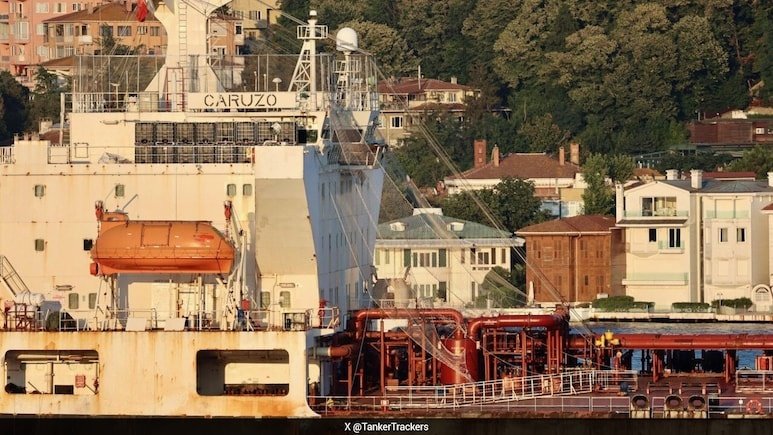
Faced with a relentless barrage from Ukrainian maritime and aerial drones, Russian commercial shipping in the Black Sea is resorting to extreme, dystopian defensive measures. In an attempt to safeguard vital oil tankers and infrastructure, Moscow’s vessels are now taking to the water draped in anti-drone netting, metal cage armor, and impact-absorbing water tanks.
Dystopian Defenses on the High Seas
The stark reality of these makeshift tactics was recently captured as the Caruzo—a 28-year-old tanker currently under UK and EU sanctions—navigated the Bosphorus strait. Footage analyzed by shipping expert Yoruk Isik revealed the vessel outfitted with anti-drone nets draped along its hull, stackable water tanks lining its sides, and a cage-like roof structure entirely enclosing the bridge.
“Mad Max movies have nothing that can top this,” noted Isik, who observed another sanctioned tanker, the Rizvel, operating under a similar blanket of protective netting in the Sea of Marmara.
These defense mechanisms, long seen on ground combat vehicles across the Ukrainian frontlines, operate on practical engineering principles:
-
Metal Cages (“Cope Cages”): Force warheads to detonate prematurely before penetrating a vessel’s primary hull or structure.
-
Water Tanks: Placed strategically along the hull to absorb the explosive force and shrapnel from incoming strikes.
-
Protective Netting: Shields vulnerable areas—like the ship’s bridge—and physically entangles incoming First-Person-View (FPV) or aerial drones.
Samir Madani, co-founder of Tankertrackers.com, noted that crews have essentially “boxed themselves in,” adding succinctly: “The fear is real.”
Kyiv’s Escalating Maritime Campaign
These unconventional countermeasures come as Ukraine aggressively expands its strikes against Russian-linked shipping and energy networks. Kyiv’s strategy centers on deploying uncrewed surface vessels (sea drones), jet-powered aerial drones, and anti-ship missiles to target Russia’s “shadow fleet” and disrupt critical fuel supply lines feeding occupied Crimea and funding Moscow’s wartime economy.
The intensity of the offensive reached a new high following an overnight assault on Russia’s naval base at Novorossiysk. Ukrainian President Volodymyr Zelensky confirmed the operation involved a coordinated strike using anti-ship missiles, jet drones, and sea drones against Russian warships, air defense positions, and port infrastructure.
As the Black Sea turns into a high-stakes arena for drone warfare, commercial and military maritime operations in the region are being fundamentally reshaped—forcing even commercial oil tankers to look less like trading ships and more like heavily armored battle stations.
