

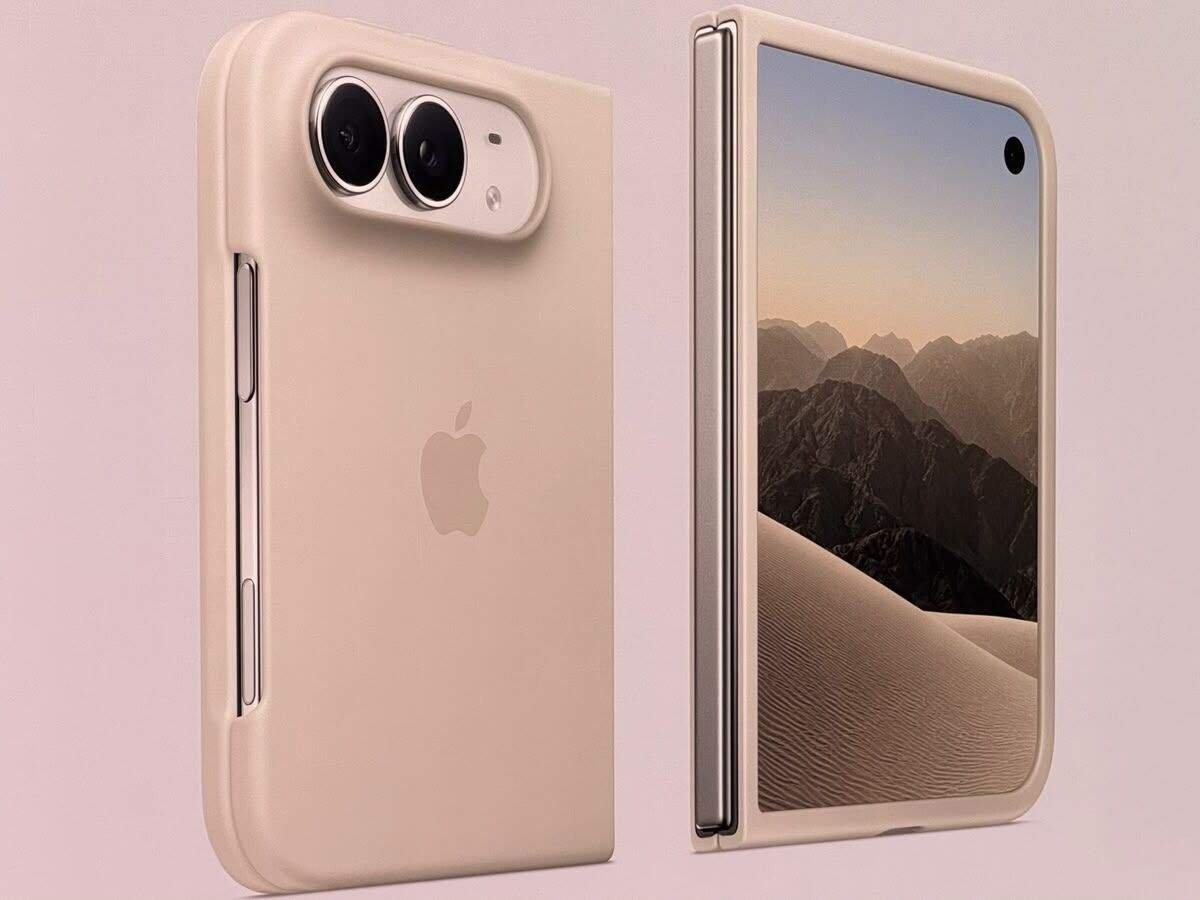
The Samsung Galaxy Z Fold series has officially met its most formidable rival. With Apple entering the book-style foldable arena with the launch of the iPhone Duo—priced at $2,000 in the US and a staggering ₹2,99,900 in India—the battle for foldable supremacy is officially on.
For years, Samsung has comfortably sat on the foldable throne, iterating through hardware designs, weight reductions, and software optimizations. But Apple’s luxury gamble changes the landscape. Pitting the brand-new iPhone Duo side-by-side with the refined Samsung Galaxy Z Fold 8 reveals how Cupertino’s newcomer stacks up against years of Android engineering.
Design and Build Quality: Engineering Philosophies Clash
Both devices embrace a book-style folding architecture, yet their execution diverges sharply:
-
iPhone Duo: Apple leans toward a slightly rounder, polished Grade 5 titanium enclosure. It relies on a custom-engineered hinge built with over 100 components reinforced by carbon fiber support plates, topped with next-gen Ceramic Shield protection. However, it carries a heavier footprint at 245 grams and a thickness of 5.4 mm when unfolded.
-
Galaxy Z Fold 8: Samsung utilizes years of iterative manufacturing to make the Z Fold 8 astonishingly thin at 4.5 mm unfolded and feather-light at 201 grams. Reinforced with a titanium-alloy film and plate directly beneath the OLED panel, it retains Samsung’s time-tested Armor FlexHinge system.
Display: Aspect Ratios and Continuity
Displays are where the two tech giants stake their biggest claims:
-
Internal Screens: Both feature vibrant 7.6-inch panels equipped with 120Hz refresh rates, nano-texture anti-reflective coatings, and 3000-nit peak brightness.
-
Cover Screens & Ratios: The iPhone Duo uses a 5.4-inch outer display with a consistent 4:3 aspect ratio across both screens, ensuring seamless app scaling whether open or closed. The Galaxy Z Fold 8 opts for a narrower outer display ratio (10:16) paired with a traditional 4:3 internal canvas. Notably, the iPhone Duo also introduces Touch ID built into the side button alongside Apple Pencil support for the inner canvas.
Performance: Cutting-Edge Silicon
Under the hood, both foldables pack industry-leading processing power:
-
iPhone Duo: Powered by Apple’s cutting-edge A20 Pro chip (built on a 2nm process), paired with an advanced vapor chamber system designed to sustain peak performance during heavy multitasking and mobile gaming.
-
Galaxy Z Fold 8: Runs on Qualcomm’s Snapdragon 8 Elite Gen 5 for Galaxy, paired with an expanded graphite cooling structure to easily handle intensive workloads and AI calculations.
Cameras and Smart Features
-
Camera Hardware: The iPhone Duo features a dual 48MP system (Primary $\text{f/1.6}$, Ultra-wide $\text{f/2.2}$) equipped with spatial capture capabilities and 4K video at 120 fps in Dolby Vision. The Galaxy Z Fold 8 relies on a 50MP dual-camera array (Primary $\text{f/1.8}$, Ultra-wide $\text{f/1.9}$).
-
Software Tools: Apple brings Smart Take AI photo capture and Duo FaceTime preview features to the foldable form factor. Meanwhile, Samsung leverages a mature suite of Galaxy AI features and multi-window power-user tools refined over multiple device generations.
The Verdict
Apple’s ₹3 lakh gamble is a masterclass in hardware ambition, offering a gorgeous, unified display experience and blistering A20 Pro performance. Yet, Samsung holds a commanding lead in ergonomics, engineering a significantly lighter and slimmer device backed by a mature foldable software ecosystem. Whether consumers will bite at Apple’s premium price tag depends on how seamlessly iOS handles the foldable transition when shipments begin.
