

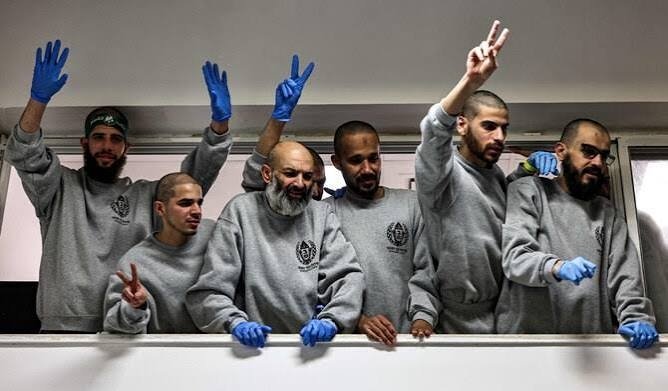
For years, Palestinian inmates in Israeli prisons relied on a clandestine method to build families from behind bars—secretly smuggling out sperm to conceive via IVF.
Following the 2025 Israel-Hamas prisoner exchange, many of these long-serving detainees were finally released. However, true freedom remains out of reach for hundreds of families. Under the terms of the exchange, Israel required that certain prisoners be deported directly to Egypt rather than being allowed to return home. Now, strict travel bans and Israeli security restrictions prevent their wives and children in the occupied West Bank from leaving to join them.
Families Divided by Exile
The structural reality of these deportations has turned hard-won freedom into a painful continuation of family separation:
-
The Case of Amjad al-Najjar: After serving a 10-year sentence during which his children—Akram (5) and Julia (2)—were conceived, al-Najjar was deported to Egypt in January 2025. Because of strict visitation laws, he has never held or met his children in person, relying entirely on phone calls from exile.
-
The Case of Ahmed Hamed: Released after 22 years in prison and exiled to Egypt, Hamed’s 10-year-old daughter, Bushra, managed to briefly cross borders to see him. However, upon returning to the West Bank, both Bushra and her aunt were detained and interrogated by Israeli intelligence. Meanwhile, his 22-year-old son, Baraa, has been repeatedly turned back at the Karameh border crossing with Jordan while trying to visit.
“A significant part of this freedom remained incomplete because the first meeting with my family didn’t happen as I had imagined,” Amjad al-Najjar told Al Jazeera. “That’s when I felt that the joy wasn’t complete.”
The Ultimate Separation
For some families, the restrictions outlasted life itself. Riyad al-Amour was exiled to Egypt after spending 23 years in an Israeli prison. While his wife managed to navigate the borders to reach him via Jordan, their five children and 12 grandchildren were completely barred from traveling.
Only months after gaining his freedom, al-Amour fell severely ill, slipped into a coma, and died in an Egyptian hospital in April. Even after his passing, his relatives in the West Bank remain barred from traveling to Egypt to stand at his grave.
A Widespread Humanitarian Impact
Data provided by human rights organizations highlights the broad scale of this systematic separation:
| Category | Documented Impact |
| Total Deported (2025 Exchange) | 383 prisoners forced out of the West Bank into exile. |
| Families Affected | At least 100 West Bank families currently barred from traveling to meet them. |
| Historical Travel Bans (2014–2025) | Over 8,700 bans logged by the Hurriyat center, targeting relatives and former detainees. |
Human rights organizations, including Al-Haq, have firmly stated that Israel’s policy of restricting the movement of these families heavily violates the fundamental international right to family reunification. Trapped in a logistical limbo, families like the Hameds are preparing to file petitions with the Israeli Supreme Court, though they face massive uncertainty over whether permissions will ever be granted.
