

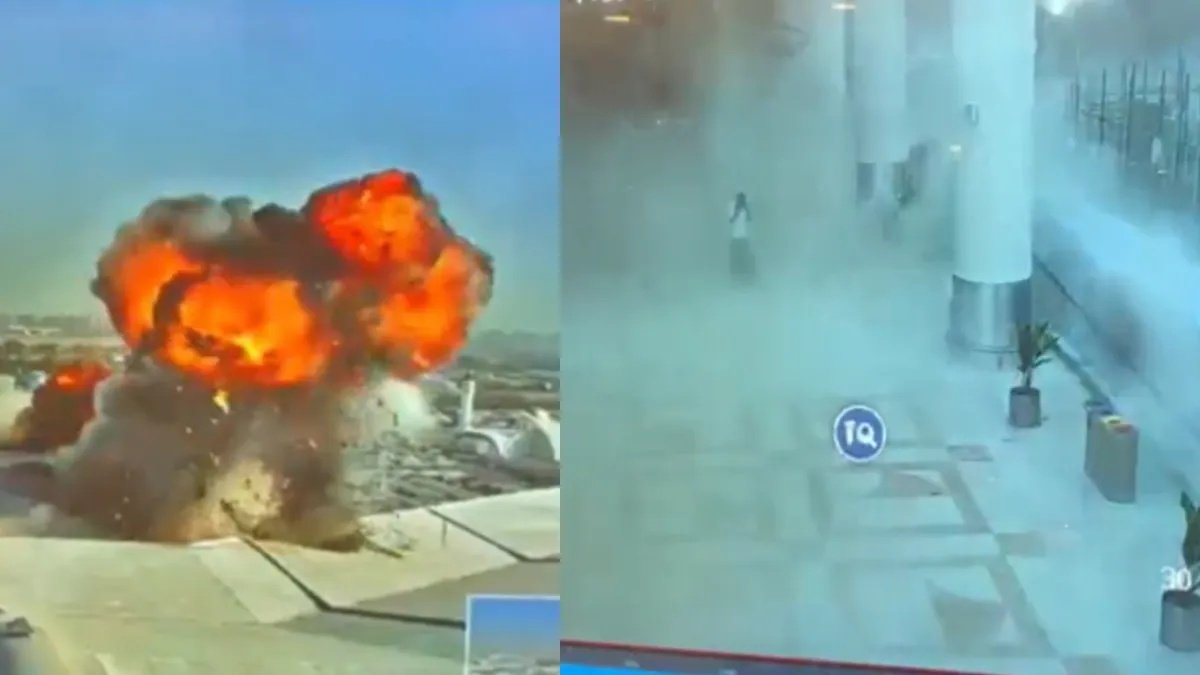
A fragile, month-old international ceasefire is facing its most dangerous breakdown yet after an explosive drone strike tore through Terminal 1 (T1) of Kuwait International Airport on Wednesday, June 3.
Kuwait’s General Directorate of Civil Aviation (DGCA) has publicly released chilling security surveillance footage documenting the exact moment the projectile pierced the airport infrastructure, sparking a massive ball of fire and triggering a catastrophic partial roof collapse inside the passenger terminal.
The attack, which Kuwaiti authorities have officially condemned as a “brutal and criminal Iranian aggression,” resulted in one fatality—confirmed to be an Indian national—and left at least 63 others wounded, forcing an emergency closure of the international airfield.
Conflict Escalation: The Claims and Counter-Claims
The strike marks a major geopolitical escalation, expanding the geographic theater of violence into Gulf nations that had previously positioned themselves as safe havens amid regional instability.
-
The Kuwaiti Position: The military has explicitly blamed Tehran for the devastation, calling the deployment of loitering munitions against a civilian aviation hub an indefensible act of aggression.
-
The Iranian Denial: The Islamic Revolutionary Guard Corps (IRGC) has vehemently denied intentionally targeting Kuwait. Instead, the IRGC claims that the terminal destruction was caused by a malfunctioning, US-made Patriot missile battery that failed to intercept inbound targets and fell catastrophically out of the sky.
-
The Broader Context: The IRGC simultaneously accused US forces of intentionally provoking the flare-up by carrying out strikes against an oil tanker and a vital military communications tower on Iran’s Qeshm Island.
International Impact & India’s Response
The tragedy has triggered an immediate diplomatic response from New Delhi. India’s Ministry of External Affairs (MEA) confirmed the death of the Indian citizen and noted that several other Indian expats were among the 63 injured passengers and airport workers.
Statement from the Indian Embassy in Kuwait: “The mission is closely coordinating with Kuwaiti authorities to render all possible support and assistance to the bereaved family in India and to provide comprehensive care for those who were injured in the attack.”
Status of the April 8 Ceasefire
The strikes represent the most severe structural test to date of the fragile international ceasefire brokered on April 8, 2026. The truce was initially established to pause a brutal month-long war ignited by joint US-Israeli bombings inside Iranian territory. While the ceasefire has largely restricted open warfare for nearly two weeks, this direct strike on a major international travel corridor signals that the proxy architecture in the region remains highly volatile.
