

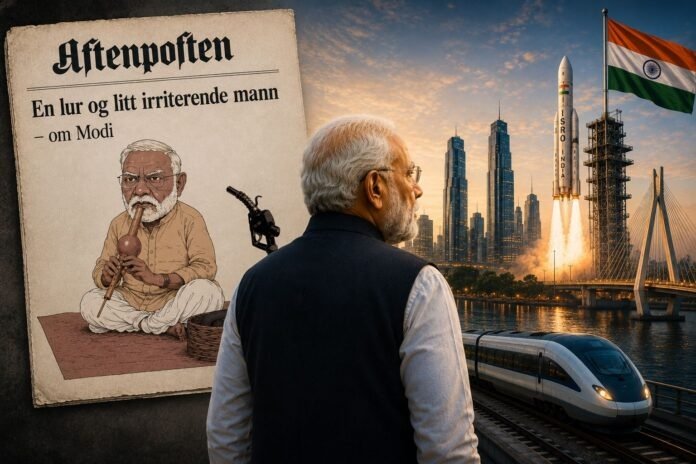
A sharp diplomatic row and intense social media backlash erupted following the publication of a political cartoon in Aftenposten, Norway’s largest print daily. The illustration, which depicts Indian Prime Minister Narendra Modi as a traditional snake charmer, has faced widespread condemnation online and in political circles for relying on outdated, racist colonial stereotypes.
The controversy comes amidst the final legs of Prime Minister Modi’s multi-nation European tour, further intensifying an already charged atmosphere surrounding international media engagement and diplomatic protocols in Oslo.
The Imagery in Question
The controversial illustration accompanied an analytical opinion piece written by prominent journalist Frank Rossavik ahead of the India-Nordic Summit. The article carried a title auto-translated from Norwegian as “A clever and slightly annoying man.”
-
The Visual Tropes: The cartoon portrays the Prime Minister sitting cross-legged and playing a pungi (a traditional wind instrument used by snake charmers) to charm a snake.
-
The Policy Context: Instead of a reptile, the snake is shaped explicitly into a fuel station pump nozzle. The visual was an apparent commentary on India’s management of domestic fuel prices and its multi-aligned foreign policy balancing global energy imports.
While neither the Prime Minister’s Office nor the Ministry of External Affairs (MEA) has released a formal state-to-state note, public reaction online was swift and overwhelmingly negative. Critics quickly noted the stark irony of the imagery, recalling PM Modi’s famous 2014 address at Madison Square Garden in New York, where he stated that a country once stereotyped by the West as a land of “snake charmers” had evolved into a digital powerhouse driven by IT professionals, or “mouse charmers.”
A Simmering Media Standoff in Oslo
The cartoon controversy landed directly into an ongoing dispute regarding press rules. Earlier in the week, Norwegian journalist Helle Lyng Svendsen publicly challenged Prime Minister Modi during a joint press appearance with Norwegian Prime Minister Jonas Gahr Støre, questioning why open floor queries were not permitted and citing international press freedom indices.
The Indian government issued a robust defense during a subsequent press briefing via senior diplomat Sibi George, who currently serves as Secretary (West) in the Ministry of External Affairs.
The Diplomatic Rebuttal
Sibi George, a highly decorated 1993-batch Indian Foreign Service (IFS) officer and former Ambassador to Japan and Switzerland, forcefully pushed back against external criticisms of India’s democratic and human rights record.
“People have no understanding of the scale of India,” Secretary George stated firmly during the media interaction. “They read one or two news reports published by some godforsaken, ignorant NGOs and then come and ask questions.
You know how many stories are up here in India? We have a lot of breaking news coming every day in the evening. At least 200 TV channels in Delhi alone… in English, Hindi, and multiple languages. We are proud to be a democracy; we have been a democratic society for centuries.”
Addressing broader foreign policy inquiries, the diplomat pointed directly to India’s institutional safeguards, noting that the Indian Constitution guarantees fundamental rights from day one of independence in 1947—including universal adult suffrage for women, which many Western democracies took decades longer to implement. He emphasized that robust legal remedies and independent courts exist for any citizen seeking constitutional redress.
