

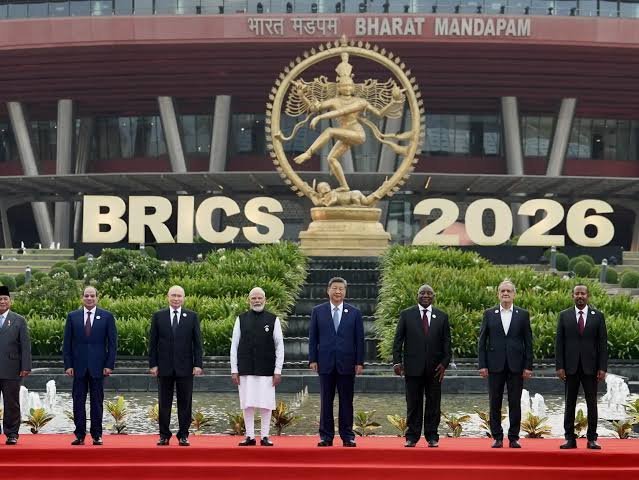
The 2026 BRICS New Delhi Declaration marks a fundamental shift in international climate diplomacy. By embedding debt, trade, technology, and global financial reform directly into its climate framework, the bloc has signaled that the Global South is no longer willing to act as a passive “rule-taker” in a green transition it is expected to finance.
Key Themes of the BRICS Climate Stance
-
Rewriting the Rules of the Global Economy: For three decades, international climate negotiations operated on the premise that the crisis could be resolved without upending the underlying economic order. The BRICS declaration punctures this assumption, arguing that meaningful climate action is inseparable from systemic reform of global financial institutions, debt relief, and equitable trade rules.
-
The Trap of Debt-Driven Climate Finance: Vulnerable nations—exemplified by present climate emergencies in countries like Nepal—are continually forced to finance disaster response and adaptation by taking on more debt. The declaration echoes long-standing campaigns by civil society groups for public, grant-based, and non-debt-creating climate finance, pushing justice from activist demands into formal state politics.
-
Elevating Adaptation and Resilience: The framework frames adaptation, ecosystem protection, and sustainable development as central pillars rather than soft add-ons to mitigation. Protecting watersheds, mangroves, and biodiversity is positioned as vital survival infrastructure equal in urgency to emissions reduction.
-
Pushback Against Unilateral Trade Barriers: The declaration implicitly targets protectionist measures like the European Union’s Carbon Border Adjustment Mechanism (CBAM), which penalizes developing nations lacking the capital and technology to green their industrial bases at Western-mandated speeds.
The Road to COP31 in Antalya
With BRICS now encompassing a diverse coalition of major emitters, fossil-fuel producers, fast-growing energy consumers, and climate-vulnerable states (including recent expansion members like Egypt, Ethiopia, Indonesia, and the UAE), the bloc holds substantial political weight ahead of COP31 in Antalya (November 9–20, 2026).
However, analysts note that the declaration must move beyond rhetoric. To genuinely alter global climate architecture, BRICS members must confront internal inequities—where marginalized local communities bear the heaviest toll of climate disasters and carbon-heavy development—while demanding true accountability, technology transfer, and grant-based support from northern economies.
