

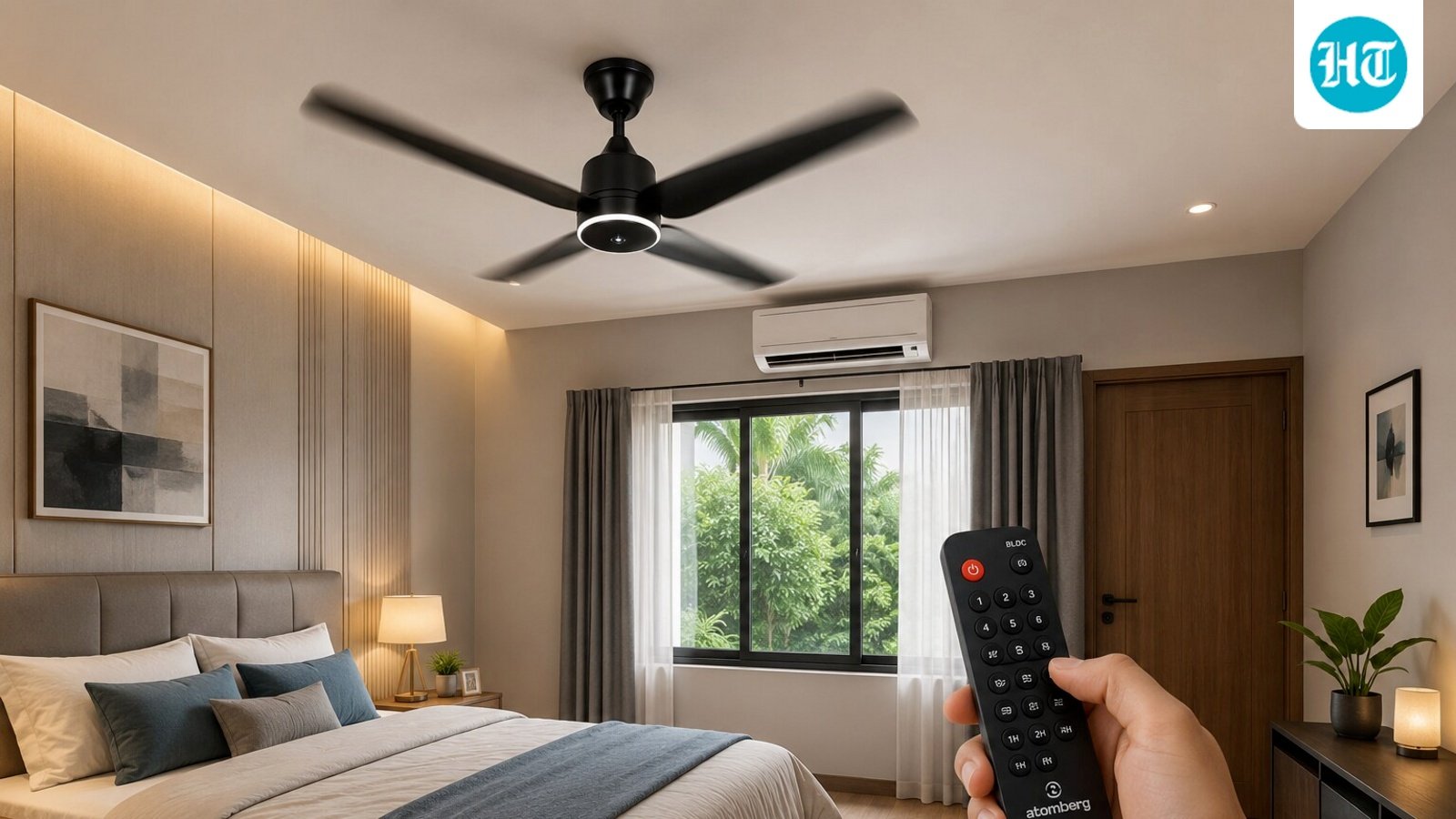
High humidity during the monsoon season makes indoor spaces feel hot and sticky even when outdoor temperatures drop. Relative humidity in India frequently climbs between 70% and 90%, preventing sweat from evaporating effectively. As a result, households tend to run ceiling fans continuously or pair them with air conditioners to stay comfortable.
Since fans operate for extended hours during these months, switching to a BLDC (Brushless Direct Current) ceiling fan can indeed lead to noticeable savings on your monthly power bill.
How Much Electricity Does a BLDC Fan Actually Save?
Traditional induction ceiling fans draw roughly 70W to 75W of power at maximum speed. In contrast, a comparable BLDC fan consumes just 28W to 35W for similar airflow, using up to 65% less energy.
The Numbers (Single Fan running 12 hours/day during Monsoons)
-
Standard Fan (75W): $0.075 \text{ kW} \times 12 \text{ hrs} \times 30 \text{ days} = \mathbf{27 \text{ units/month}}$
-
BLDC Fan (30W): $0.030 \text{ kW} \times 12 \text{ hrs} \times 30 \text{ days} = \mathbf{10.8 \text{ units/month}}$
-
Monthly Savings per Fan: ~16.2 units of electricity
At an average domestic electricity tariff of ₹8 per unit, a single BLDC fan saves around ₹130 every month. If your home runs 4 fans daily, the savings add up to over ₹500 per month.
The AC + Fan Synergy: Bonus Savings
If you run an air conditioner alongside a ceiling fan, a BLDC fan offers a double benefit:
-
The Wind-Chill Effect: Moving air makes room occupants feel $2^\circ\text{C}$ to $3^\circ\text{C}$ cooler than the actual room temperature.
-
Raising the Thermostat: By keeping the fan on, you can set your AC to $24^\circ\text{C}$ or $25^\circ\text{C}$ instead of $21^\circ\text{C}$ or $22^\circ\text{C}$.
-
The Result: Every $1^\circ\text{C}$ increase on your AC thermostat reduces AC power consumption by roughly 6%. Since an AC consumes significantly more power ($1,000\text{W}$–$1,500\text{W}$) than a fan ($30\text{W}$), raising the AC temperature saves far more money than the fan costs to run.
Popular BLDC Fan Recommendations
| Model | Sweep Size | Motor Wattage | Key Highlights | Warranty |
| Atomberg Renesa Elite Smart | 1200 mm | 35W | Alexa & app controls, Moonbeam LED light, stable on voltage dips | 5 Years |
| Colorbot Knoxx Quad | 1200 mm | 30W | 4-blade design, ultra-quiet, reverse rotation mode | 4 Years |
| LUKER USA Alpha Galaxy | 1320 mm | 5-Star Rated | Wider coverage for large living rooms, ultra-quiet | 3 Years |
| TVS Green Eternia | 1200 mm | 36W | Advanced iDrive motor, multi-speed remote, low voltage support | 3 Years |
| KUHL Meridian M3 | 1200 mm | 30W | RF point-anywhere remote, LED indicators, free installation | 5 Years |
Should You Upgrade?
-
Yes, if: Your fans run for more than 8–10 hours daily, you use multiple fans across the house, or your local electricity slab rates are high. The extra upfront cost of a BLDC fan (typically ₹1,500–₹3,000 higher than standard fans) pays for itself in about 12 to 18 months.
-
No, if: The fan is in a guest room or only used for 1–2 hours a day. The payback period in low-use cases can stretch out to several years.
