

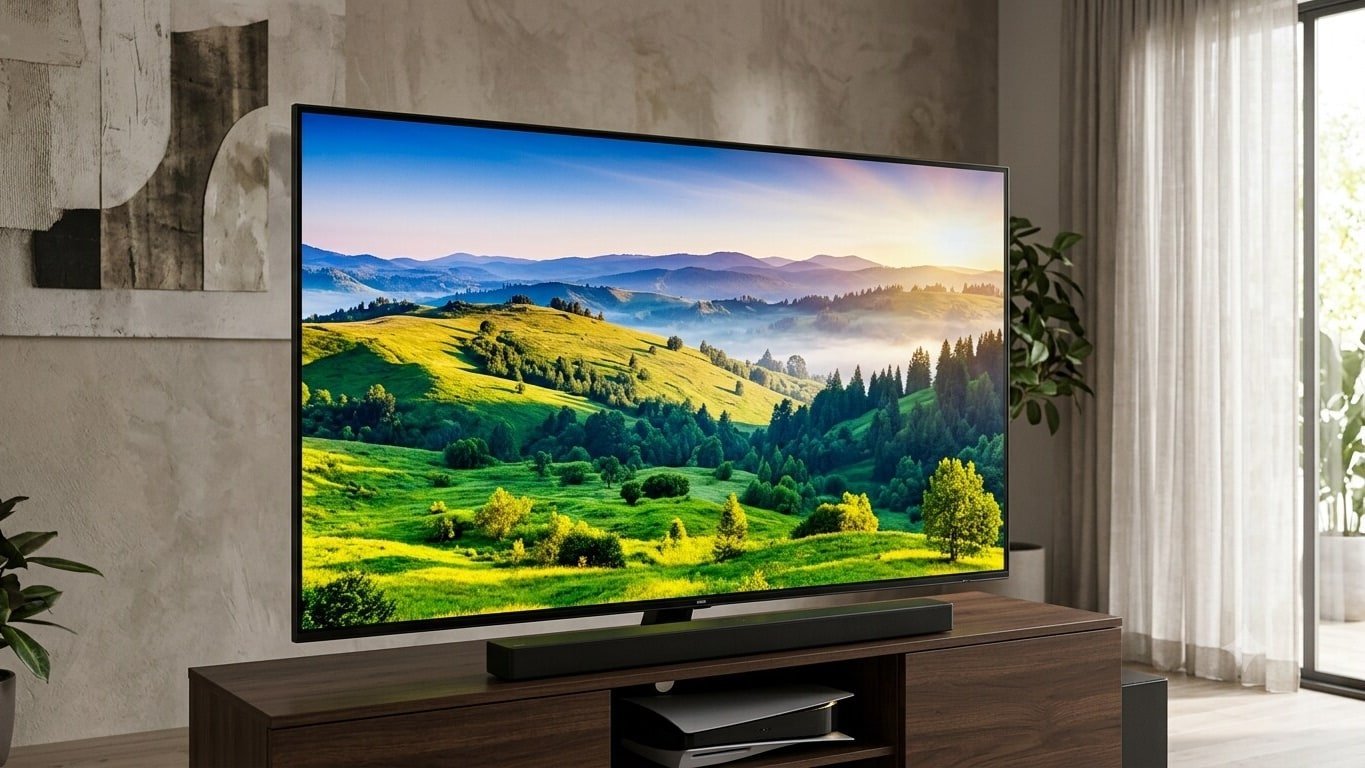
The budget-to-midrange television market has evolved substantially, bringing advanced panel architectures—including Quantum Dot (QLED) and QD-Mini LED backlighting—down to accessible price tiers.
Below is a technical evaluation and feature breakdown of five leading 4K Smart TVs under or around the ₹40,000 price point.
Comparative Feature & Panel Matrix
| Model | Screen Size & Display Technology | HDR Formats & Processing | Audio Output | Operating System | Key Strengths & Caveats | Current Price / Discount |
| Hisense 50E75Q | 50″ (126 cm) QLED | Dolby Vision, HDR10+, AI 4K Upscaler | 48W Speakers with Dolby Atmos | VIDAA OS (ALLM, VRR, Game Mode) |
Pros: High 48W speaker output, ALLM/VRR for gaming. Cons: VIDAA OS app selection is more restricted than Google TV. |
₹32,490 (46% off ₹59,999) |
| Lumio Vision 7 II (FTW3-ADSK) | 55″ (139 cm) QLED | Dolby Vision, HDR10 | Dolby Atmos | Google TV |
Pros: 55-inch QLED panel with full Google TV app ecosystem. Cons: Mixed customer reports regarding UI boot-up latency. |
₹38,999 (51% off ₹79,999) |
| LG NU87 AI Series (50NU870BPLA) | 50″ (126 cm) NanoCell / 4K LED | HDR10 Pro, α5 AI Processor Gen7 | 20W Output with AI Sound Pro | webOS |
Pros: Robust brand reliability, polished webOS ecosystem. Cons: Standard LED backlighting offers lower contrast than QLED/Mini LED. |
₹38,999 (41% off ₹65,990) |
| Samsung Vision AI (UA43M71HAULXL) | 43″ (108 cm) 4K Mini LED / Vision AI | HDR10+, Crystal Processor 4K | 20W Output | Tizen OS |
Pros: Deep contrast via Mini LED backlighting, ideal for small rooms. Cons: Smaller 43-inch screen size at this price tier. |
₹40,490 (25% off ₹53,900) |
| Xiaomi X Pro 4K (L55MB-APIN / L55MC) | 55″ (139 cm) QD-Mini LED | Dolby Vision, HDR10+, Gemini AI | 34W Boom Box Speakers | Google TV (120Hz Game Booster) |
Pros: Superior local dimming & peak brightness via QD-Mini LED, 120Hz boost. Cons: Requires adequate room dimensions for a 55-inch display. |
₹43,999 (30% off ₹62,999) |
Key Technical Buying Factors
-
Panel Architecture (LED vs. QLED vs. QD-Mini LED):
-
Standard 4K LED: Reliable, budget-friendly performance, but limited in local dimming and peak brightness.
-
QLED (Hisense, Lumio): Utilizes quantum dots to expand color gamut volume and enhance saturation.
-
QD-Mini LED (Xiaomi, Samsung): Combines quantum dot color accuracy with thousands of tiny LED backlights, enabling precise local dimming zone control, elevated contrast ratios, and deeper black levels.
-
-
Operating System Trade-Offs:
-
Google TV (Xiaomi, Lumio): Offers the broadest app library, native Chromecast support, and Google Assistant/Gemini integration.
-
webOS / Tizen OS (LG, Samsung): Highly polished, intuitive interfaces with strong ecosystem integration, though app store options are strictly curated.
-
VIDAA OS (Hisense): Extremely fast and light on resources, but lacks some niche local streaming applications.
-
-
Audio Architecture: Models featuring built-in high-wattage sound systems (e.g., Hisense’s 48W array or Xiaomi’s 34W Boom Box) reduce the immediate need for a separate external soundbar in small-to-medium rooms.
