

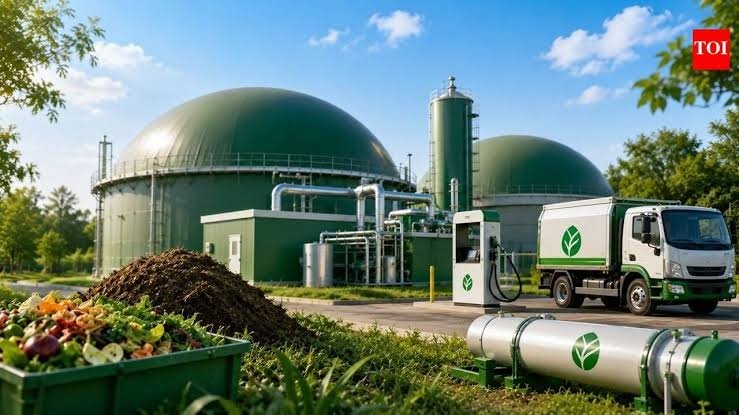
In a major push toward clean energy and rural empowerment, the Union Cabinet, chaired by Prime Minister Narendra Modi, has greenlit GOBARdhan: The National Circular Bioenergy Scheme with a total outlay of ₹23,731 crore.
Spanning a 10-year implementation window from FY27 to FY36, the flagship initiative aims to scale India’s domestic Compressed Biogas (CBG) production nearly tenfold, attract private investments, and build a sustainable circular bioeconomy.
Key Highlights & Framework
-
CBG Offtake Assurance: The scheme introduces a structured framework converting blending mandates into long-term demand signals. City Gas Distribution (CGD) entities are set to procure CBG to meet blending targets of:
-
3% in FY27
-
4% in FY28
-
5% from FY29 onwards (across CNG and domestic PNG segments)
-
-
Administered Pricing: To guarantee steady returns while maintaining consumer affordability, the government established a base CBG price of ₹2,110 per MMBTU guaranteed for at least 10 years.
-
Capital Subsidies for Infrastructure:
-
Eligible greenfield CBG projects will receive capital assistance up to ₹2 crore per ton per day (TPD) of installed capacity. Funding also covers feedstock aggregation, organic manure processing, and expansion of brownfield facilities.
-
Funding will support both standalone and cluster-based pipeline connectivity to integrate CBG plants directly into trunk pipelines and local CGD networks.
-
-
Financial & Local Ecosystem Boost:
-
Credit Guarantee Mechanism: Designed to share lending risks, lower collateral demands, and boost institutional credit for MSME-led CBG projects.
-
CBG Ecosystem Challenge Fund: Aimed at driving district-level execution and bolstering localized bioenergy supply chains.
-
Overseen by the Ministry of Petroleum and Natural Gas, the GOBARdhan scheme serves as a single integrated platform designed to streamline the bioenergy value chain across the country.
