

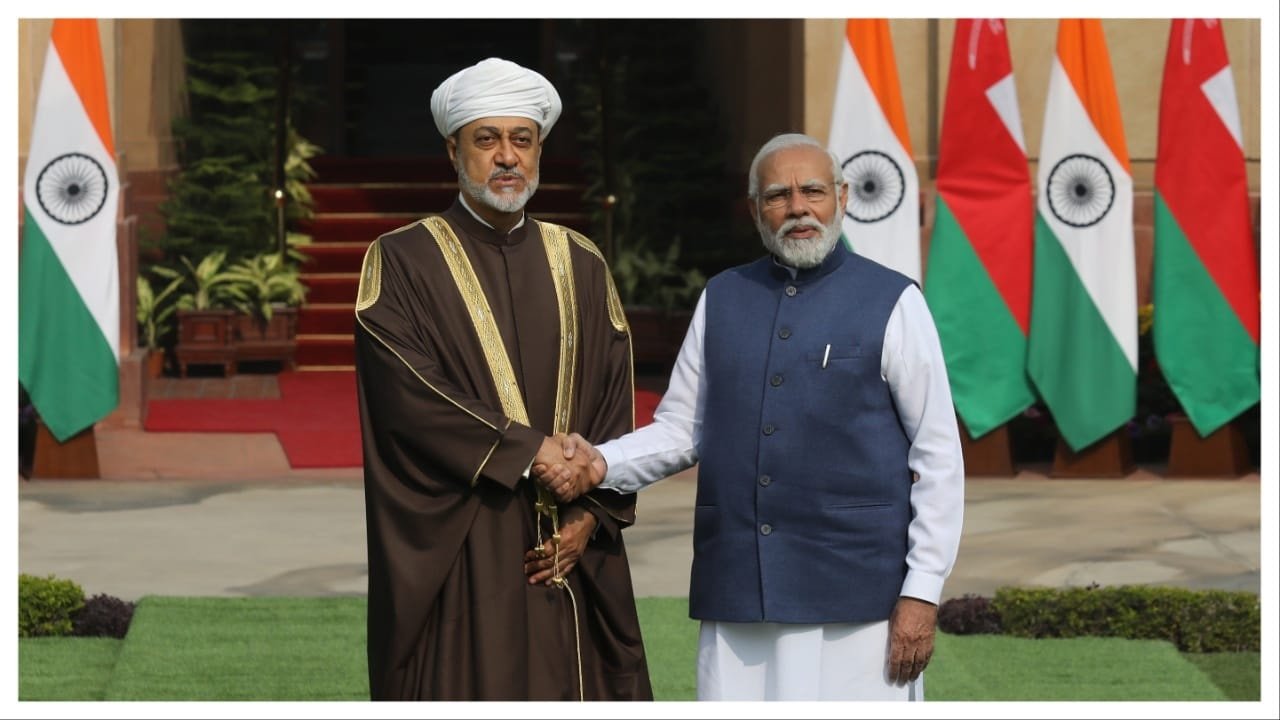
A major shift in Middle Eastern trade routes officially begins today. The India-Oman Comprehensive Economic Partnership Agreement (CEPA) has come into effect, throwing open a strategic backdoor to the Gulf at a time when traditional shipping lanes are paralyzed by conflict.
Signed last December during Prime Minister Narendra Modi’s visit to Muscat, the deal drastically slashes trade barriers, offering zero-duty access to nearly all Indian exports.
The Strategic Escape Hatch: Bypassing the Strait of Hormuz
The timing of this pact is critical. An ongoing US-Iran war has severely disrupted shipping through the Strait of Hormuz—the world’s most vulnerable energy chokepoint, which normally handles 20% of global daily oil consumption.
Iran’s tightening grip on the Strait has choked off energy supplies to India from Saudi Arabia, Qatar, and the UAE, sending crude prices soaring. Between April 2025 and April 2026, India’s overall trade with major Gulf economies plummeted:
-
Imports dropped from $15 billion to $9.8 billion.
-
Exports fell from $4.4 billion to $2.7 billion.
Oman is the geographical exception. Because much of Oman’s coastline sits outside the Strait of Hormuz, directly facing the Arabian Sea and the Gulf of Oman, its major ports—like Salalah and Duqm—remain fully accessible.
While trade with the rest of the Gulf withered over the past year, India’s imports from Oman skyrocketed by 246.4% (jumping from $430 million to nearly $1.5 billion), proving that Oman can act as India’s ultimate alternative energy gateway.
What India Gains: A Boost for Manufacturing
Under the new deal, Oman is eliminating duties on 98.08% of its tariff lines, which covers more than 99% of Indian exports. Previously, only 15.3% of Indian goods entered Oman duty-free.
Key Sectors Winning Zero-Duty Access: Gems and jewelry, textiles, leather, footwear, engineering products, pharmaceuticals, automobiles, and agricultural goods.
While 80% of Indian goods previously faced a relatively low 5% tariff, some items faced duties as high as 100%. Removing these tariffs will make Indian goods significantly more competitive, though experts at the Global Trade Research Initiative (GTRI) note that overall export growth will eventually face a ceiling due to Oman’s modest market size (5.5 million population; $110 billion GDP).
In fiscal 2026, India’s $3.64 billion export basket to Oman was led by:
-
Refined Petroleum (Petrol & Naphtha): $1.52 billion
-
Calcined Alumina: $277 million
-
Iron & Steel: $230 million
What Oman Gains: Securing Its Top Customer
In return, India is reducing or eliminating tariffs on 78% of its tariff lines. This directly benefits Oman’s core industrial and energy sectors, which are already heavily reliant on Indian buyers.
Out of the $7.2 billion worth of goods India imported from Oman in fiscal 2026, the deal heavily favors Oman’s economic pillars:
| Omani Export to India | Fiscal 2026 Value |
| Crude Oil | $1.6 Billion |
| Liquefied Natural Gas (LNG) | $1.2 Billion |
| Fertilizers | $843 Million |
| Methanol | $465 Million |
| Ammonia | $424 Million |
Ultimately, the CEPA transitions India-Oman relations from a standard trading partnership into a vital economic insurance policy for New Delhi’s energy security.
