

Every once in a while, a piece of technology transcends the boundary of a typical product review and enters the realm of pure collector’s obsession. The ASUS ROG Flow Z13 KJP is exactly that. Born from a deep collaboration between ASUS and Kojima Productions, this limited-edition device is a spectacular love letter to fans of Hideo Kojima’s Death Stranding.
At ₹3,79,990, it commands an astronomical price tag. Yet, beneath its sci-fi aesthetic lies an incredibly powerful, uniquely engineered Windows gaming tablet that balances world-class novelty with desktop-class architecture.
Technical Specifications
| Component | Specification Details |
| Processor | AMD Ryzen AI Max+ 395 (Up to 50 TOPS NPU) |
| Graphics | AMD Radeon 8060S (Integrated, RTX 4060-equivalent performance) |
| Memory | 128GB LPDDR5X |
| Storage | 1TB PCIe 4.0 SSD (With external single-screw access door) |
| Display | 13.4-inch ROG Nebula Touchscreen, 2560 x 1600 (QHD), 180Hz |
| Battery Capacity | 70Wh |
| Weight | 1.7 kg |
| Operating System | Windows 11 Pro |
Design: Stranded in the Best Way Possible
The biggest compliment the ROG Flow Z13 KJP earns is that it refuses to take the easy way out. While most special editions settle for a pre-loaded wallpaper and a logo sticker, ASUS completely re-engineered the physical chassis.
-
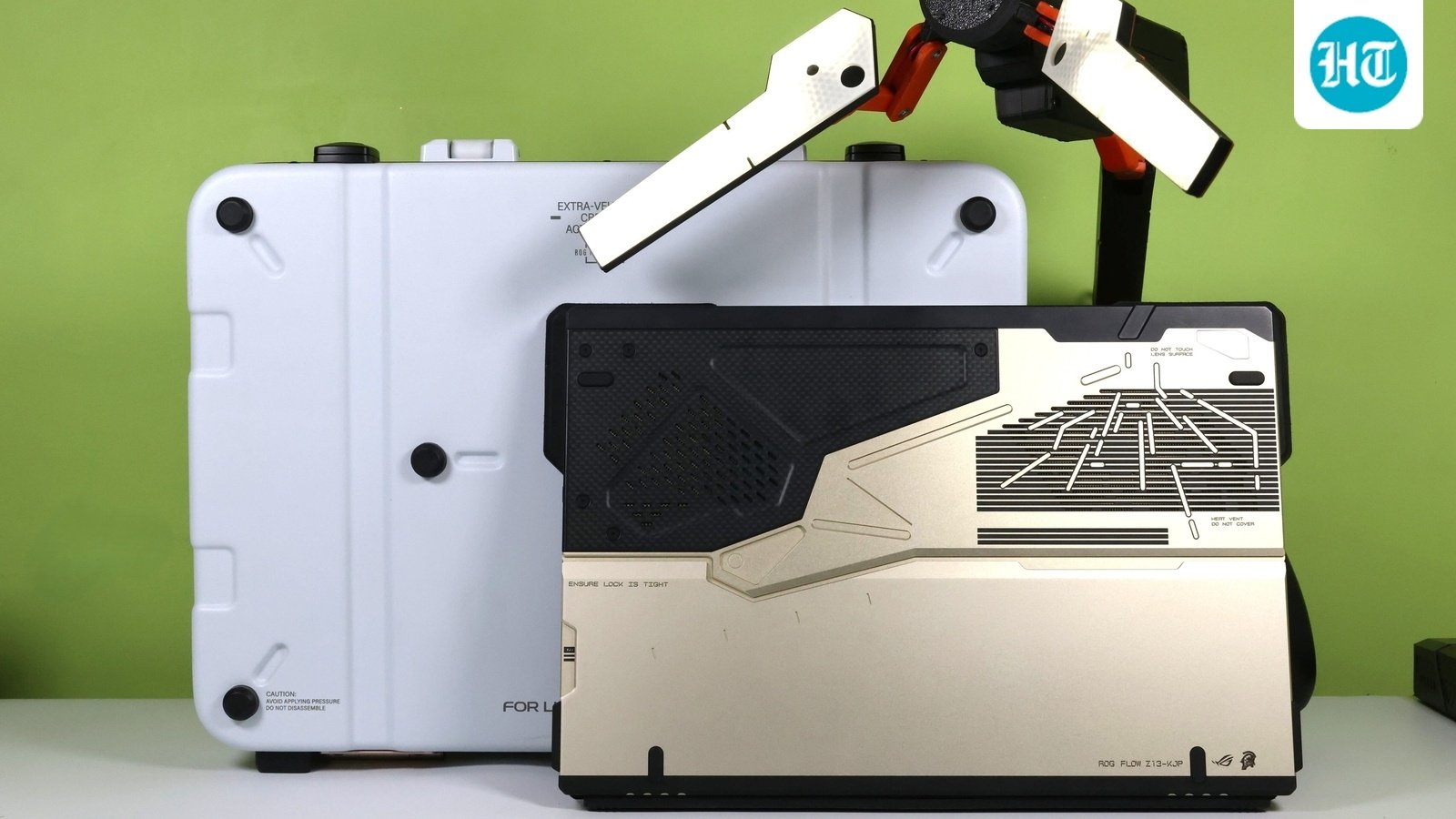
Chassis Artistry: Adorned with striking gold accents, structural carbon-fiber detailing, and intentional thematic artwork spread across every edge, the tablet feels like a piece of lore pulled directly from the game.
-
The Porter Kit: It comes bundled with an industrial white carrying case that mirrors the exact aesthetic of the cargo containers Sam Porter Bridges hauls across a fractured America. Custom stickers and bespoke packaging elevate the unboxing into a premium, archival experience.
-
Thoughtful Ergonomics: The magnetic pogo-pin detachable keyboard features a sharp black-and-white contrast scheme, the integrated kickstand adjusts well past 90 degrees, and a dedicated, single-screw SSD door on the back makes storage upgrades remarkably simple.
Display & Audio: Visual Magic
The 13.4-inch ROG Nebula Display is a marvel. Boasting a QHD resolution and a rapid 180Hz refresh rate, the screen provides exceptional color accuracy and punchy HDR depth.
What makes this panel special is that its high refresh rate isn’t just marketing fluff—the internal hardware actually has the muscle to feed it. Playing Death Stranding on a machine designed inside the Kojima universe feels incredibly poetic. The landscape’s subtle gradients look flawless, text stays perfectly sharp, and motion remains fluid.
Thermal & Noise Note: When you kick the device into Turbo Mode to push modern graphics, the cooling fans ramp up aggressively. The fan noise can easily overpower the tablet’s modest built-in speakers, making a pair of quality gaming headphones an absolute necessity. Fortunately, because all core components live behind the screen rather than under a keyboard, the heat is blown straight out the top, keeping your hands entirely cool.
Performance: The Power of Integrated Architecture
It is easy to get distracted by the outer artwork and forget how absurd the internal specs are. Powered by AMD’s flagship Ryzen AI Max+ 395 and Radeon 8060S graphics, this machine defies conventional tablet limitations by trading blows with dedicated mid-range gaming laptops.
-
Real-World Gaming: Death Stranding and Forza Horizon 5 comfortably cruise past the 100 FPS mark at optimized settings. Even notoriously punishing titles like Cyberpunk 2077 and Black Myth: Wukong maintain smooth, highly playable frame rates with the assistance of AMD FSR upscaling.
-
Overkill Multitasking: The jaw-dropping 128GB of LPDDR5X RAM is an absolute overkill spec for gaming, meaning you will never encounter memory bottlenecks, even if you run heavy video editing software, a streaming setup, and dozens of browser tabs simultaneously.
Usability and Battery Dynamics
-
The Weight Factor: At 1.7 kg, calling this a “tablet” requires a bit of nuance. It is simply too heavy to hold comfortably in mid-air like an iPad. Instead, it functions best as an ultra-portable, modular laptop clone utilizing its stellar built-in kickstand.
-
Battery Longevity: For lightweight daily tasks—such as documents, media streaming, and web browsing—the 70Wh battery delivers a respectable 6 to 7 hours of life.
-
Gaming Unplugged: While the system surprisingly manages to run demanding titles on battery power without devolving into a stuttering mess, you will realistically get only about 1 hour of game time before needing to find a wall outlet.
Pros & Cons
Reasons to Buy:
-
An absolute masterpiece of collaboration design for Hideo Kojima enthusiasts.
-
Incredible gaming performance out of an integrated AMD graphics architecture.
-
A phenomenal 180Hz QHD Nebula touchscreen.
-
An absurdly future-proof 128GB RAM configuration.
Reasons to Avoid:
-
Extremely high luxury premium pricing (₹3,79,990).
-
Too heavy for comfortable standalone tablet use.
-
Loud fan acoustics under heavy gaming loads.
Final Verdict: The Price of Fandom
If you evaluate the ASUS ROG Flow Z13 KJP purely through the lens of a price-to-performance matrix, it makes little financial sense. For the same price, you can easily purchase a traditional flagship gaming laptop with a significantly larger display and a top-tier desktop-class discrete GPU.
But this device isn’t fighting for “best value per rupee.” You are paying for the novelty, the strict manufacturing limits, and a genuine, deeply respectful collaboration between two industry titans. If you are looking for a primary, cost-effective gaming rig, look elsewhere. But if you have the financial freedom and a deep appreciation for the art of Death Stranding, you aren’t buying this machine just to play games—you’re buying it to own a piece of history.
