

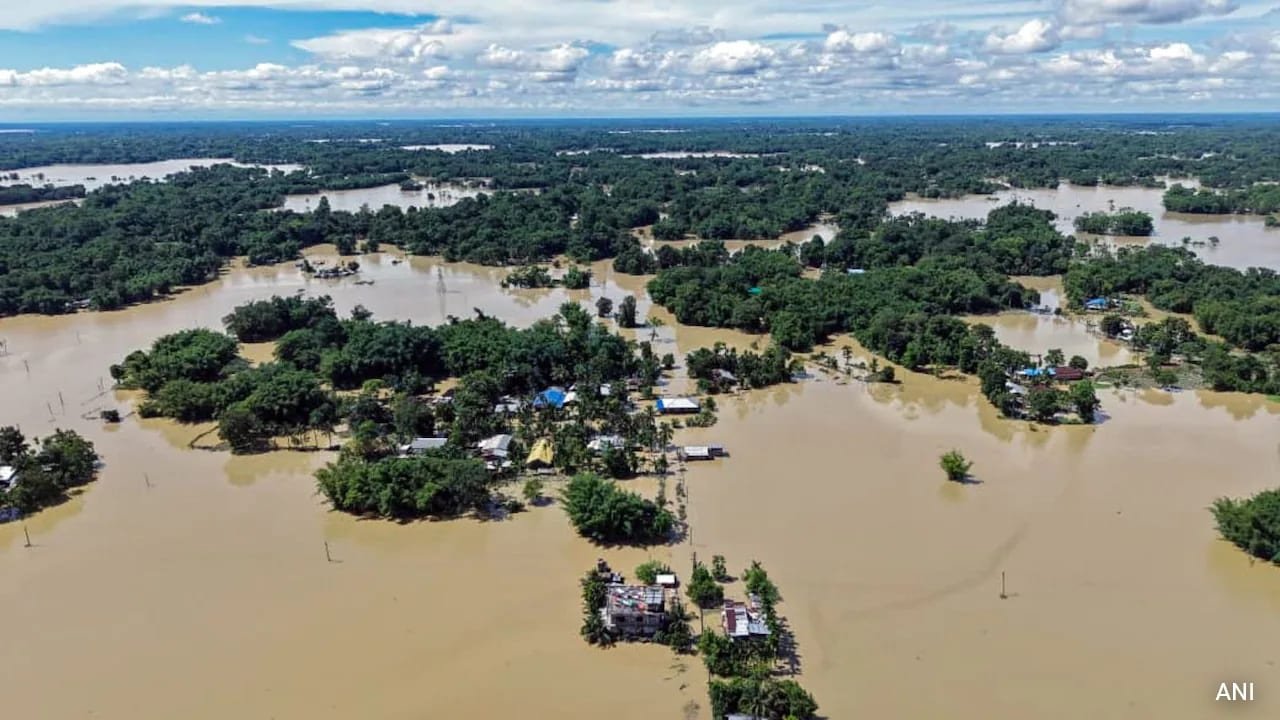
Severe flooding continues to devastate Assam, with official figures reporting 68 fatalities and over 524,000 people impacted across Sivasagar, Golaghat, Charaideo, Jorhat, Nagaon, and Kamrup (Metropolitan). Rescue teams using 67 boats are actively operating in affected areas, where over 37,000 hectares of cropland remain under water and more than 26,000 animals have been swept away.
Beyond Monsoon Rainfall: The “Compound Disaster”
While seasonal monsoons regularly inundate the Brahmaputra valley, experts emphasize that extreme rainfall is only part of the equation. According to Professor Dhrubajyoti Sahariah of Gauhati University, the crisis represents a compound disaster where natural weather events are exacerbated by human activity and failing infrastructure.
-
Deforestation and Siltation: Clearing forests and excavating surrounding hills for construction looses topsoil into the river network. This causes severe siltation, shallowing the Brahmaputra’s bed and reducing its capacity to carry heavy water flows during peak rainfall.
-
Aging Infrastructure: Assam relies heavily on earthen embankments, many of which are decades old. Under high pressure, these fragile structures frequently breach, transforming rising water levels into destructive flash floods.
-
Dam Water Discharges: Torrential rainfall forces upstream hydroelectric projects to release large volumes of water to protect dam integrity, compounding the volume downstream.
Long-Term Mitigation Strategies
Environmentalists and geography experts call for shifting from reactive flood relief to structural management:
-
Channel Desilting: Targeted dredging to restore the Brahmaputra’s historical depth and water capacity without destroying local aquatic ecosystems.
-
Modernized Protection: Replacing earthen embankments with smart-monitored, reinforced barriers equipped with real-time pressure sensors.
-
Upstream Coordination: Establishing real-time data networks and coordinated water release schedules with upstream dam operators prior to heavy rainfall events.
-
Watershed Restoration: Enforcing strict anti-excavation regulations on hill slopes alongside large-scale afforestation programs to stabilize topsoil.
