

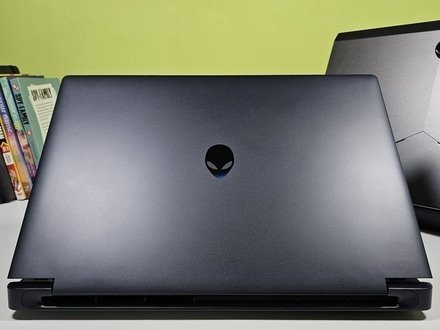
For years, the Alienware brand has stood as a symbol of uncompromised gaming culture—typified by futuristic designs, aggressive chassis styling, and striking per-key RGB lighting. When Dell announced the new Alienware 15, the prospect of a more accessible, mid-tier 15-inch gaming laptop drew immediate interest. Priced at ₹1,63,990, it sits in a competitive segment, but after two weeks of rigorous daily testing and gaming, it leaves a complicated impression. It is undeniably a capable machine, but it plays things a little too safe.
Build and Design: Understated, Sturdy, But Missing Its Soul
Out of the box, the Alienware 15 surprises with its robust build quality. Despite utilizing a plastic chassis, the main frame exhibits virtually no flex, and the finish handles everyday handling well. Tipping the scales at 2.25kg (over 2.5kg with the charging brick), it is standard heft for a gaming laptop of this size.
However, in stripping away its signature design elements, Dell has diluted the brand’s identity. The iconic glowing alien head logo is gone, replaced by a subdued aesthetic. Even more frustrating for long-time fans is the omission of RGB backlighting; you get a basic single-color white backlight with three brightness steps. Combined with a cramped power button layout that sits right where the Delete key usually resides, the physical interface feels uncharacteristically generic.
Display: Smooth Refresh, but Dull Colors
The 15.3-inch WUXGA (1920×1200) display offers a sensible resolution for mobile graphics and a fluid 165Hz refresh rate that makes fast-paced titles feel exceptionally smooth. Its matte coating also does an admirable job of cutting down reflections in bright environments.
The compromise lies entirely in color fidelity. While fine for general gaming and casual video consumption, the panel looks noticeably muted. Colors lack the punch and vibrancy expected at this price point, meaning creative professionals looking for a display suited for color-critical photo or video editing will want to look elsewhere.
Performance and Cooling: Unthrottled Reliability
Under the hood, the pairing of an Intel Core 7 240H processor and an Nvidia GeForce RTX 5050 (8GB GDDR7) punches above its weight class. In real-world testing, it handles demanding AAA titles like Cyberpunk 2077 at around 80fps and Black Myth: Wukong near the 50fps mark without needing to slash visual settings.
Crucially, thermal management is a standout victory. Armed with an efficient three-pipe cooling layout and smart airflow routing, the laptop sustains long gaming sessions without thermal throttling. While fan noise becomes audible under load and the upper-left keyboard deck gets warm, the system successfully keeps critical components cool.
On the software front, however, the Alienware Command Center continues to feel dated, clunky, and unintuitive—detracting from what should be a polished premium experience. Meanwhile, battery life remains a standard pain point, averaging 4 to 5 hours of light productivity and plummeting to roughly 1.5 hours during heavy gaming.
The Verdict: The “Aurora” Dilemma
The Alienware 15 (2026) is a well-built, thermally sound, and performant gaming laptop. Yet, it faces a major identity crisis. With Dell’s own Aurora lineup sitting at a remarkably similar price point—offering cleaner rear-port arrangements and a more striking design—it is hard to find a compelling reason to choose this specific model unless you have a strict preference for its 15-inch form factor.
For buyers seeking reliable 1080p gaming performance and excellent cooling, it gets the job done. But if you are buying an Alienware for its distinct personality, lighting, and visual flair, this machine leaves you wanting more.
