

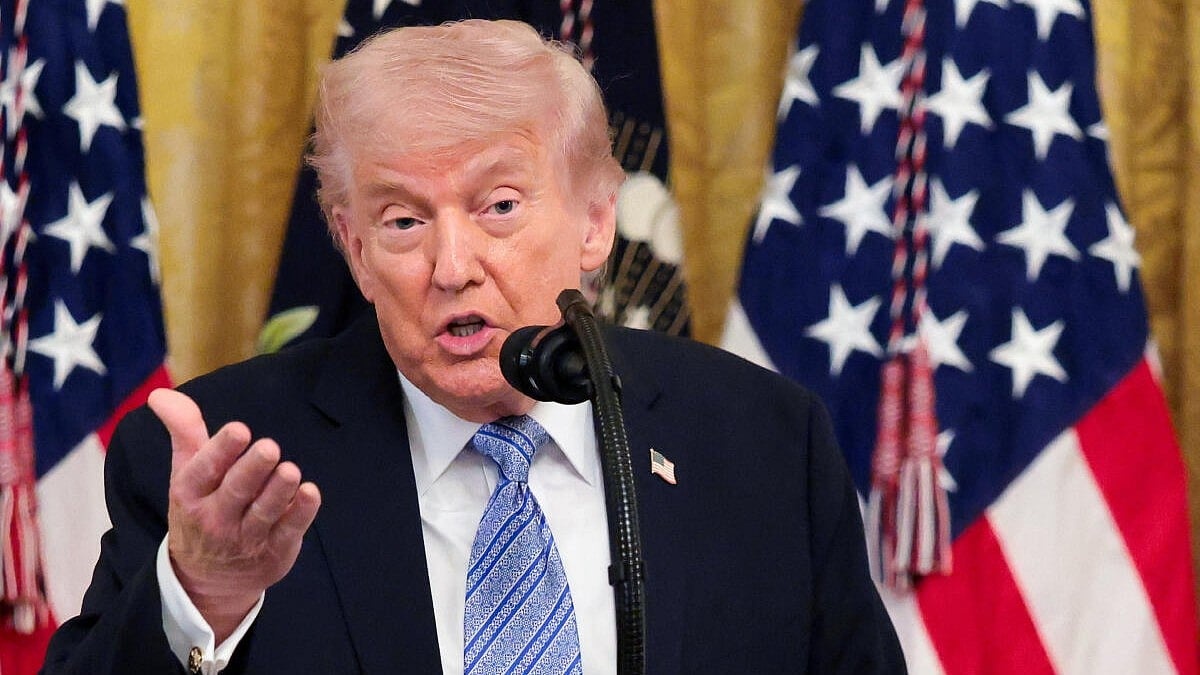
U.S. President Donald Trump has issued a direct demand to Tehran, stating that Iran must hand over its enriched uranium—which he termed “Nuclear Dust”—to the United States or destroy it locally under international supervision.
The high-stakes ultimatum coincided with fresh U.S. military strikes in southern Iran and ongoing, fragile peace talks in Doha, highlighting a strategy of mixing military force with diplomatic pressure.
Dual Realities: Military Action vs. Peace Talks
The diplomatic landscape is moving fast, with heavily contrasting developments occurring simultaneously:
-
The U.S. Strikes: U.S. Central Command (CENTCOM) launched “self-defense” strikes targeting Iranian missile launch facilities and naval boats attempting to deploy mines in southern Iran. The action directly threatens a fragile ceasefire that has been in place since April 8.
-
The Doha Negotiations: Despite the military escalation, top Iranian negotiators—including chief negotiator Mohammad Bagher Ghalibaf and Foreign Minister Abbas Araghchi—remain in Doha, Qatar, trying to hammer out a deal to end the conflict that erupted on February 28.
Inside Trump’s Uranium Ultimatum
Preventing Iran from developing a nuclear weapon has become a core American priority in resolving the war. Trump outlined two distinct options for handling Iran’s highly enriched uranium stockpile:
-
Immediate Export: Turning the material over directly to the United States to be transported and destroyed on American soil.
-
In-Country Destruction: Destroying the stockpile within Iran or another mutually agreed-upon location, witnessed by the “Atomic Energy Commission” or an equivalent international nuclear watchdog.
While Iran has consistently denied harboring nuclear weapons ambitions, its growing stockpile remains the primary sticking point for Washington.
The Abraham Accords Mandate
Trump also explicitly tied any final peace deal to his signature regional normalization framework, the Abraham Accords. He revealed that during negotiations, he made it clear to regional leaders that joining the accords should be “mandatory.”
| Country | Existing Stance on Israel | The Obstacle to Trump’s Demand |
| Egypt, Jordan, Turkey | Already maintain formal diplomatic ties. | Public pressure and regional instability make expanding ties highly sensitive. |
| Saudi Arabia, Qatar | No formal diplomatic relations. | Demand a clear, irreversible pathway to Palestinian statehood before any normalization occurs. |
| Pakistan | No diplomatic relations; passport explicitly bars travel to Israel. | Deep-seated state ideology and the threat of massive domestic political backlash. |
Trump noted that while he might accept “one or two” countries opting out of the regional mandate, he expects the vast majority to sign onto the accords simultaneously to bring a permanent end to the conflict.
