

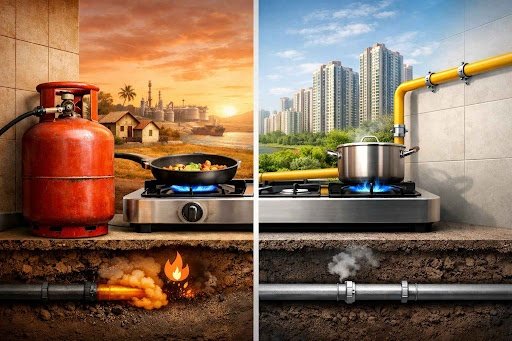
As the conflict between the US-Israel alliance and Iran escalates, the Strait of Hormuz—a vital artery carrying 20% of the world’s fuel—has become a global energy chokehold. With tankers facing missile and drone strikes, India is aggressively pushing a transition from Liquefied Petroleum Gas (LPG) cylinders to Piped Natural Gas (PNG) to secure its domestic energy supply.
The Crucial Differences: PNG vs. LPG
Understanding why the Indian government is prioritizing one over the other requires looking at their origins and delivery methods:
| Feature | Piped Natural Gas (PNG) | Liquefied Petroleum Gas (LPG) |
| Composition | Primarily Methane | Propane and Butane |
| Source | Natural gas fields (onshore/offshore) | Refined from crude oil |
| Delivery | Continuous underground pipelines | Pressurized metal cylinders |
| Reliability | No refilling needed; low pressure | Requires periodic booking and delivery |
| Import Dependency | ~50% (diversified sources) | ~60% (90% from Strait of Hormuz) |
Why LPG is Struggling
The current “cylinder crisis” is a direct result of the Middle East conflict.
-
The Hormuz Bottleneck: 90% of India’s LPG imports pass through the Strait of Hormuz. Constant military threats have led to severe logistical delays and supply breakdowns.
-
Crude Oil Link: Since LPG is a byproduct of crude oil refining, its availability is tied to the volatile global oil market, which is currently reeling from strikes on Gulf region refineries.
Why PNG is Holding Up
PNG offers a “structural resilience” that cylinders cannot match:
-
Domestic Foundation: India produces 50% of its natural gas requirements internally, drawing from the Krishna-Godavari (KG) Basin, Assam, and Tripura.
-
Diversified Imports: While India still imports Liquefied Natural Gas (LNG), its sources are more spread out. In 2025, the United States provided 19% of India’s LNG, offering a buffer against Middle Eastern disruptions.
-
Continuous Flow: Because PNG moves through a fixed pipeline network, it doesn’t suffer from the “last-mile” delivery hurdles (like empty trucks or closed agencies) that plague LPG during a crisis.
The Government Mandate: “Switch or Lose Supply”
In a bold move to bolster national energy security, the Ministry of Petroleum has issued a new directive:
-
Mandatory Transition: Households in areas where PNG infrastructure exists must switch from cylinders to piped connections within three months of notice.
-
Consequence: Failure to switch will result in the discontinuation of LPG refills.
-
Exemption: Supply will only continue if a distributor certifies that a piped connection is “technically infeasible” for a specific address.
“Our import dependency for LPG is much higher than for PNG. We produce 50% domestically… it is in the interest of the nation that we shift.” — Sujata Sharma, Joint Secretary, Ministry of Petroleum.
Current Landscape
India currently manages over 332 million LPG consumers compared to just 16.2 million PNG connections. This massive gap highlights the scale of the infrastructure challenge ahead as the government races to shield the public from the fallout of the West Asia war.
