

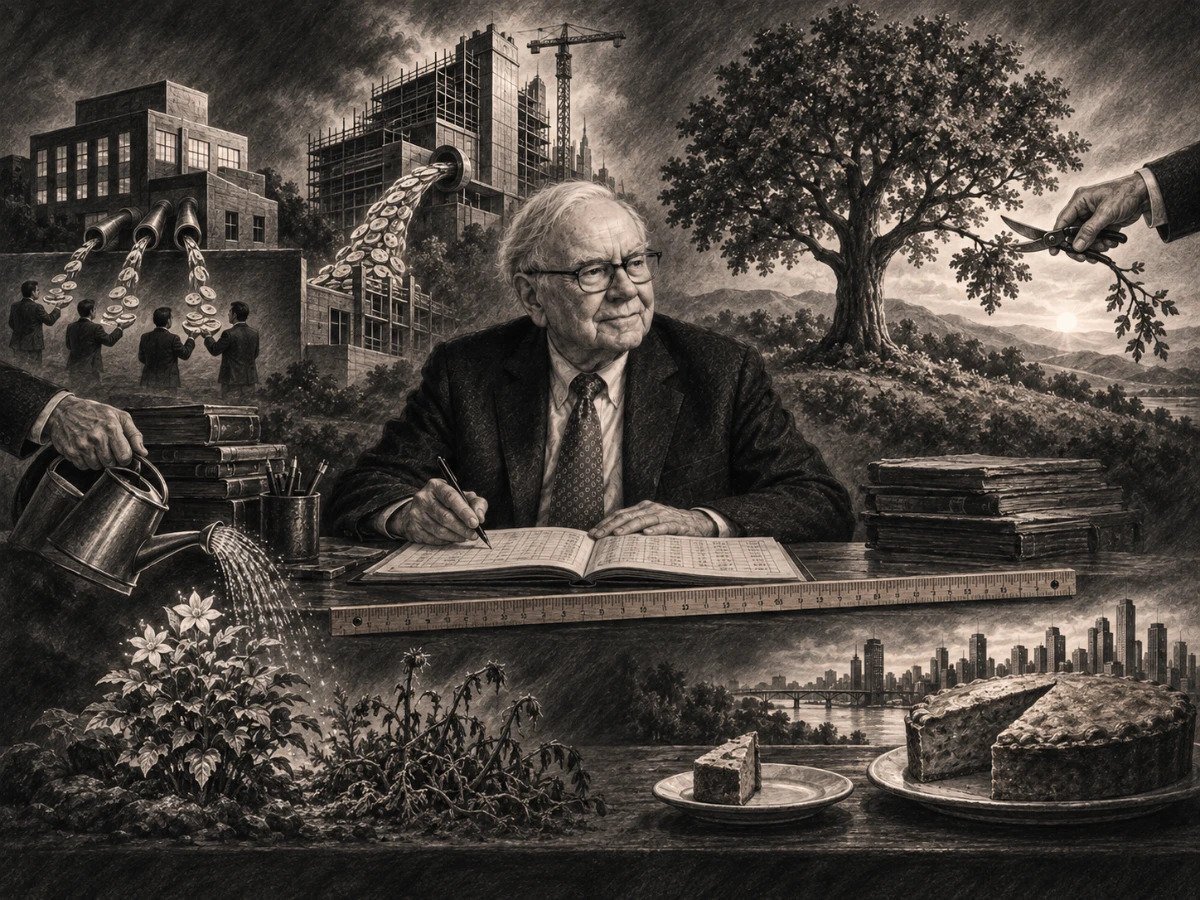
When Warren Buffett sits down to write his annual letter to shareholders, he could easily bask in record profits and let the numbers speak for themselves. Instead, he often opens with the bad news, breaks down why certain metrics aren’t good enough, and explicitly promises not to move the measuring stick to make himself look better.
In one particularly memorable shareholder letter, Buffett tackled a contentious topic: why Berkshire Hathaway does not pay dividends, despite many investors repeatedly asking for them. Recognizing that people often debate the topic based on gut feeling or opinion, Buffett decided to settle the debate using pure arithmetic.
The Hypothethical Company: Dividends vs. Retention
To prove his point, Buffett constructed a simple, hypothetical business on paper. Imagine a company worth $2 million owned equally by two partners, generating a steady 12% return on equity (or $240,000) every single year. Outside investors are willing to buy shares at a fixed price relative to intrinsic value.
Buffett then runs the business over a 10-year period using two entirely different strategies:
-
The Dividend Route: The partners agree to distribute one-third of the annual earnings as cash dividends while reinvesting the remaining two-thirds back into the company for modest growth. In the first year, each owner takes home a cash dividend check, but the underlying business grows at a slower, restricted pace.
-
The Zero-Dividend Route: The company retains 100% of its earnings, allowing the business to compound at its maximum possible rate. To match the exact same cash flow needed by the owner in year one, the partner simply sells off a tiny fraction of their equity.
What the Math Reveals
When the 10-year projection plays out, the arithmetic surprises many traditional investors.
The partner who chose the zero-dividend, “sell-off” approach ends up significantly richer—boasting both a higher total capital value and more cumulative cash generated than the partner who took regular dividends.
Why? Because allowing the business to retain 100% of its earnings fuels faster, uninterrupted compounding. Even though the owner is technically selling a small slice of their ownership over time, the total pie has grown so much larger that their remaining stake is worth vastly more than the stagnant, dividend-paying alternative. Furthermore, retaining earnings avoids the immediate tax friction of regular dividend payouts, letting capital work harder for longer.
The Bottom Line
Warren Buffett famously collects billions in dividends from the massive stakes Berkshire Hathaway holds in other companies, yet he refuses to pay out a single penny in dividends to his own shareholders.
While investors love the psychological comfort of receiving a cash check in their account, Buffett’s arithmetic proves a powerful counter-intuitive truth: if a management team can reinvest retained earnings at high rates of return, shareholders are frequently better off letting the business compound on its own—even if it means selling a tiny piece of your stock when you need cash.
