

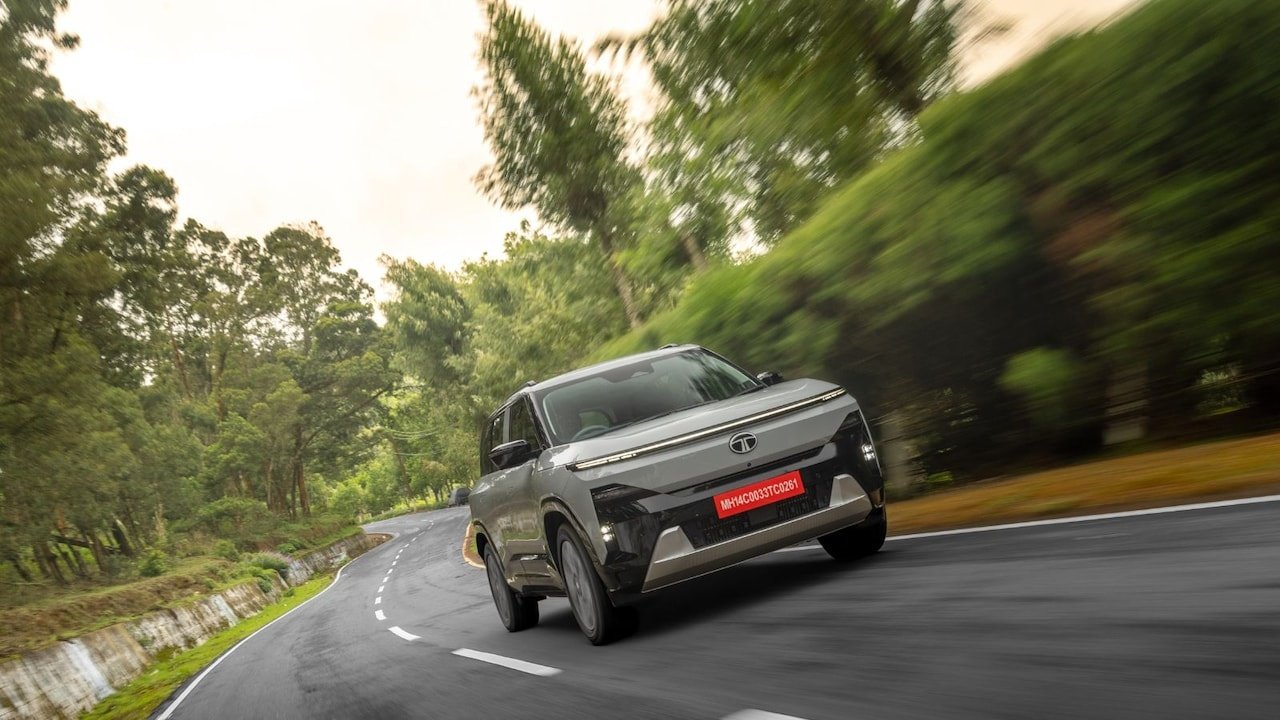
Tested against the intense monsoon downpours of Tamil Nadu, the highly anticipated Tata Sierra EV makes its debut. Starting at an aggressive ₹18.79 Lakh, it quickly proves it isn’t just another addition to Tata Motors’ growing electric vehicle garage—it establishes itself as the brand’s most complete and well-rounded electric SUV yet.
Design: Respecting the Heritage
Visually, the Sierra EV outshines its internal combustion engine (ICE) siblings. The front fascia blends a tech-forward identity with modern connected daytime running lights (DRLs), a completely closed-off grille, and EV-focused aerodynamic details. Crucially, Tata preserved the iconic Sierra design DNA by leaving the signature silhouette and massive rear glasshouse unchanged.
Tech and Cabin Space
The interior layout will feel familiar to those who have driven recent Tata flagships, but it ups the ante with premium material choices and notable technology upgrades:
-
Smart Access: Drivers can unlock and start the car using an integrated NFC card system.
-
Auto Park Assist: The headline feature allows you to park or summon the SUV from outside the cabin using only the key fob.
-
Visual Safety: A sprawling infotainment display works alongside a highly clear 540-degree camera system.
-
The Catch: At this price point, omitting an auto up/down function on the co-driver’s side window stands out as an unnecessary bit of cost-cutting.
Driving Dynamics and Ride Comfort
With instant electric torque, the Sierra EV accelerates briskly, handling city traffic and highway overtaking maneuvers effortlessly.
While it isn’t an aggressive, sharp corner-carver and tends to lean away from rapid directional changes, it compromises beautifully on ride quality. In the ₹40–50 Lakh segment, it stands out as arguably the most comfortable electric SUV available. The only dynamic shortfall is the braking system, which could benefit from a sharper initial bite upon pressing the pedal.
Dual-Motor AWD and Battery Range
Tata has packaged the Sierra EV with a true dual-motor All-Wheel Drive (AWD) option. Thanks to the heavy floor-mounted battery pack lowering the center of gravity, the SUV feels incredibly planted across rugged, off-road terrain. Precise throttle modulation is necessary, and while it crawls over obstacles easily, the Hill Descent Control system can occasionally feel hesitant on steep inclines.
The vehicle is offered in two distinct configurations:
| Battery Capacity | ARAI Claimed Range | Observed Real-World Range | DC Fast Charging Speed |
| 65 kWh | Entry Level Base | — | — |
| 75 kWh | Up to 665 km | ~445 km | 120 kW (Adds ~250 km in 15 mins) |
The Verdict
If you are currently shopping between the Tata Harrier EV, Curvv EV, or the Mahindra BE 6, the Sierra EV warrants immediate consideration. It brings the heavy-hitting specifications of the Harrier EV down to a more accessible price point, offers much better passenger space than the Curvv EV, and completely avoids the bouncier, unsettled ride qualities found in competitors like the BE 6 or Windsor EV.
