

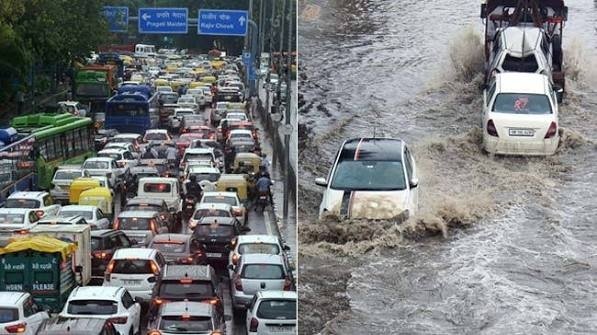
A massive structural weather shift has taken hold of the National Capital Region. Driven by the seasonal monsoon trough shifting northwards toward the Himalayan foothills, consecutive hours of intense overnight and early morning rainfall have pushed local drainage systems past their breaking points.
While the downpour brought maximum daytime temperatures down to a cool 24.3°C (3.6 degrees below normal), it triggered widespread civic paralysis. The India Meteorological Department (IMD) issued an immediate three-hour “Red Alert” for the capital alongside a parallel “Orange Alert” across wider NCR nodes, warning that intense convective cloud bands will continue to generate heavy downpours.
The Precipitation Footprint: District-Wise Variations
The intensity of this monsoon spell varied considerably across neighborhoods, with the eastern and northeastern boundaries of the NCR bearing the absolute brunt of the volume over a 24-hour window ending at 8:30 AM:
-
The Upper Limits (100mm+): Kamala Nehru Nagar in Ghaziabad emerged as the highest point of impact, registering a massive 164 mm of rainfall, followed closely by Hindon at 134 mm and Mayur Vihar at 103 mm.
-
The Institutional Baseline: Central and North Delhi witnessed substantial volumes, with Lodhi Road recording 80.2 mm, the Ridge at 77.8 mm, Safdarjung at 72.6 mm, and Delhi University reporting 90 mm.
-
The Southern Core: In Gautam Buddha Nagar, Noida (Tanda) recorded 62 mm, while Gurugram’s automated stations tracked a lighter but steady footprint between 27 mm and 36 mm.
Infrastructure Distress and Commute Advisory
The rapid accumulation of water exposed structural vulnerabilities across prime commercial and residential corridors, prompting multiple private corporate entities to enforce emergency remote-work protocols.
-
The Drainage Deficit: Authorities in Gurugram acknowledged that the municipal drainage network “virtually collapsed” under the strain of 115 mm of aggregate rainfall within 48 hours. Heavy flooding completely stalled traffic inside the Cyber City business district, along the service lanes of the Delhi-Jaipur Highway, and around key residential complexes in Noida’s Sector 45.
-
Uprooted Green Cover: Beyond standing water, the saturation of urban topsoil—frequently worsened by concrete paving and lack of root space—led to numerous tree falls. High-volume transit routes like Raja Dhir Singh Marg in East of Kailash were blocked after mature trees crashed onto commercial vehicles outside the National Heart Institute.
-
The Environmental Silver Lining: The singular structural benefit of the relentless deluge was a complete flushing of atmospheric particulate matter. Delhi’s typically stressed air profile experienced a dramatic cleanup, with the Air Quality Index (AQI) plunging to a remarkably clean “Satisfactory” reading of 61 during peak morning hours.
The Structural Forecast: Commuters are advised to minimize non-essential travel across East Delhi, Noida, and Ghaziabad, as current Skymet models indicate these eastern quadrants could absorb an additional 180 mm to 250 mm of rain over the next 24 hours. Transit lines are expected to remain congested until the embedded low-pressure system moves fully north out of the NCR territory.
