

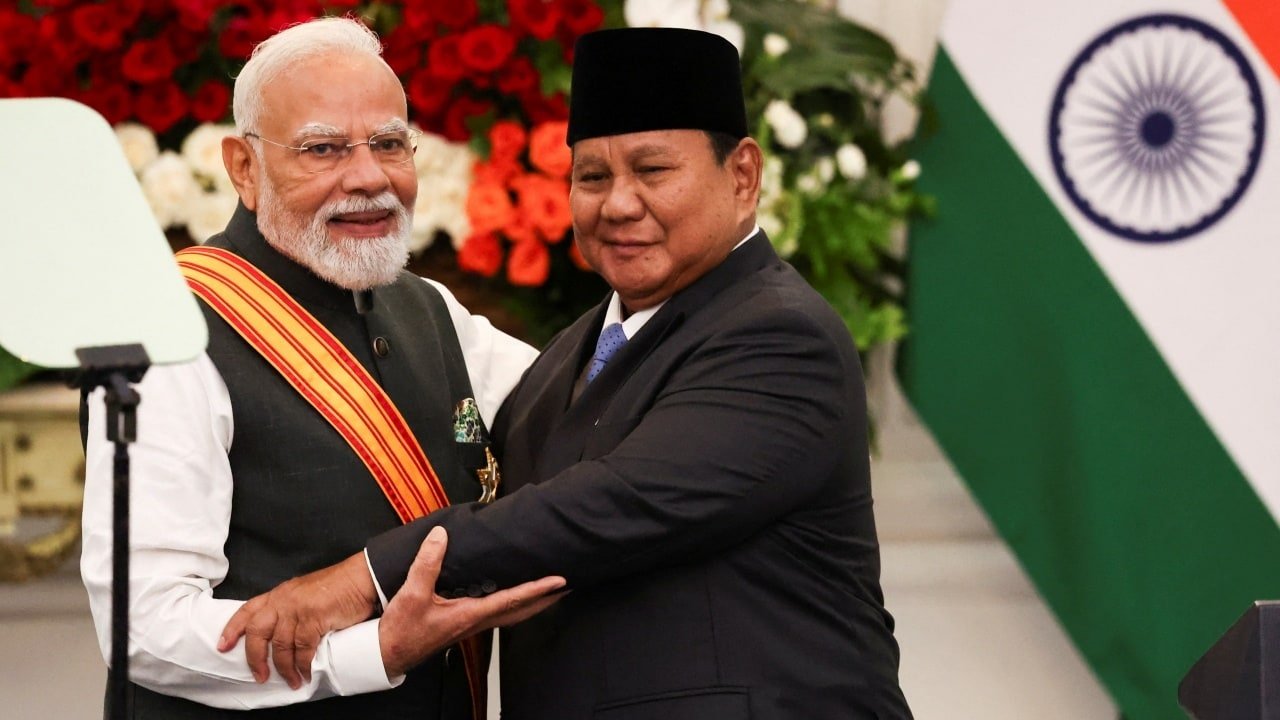
Signaling a monumental shift in the geopolitical architecture of the Indo-Pacific, Prime Minister Narendra Modi’s three-day state visit to Indonesia has culminated in a series of sweeping strategic, defense, and technological pacts. At the invitation of Indonesian President Prabowo Subianto, the high-profile visit marks the first major bilateral milestone since the two maritime neighbors elevated their relationship to a Comprehensive Strategic Partnership.
From sophisticated missile sales to critical mineral chains and cross-border democratic infrastructure, New Delhi and Jakarta are establishing an unshakeable axis aimed at ensuring regional stability and supply-chain resilience.
A New Era of Defense Exports: Astra and BrahMos Take Center Stage
In what is being viewed as an aggressive expansion of India’s indigenous defense export portfolio, Indonesia has moved to significantly integrate Indian-made weaponry into its armed forces.
Most notably, Jakarta is set to become the first international buyer of India’s advanced Astra beyond-visual-range air-to-air missiles. The defense agreement follows the highly publicized operational validation of the Astra system during India’s Operation Sindoor in May 2025. In that engagement, Indian-made defense ecosystems successfully tracked, jammed, and neutralized complex external aerial threats, generating massive global interest in New Delhi’s indigenous hardware.
Additionally, Indonesia is heavily expanding its existing BrahMos supersonic cruise missile inventory. Under the new frameworks, India will supply multiple additional BrahMos missile batteries to reinforce Jakarta’s coastal defense and maritime surveillance capabilities.
Geopolitical Anchors: The Joint Development of Sabang Port
On the maritime front, the two nations have finalized plans to jointly build out Sabang Port. Strategically located at the tip of Sumatra, Sabang overlooks the vital bottleneck of the Strait of Malacca—one of the world’s busiest international shipping lanes.
The move carries immense geopolitical weight: Sabang lies barely 100 miles from India’s multi-billion-dollar mega-port project currently under construction at Great Nicobar Island. By coordinating infrastructure at these twin sentinels, New Delhi and Jakarta will gain unprecedented, synchronized oversight over critical trade channels connecting the Indian and Pacific Oceans.
Deepening Ties: From Critical Minerals to Digital Democracy
Beyond heavy munitions, the state visit delivered landmark breakthroughs in institutional technology and resource security:
-
Exporting the Indian Election Model: In a profound endorsement of India’s technological governance, New Delhi will assist Jakarta in manufacturing Indonesia-specific Electronic Voting Machines (EVMs). The deal represents a significant soft-power milestone, exporting India’s robust, secure election management architecture to the world’s third-largest democracy.
-
Critical Mineral Supply Chains: Capitalizing on Indonesia’s status as a mineral superpower—holding roughly 21 percent of global nickel reserves—Indian firms will actively invest in onshore Indonesian processing plants. The focus will center on manufacturing steel, processing nickel, and producing rare-earth permanent magnets, which are foundational to global electric vehicle (EV) grids and advanced electronic hardware.
-
The “Jan Aushadhi” and Digital Pay Expansion: To support President Prabowo’s rural health initiatives, the two countries are establishing a government-to-government bulk supply framework for affordable pharmaceuticals, directly modeled after India’s successful Jan Aushadhi Scheme. Concurrently, technical teams are linking India’s Unified Payments Interface (UPI) with Indonesia’s QRIS digital payment grid to allow seamless cross-border retail transactions.
A Century of Shared Vision
The diplomatic triumphs were balanced by deep civilizational outreach. Prime Minister Modi and President Prabowo traveled to Yogyakarta to jointly initiate restoration works at the UNESCO World Heritage Prambanan Temple Compounds—the largest Shiva temple complex in Indonesia. The leaders also announced a joint commemoration for 2027 to mark the centenary of Gurudev Rabindranath Tagore’s historic voyage to the Indonesian archipelago.
“This visit opens entirely new avenues for priority sector cooperation,” the Ministry of External Affairs said in an official statement, noting that the agreements reinforce the “deep trust and enduring friendship” binding the two nations.
Following his departure from Jakarta, Prime Minister Modi will continue his three-nation tour, heading next to Melbourne, Australia, and Auckland, New Zealand, further stitching together India’s Act East and MAHASAGAR maritime security policies.
